이책은 만리장성 너머에 중국과 시베리아 변경 지역에 고대 유물에 대한 자료를 다루는 터라 우리 고대사 연구에도 도움이 될까 해서 싣는다. 이 책정식 이름은 샐모니 알프레드(Salmony, Alfred)가 지은 “C. T. 루 소장품의 중국-시베리아 예술. (Sino-Siberian Art in the Collection of C. T. Loo.)”이다. 1933년 프랑스 파리에서 출판된 이 책은 디지탈 실크 로드(Digital Silk Road)에서 내려받았다. 아래에 우리말 번역본은 크게는 구글번역기, 작게는 파파고 번역기, 그리고 아주 조금에 손질을 거쳤다.
CHAPTER I
INTRODUCTION
In recent years there have been brought to our notice by art dealers and some archeologists who import Chinese art, certain objects which are not sufficiently explained by the artistic development of the Far East alone. Among these dealers, C.T. Loo and Co. have for some years been accumulating a group of articles permitting a study of this art today. These objects have already interested sinologues, and the question of their origin has provoked considerable discussion. We are usually given some indication as to their provenance, connecting them with countries bordering the north of China. It has been possible at times to make this origin appear probable, even to prove it, but little has been gained by an approximative geographic determination. These objects from the north of China have for the most part been brought to us with no report of their discovery, with no tomb inventories, and above all with no inscriptions, that is to say, with none of those means by which science is usually helped, when it endeavours to classify unknown material.
제1장
서론
최근 중국 예술품을 수입하는 예술상들과 일부 고고학자들은 극동 지역의 예술적 발전만으로는 충분히 설명되지 않는 몇몇 유물들을 주목하게 되었습니다. 이러한 예술상들 중 C.T. 루 앤드 컴퍼니(C.T. Loo and Co.)는 수년간 이 예술을 오늘날 연구할 수 있는 일련의 논문들을 수집해 왔습니다. 이러한 유물들은 이미 중국 학자들의 관심을 끌었으며, 그 기원에 대한 의문은 상당한 논의를 불러일으켰습니다. 우리는 보통 중국 북부와 접경한 국가들과 관련된 기원에 대한 단서를 접하게 됩니다. 때로는 이러한 기원이 그럴듯하게 보이도록 만들거나 심지어 증명하는 것도 가능했지만, 대략적인 지리적 확인으로는 거의 얻은 것이 없습니다. 중국 북부에서 발견된 이러한 유물들은 대부분 발견에 대한 보고나 무덤 목록, 그리고 무엇보다도 비문 없이, 즉 과학이 미지의 자료를 분류할 때 일반적으로 도움을 주는 그러한 수단 없이 우리에게 전해졌습니다.
Difficulty begins at once with the designation of these articles. The adjective " Scythian " has frequently been used by dealers, who with this word wish to convey the idea that such articles owe some part of their artistic formation to the inhabitants of the Eurasiatic Steppes. This is no doubt true, only unfortunately, in certain cases we do not know in detail what tribe nor even what race from the northern frontier of China may be considered as inspiring this art. This search for the creator is at once combined with a search for the period of creation, since we have sufficient information on the succession of the different peoples on the continent of Eurasia, thanks to historical documents of both East and West. With the adjective " Scythian " we refer only to the first ethnical group the existance of which has been historically proved, and which inhabited the extreme west of the zone of the Steppes. In attempting to start exclusively from the Scythians in order to determine the period of all this Chinese frontier art, a date is reached that in most cases seems to us too early (I). Besides it is quite impossible that a people limited in time and space should alone have influenced China. Their successors were no farther away from her, often even nearer. Therefore we must give up a designation that takes the name of only one people of the Steppes. Different geographic appelations have been suggested at various times for this art, as for example, after the Mongol country of the Ordos (2), or after a locality where discoveries were accidently made, situated in the province of Shan-si, named Sui yüan (3). Occasionally the adjective " Eurasiatic " has been adopted, which to my mind is more suitable, as it permits these artistic manifestations to be connected with various regions in the circle of the Steppes. In order to emphasize the creation under Chinese influence, as well as the confusion of influences from lands to the north of China, we have chosen the term " Sino-Siberian ", which is easy to remember.
어려움은 이 물품들의 명칭에서부터 시작됩니다. 상인들이 "스키타이"라는 형용사를 자주 사용하는데, 그들은 이 단어를 통해 이러한 물품들의 예술적 형성 과정 중 일부가 유라시아 대초원 주민들에게서 비롯되었다는 생각을 전달하고자 합니다. 이는 분명 사실이지만, 안타깝게도 어떤 경우에는 중국 북부 국경 지역의 어떤 부족, 심지어 어떤 민족이 이 예술에 영감을 주었는지 자세히 알 수 없습니다. 창조자에 대한 이러한 탐구는 창조 시기를 찾는 것과 동시에 결합되는데, 동서양의 역사적 기록 덕분에 유라시아 대륙의 다양한 민족들의 계승에 대한 충분한 정보를 확보했기 때문입니다. "스키타이인"이라는 형용사는 역사적으로 그 존재가 증명되었고, 대초원 지대의 최서단에 거주했던 최초의 민족 집단만을 지칭합니다. 이 모든 중국 변방 예술의 시기를 확정하기 위해 오로지 스키타이인부터 시작하려는 시도는, 대부분 경우 너무 이른 시기로 여겨지는 날짜에 도달하게 됩니다(I). 게다가 시간과 공간에 제약을 받는 민족이 단독으로 중국에 영향을 미쳤다는 것은 전혀 불가능합니다. 그들의 후계자들은 중국과 그리 멀지 않았으며, 오히려 더 가까웠습니다. 따라서 우리는 대초원의 한 민족의 이름만을 따서 명명하는 것은 지양해야 합니다. 이 예술에 대해서는 시대에 따라 다양한 지리적 명칭이 제시되었는데, 예를 들어 몽골의 오르도스(2)에서 따온 것이나, 우연히 발견된 산서성(山西省)의 수원(隋園)에서 따온 것이 있습니다. (3) 때때로 "유라시아"라는 형용사가 사용되기도 했는데, 제 생각에는 이 형용사가 더 적절합니다. 이러한 예술적 표현이 대초원 권역의 여러 지역과 연결될 수 있기 때문입니다. 중국의 영향 하에 창조되었다는 점과 중국 북부 지역의 영향으로 인한 혼란을 강조하기 위해, 우리는 기억하기 쉬운 "중국-시베리아"라는 용어를 선택했습니다.
Light cannot be thrown on the obscurity surrounding this art without corn-paring it with that of the Steppes. If in countries bordering China all basis for scientific work is lacking, we have at our disposal at the other side of the Great Wall, at least now and then, reports on excavations and tomb inventories, but unfortunately very rarely what is most important : inscriptions. And above all in south Russia, the Caucasus, the Ural and Siberia, there is a certain relative chronology based on actual facts that should help us to group the vast number of pieces coming from the north of China. The first to point out the possibility of grouping monuments brought out by dealers without too great an archeological burden was Pelliot (4). He enumerates the intercrossing of influences to be encountered in the quest for the creators of these works of art :
이 예술을 둘러싼 모호함을 밝히려면 대초원의 예술과 비교해야 합니다. 중국과 접경한 나라들에서 과학적 연구의 근거가 전혀 없다면, 만리장성 너머에서는 적어도 가끔씩 발굴과 고분 목록 보고서를 접할 수 있습니다. 하지만 안타깝게도 가장 중요한 비문은 거의 찾아볼 수 없습니다. 그리고 무엇보다도 러시아 남부, 코카서스, 우랄, 시베리아에는 실제 사실에 기초한 상대적 연대기가 있는데, 이를 통해 중국 북부에서 온 방대한 양의 작품을 그룹화하는 데 도움이 될 것입니다. 상인들이 가져온 기념물들을 고고학적 부담 없이 그룹화할 가능성을 처음으로 지적한 사람은 펠리오(4)였습니다. 그는 이러한 예술 작품의 창작자를 찾는 과정에서 마주치게 되는 여러 영향의 교차점을 다음과 같이 열거합니다.
1) " Siberian, influenced by western Sarmatian art and even by Greek art. " This possibility arises for articles that have been imported and that are found, therefore, only separately. But nearly all articles are part of a series that may be typified by one specimen alone.
1) "서부 사르마티아 예술과 심지어 그리스 예술의 영향을 받은 시베리아 예술품." 이러한 가능성은 수입되어 개별적으로만 발견되는 유물에서 나타납니다. 그러나 거의 모든 유물은 하나의 표본만으로도 대표성을 가질 수 있는 일련의 유물 중 일부입니다.
2) " Siberian, properly so called. " What we have just stated must be repeated for this case.
2) "알맞게 불린 이름인 시베리안." 방금 언급한 내용은 이 경우에도 반복되어야 합니다.
3) " Siberian, made by Turco-Mongolian tribes. " Certainly the most frequent case.
3) "투르크-몽골 부족이 만든 시베리안(‘시베리아산’이라는 뜻)." 확실히 가장 흔한 경우입니다.
4) " Siberian, reproduced by Turco-Mongols settled on Chinese soil ". This possibility seems to me to be closely connected with the preceding case.
4) "중국 땅에 정착한 투르크-몽골인들에 의해 재생산된 시베리안". 이 가능성은 앞의 사례와 밀접한 관련이 있는 것으로 보입니다.
5) " Chinese, which still shows a Siberian origin more or less remote. " This case also is not rare, it may easily be explained by assimilation.
5) "‘중국산’이라는 이름은 여전히 시베리아 기원이 다소 먼 것으로 보인다." 이 경우도 드물지 않으며, 동화(同化)라는 말로 쉽게 설명될 수 있습니다.
It might be added : " Chinese, but imitated at a later date in the country of assimilated neighbours ", since peculiarities in material and in patina are encountered which are not found among the majority of similar Chinese objects, but which are usual at the northern frontier.
"중국산이지만 나중에 동화된 이웃 나라에서 모방되었다"고 덧붙일 수도 있다. 대부분의 비슷한 중국 물건에서는 발견되지 않지만, 북쪽 국경에서는 흔히 볼 수 있는 재료와 녹청의 특이성이 발견되기 때문이다.
If, finally, we decide to examine these objects from the point of view of their connection with the north and northwest, we continually run into the question : whether it is the object and its use, or only the ornament; or whether it is the object and the ornament that have been borrowed.
마지막으로, 우리가 이러한 유물을 북쪽과 북서쪽과의 연관성이라는 관점에서 조사하기로 결정한다면, 우리는 계속해서 다음과 같은 질문에 부딪히게 됩니다. 그것이 그 물건에 그 용도인지, 아니면 바로 장식품인지, 아니면 빌려온 그 물건에 그 장식품인지 아닌지 입니다.
In order to set forth this series of questions, the documents must be classified in some way. In an attempt to do this, we shall group the different uses starting from the possibility of their origin. This distribution has always the advantage of being clear, but has the disadvantage of not taking into account the diversity of concordant forces. Thus, although the names seem to show that they owe their inspiration to a definite geographic locality, the subdivisions are oriented quite differently. In order to account for the definite intermixture of influences, we should repeat the same process of distribution for the ornamental motives alone, without reference to the object's use.
이러한 일련의 질문을 제기하기 위해서는 문서를 어떤 방식으로든 분류해야 합니다. 이를 위해, 출처 가능성을 기준으로 다양한 용도를 분류해 보겠습니다. 이러한 분포는 항상 명확하다는 장점이 있지만, 일치하는 세력의 다양성을 고려하지 못한다는 단점이 있습니다. 따라서 이름만 보면 특정 지리적 위치에서 영감을 받은 것처럼 보이지만, 세부 분류는 상당히 다른 방향을 향하고 있습니다. 여러 가지 영향의 확실한 혼합을 설명하기 위해, 우리는 그들 물건의 용도와 관계없이 그 장식적인 동기에 대해서만 똑같은 분배 과정을 반복해야 합니다.
What I am attempting to do here, is to combine these two methods of considering the problem. In the following chapters we shall search not only for the Eurasiatic precurser of each type of utensil, and of each ornament from the north of China, but we believe it will be possible to point out along with the influences, the individual developments peculiar to the region. This neighbouring country took little if any part in the changes in Chinese style. For the famous " Asiatic retardation ", conditions could be no better except in those places where the inhabitants of the Steppes could turn towards a higher civilization, when at the same time a strange world was opening up for the Chinese that, compared to her, was poor in artistic form.
내가 여기서 하려는 것은 이 두 가지 문제 해결 방식을 결합하는 것입니다. 다음 장에서는 각 유형의 도구와 중국 북부의 각 장신구의 유라시아 선구자를 탐구할 뿐만 아니라, 그 영향과 더불어 그 지역 특유의 개별적인 발전 양상을 지적할 수 있을 것으로 생각합니다. 이 이웃 나라는 그 어떤 중국 양식의 변화에 거의 관여하지 않았습니다. 유명한 "아시아적 지체"의 경우, 대초원 주민들이 더 높은 문명으로 나아갈 수 있는 곳을 제외하고는, 상황이 이보다 더 좋을 수 없었습니다. 동시에 예술적 형태가 중국에 비해 빈약했던 중국인들에게는 낯선 세계가 열리고 있었습니다.
CHAPTER II 제2장
CHINA AND THE EURASIATIC NORTH IN PREHISTORY 선사 시대의 중국과 유라시아 북부
That man existed in China in the remotest of periods, namely in the paleolithic age, has been proved by the discovery of a great number of stone implements (I), but no works of art as old as these have been found. There is also nothing that may be compared with the rich discoveries from Malta, near Irkutsk (2).
인간이 가장 오래된 시기, 즉 구석기 시대에 중국에 존재했다는 것은 수많은 석기(I)의 발견을 통해 입증되었지만, 이만큼 오래된 예술 작품은 발견되지 않았습니다. 또한 이르쿠츠크 인근 몰타에서 발견된 풍부한 유물(2)에 비견할 만한 것도 없습니다.
Since the excavations of Andersson, we know the Chinese neolithic period particularly by its painted pottery (3). This pottery long outlived the metal age, and the discovery of a painted potsherd at An-yang, on the site of the capitol of the Yin is positive proof of this (4). It has been frequently suggested, and with good reason, that the painted pottery of China must in some way be connected with that of the Mediterranean coast or of southeastern Europe. But it cannot possibly have taken the " road across the Steppes " without leaving some trace. On the other hand this art is entirely lacking in northern Asia. There is only one locality in this district where painted potsherds have been unearthed, that is near the Amour in the region of Chabarovsk (5). However, the latter must be considered as a northern outgrowth of Sino-Manchurian art. There can therefore be question of only one road by which painted pottery was brought into China, the southern route passing through Chinese Turkestan along which it has even been possible to point out the halting places. This assertion is of importance, since Andersson found painted pottery in the province of Kan-su, in localities which also produced bronzes in the animal style about which we shall speak here (6). He prudently draws no deduction from this surprising fact. If we keep in mind the inventory of Siberian art, we may feel sure that any connection between these two categories of objects : painted pottery on the one hand and animal style bronzes on the other, is absolutely impossible.
안데르손의 발굴 이후, 우리는 특히 채색 토기를 통해 중국 신석기 시대를 알게 되었습니다(3). 이 토기는 금속 시대(metal age)보다 오래전에 존재했으며, 은나라 수도였던 안양에서 채색 토기 조각이 발견된 것은 이를 뒷받침하는 확실한 증거입니다(4). 중국의 채색 도자기가 지중해 연안이나 동남유럽의 채색 도자기와 어떤 식으로든 연관되어 있을 것이라는 주장이 자주 제기되어 왔으며, 그럴 만한 이유가 있습니다. 하지만 "대초원을 횡단하는 길"을 밟았다고 해서 흔적을 남기지 않았을 리가 없습니다. 반면 북아시아에는 이러한 예술이 전혀 없습니다. 이 지역에서 채색 토기 조각이 발굴된 곳은 단 하나, 하바롭스크(5) 지역의 아무르 강 근처입니다. 그러나 이 중에 후자는 중(中國)-만주(Sino-Manchurian) 예술의 북방 분지로 간주되어야 합니다. 따라서 채색 토기가 중국으로 유입된 경로는 단 하나뿐이며, 중국 투르키스탄을 통과하는 남방 경로가 그 중간 기착지를 지적하는 것조차 가능했습니다. 안데르손이 간쑤성(감숙성)에서 채색 토기를 발견했기 때문에 이러한 주장은 중요합니다. 이 지역에서는 우리가 여기서 언급할 동물 양식의 청동기가 생산되기도 했습니다(6). 그는 이 놀라운 사실로부터 신중하게 어떠한 추론도 도출하지 않습니다. 시베리아 예술의 목록을 염두에 두면, 이 두 범주의 사물, 즉 한편으로는 채색 도자기, 다른 한편으로는 동물 스타일의 청동 작품 사이에 연관성이 전혀 없다고 확신할 수 있습니다.
The situation is different for primitive stone weapons which are not always necessarily neolithic, but which often continue the traditions of this period into a later epoch. Hentze. has shown that the Pi, symbol of heaven, corresponds with the more or less circular axes, hollowed out in the centre, which are a part of the European neolithic age (7). As these weapons are often of soft stone he deduces that they were designed for votive or processional occasions. In China this object of irregular form becomes a weapon by moving the opening towards the edge, and by forming two triangular corners (Pl. I, No. 1). This piece from the Sonnenschein collection is certainly very old. It was whetted so thin that it can never have been put to practical use, but, just as in Europe, was for ceremonial purposes alone. The circular opening which was bored by a centre-bit is funnel shaped, a characteristic of very early periods.
원시 석기 무기의 경우는 상황이 다릅니다. 이러한 무기는 굳이 신석기 시대가 아니더라도, 이따금 이 시대의 전통이 후대까지 이어갑니다. 헨체(Hentze)는 하늘을 상징하는 파이(Pi : 가운데가 둥글게 파여있는, 이런 ‘⊚’ 디스크 모양에 장식물로 중국에서는 ‘하늘’을 상징)가 중앙이 비어 있는 다소 원형 축과 일치한다는 것을 보였습니다. 이러한 원형 축은 유럽 신석기 시대의 일부입니다(7). 이러한 무기는 대개 부드러운 돌로 만들어졌으므로, 그는 봉헌이나 행렬을 위해 고안되었을 것으로 추정합니다. 중국에서는 이 불규칙한 형태의 물체가 가장자리 쪽으로 구멍이 옮겨지고 두 개의 삼각형 모서리를 형성함으로써 무기가 됩니다(도판 I, No. 1). 존넨샤인(Sonnenschein) 컬렉션의 이 작품은 분명 매우 오래된 작품입니다. 너무 얇게 깎아져 실제 사용은 불가능했을 터이지만, 유럽처럼 오로지 의식용으로만 사용되었습니다. 중앙 비트로 뚫은 원형 구멍은 깔때기 모양으로, 아주 초기 시대의 특징입니다.

The ordinary axe may be considered as the next typological step (8). Its form is that of a trapezium with rounded corners, and the opening has become smaller in diameter.
일반적인 도끼는 다음 유형학적 단계(8)로 볼 수 있습니다. 그 형태는 모서리가 둥근 사다리꼴이며, 그 구멍의 지름이 더 작아졌습니다.
A neolithic stone axe coming from the east of Lake Baikal (Pl. I, No. 2) perfectly corresponds with this description. Now arises the question whether one should here speak of Chinese influence, or whether there are analogous forms having as fundamental principle one that was the same for all northwestern antiquity, or finally whether this weapon was developed under the influence of Siberia which in its turn transmitted forms coming from the west.
바이칼 호 동쪽에서 발견된 신석기 시대 돌도끼(도판 1, 2번)는 이 설명과 완벽하게 일치합니다. 이제 여기서 중국의 영향을 언급해야 할지, 아니면 북서부 고대 전체에 걸쳐 동일했던 기본 원리를 가진 유사한 형태가 있는지, 아니면 이 무기가 시베리아의 영향으로 개발되었고, 그 영향으로 서양에서 유입된 형태가 전해진 것인지에 대한 의문이 제기됩니다.
Another possibility of connection in prehistoric times between the west and countries in northern Asia deserves to be considered. Pelliot quotes the opinion of H.T. Chang, who believes that the Chinese imported jade from Central Asia already considered at an early date a most precious material (9). Among the places he enumerates where this semi-precious stone may be found, he mentions the country surrounding Lake Baikal, where in fact there are archaic jade weapons. A magnificent piece comes from the neighbourhood of Irkutsk (Pl. I, No. 3), the edges are slightly thinned, the blade very much so. The neolithic axes from Honan are similar in appearance (1o). The Cologne Museum of Far-Eastern Art possesses a " coup de poing " (Pl. I, No. 4) that shows progress compared to pieces found by Andersson. In this case the mass is more vigourously wrought so that the convex side is framed by a rim. However, this piece is still very far from the final form of the Chou period, which rarely lacks a transversal hole (I I). We may compare the Chinese coup de poing, probably neolithic, with a small specimen of flattened cylindrical shape that was found to the east of Lake Baikal (Pl. I, No. S). Because of its round form it corresponds to a type called " Huan-Kuei " (12).
선사 시대에 서양과 북아시아 국가들 사이의 연결 가능성도 고려해 볼 만합니다. 펠리오는 중국인들이 중앙아시아에서 옥을 수입하여 이미 초창기에 매우 귀중한 재료로 여겨졌다고 믿는 H.T. 창의 의견을 인용합니다(9). 그는 이 준보석이 발견될 수 있는 장소로 바이칼 호 주변 지역을 언급하는데, 그곳에는 실제로 고대 옥 무기가 있습니다. 이르쿠츠크 인근에서 훌륭한 작품이 발견되었는데(도판 1, 3번), 날은 약간 얇고 칼날은 매우 얇습니다. 호난(지금 하남성을 말하는 듯)에서 출토된 신석기 도끼는 외형이 유사하다(1o). 쾰른 극동예술관에는 안데르손이 발견한 유물들과 비교했을 때 발전된 모습을 보여주는 "쿠 드 포잉"(도판 I, 4번)이 소장되어 있다. 이 경우 덩어리가 더욱 세밀하게 만들어져 볼록한 면이 테두리로 둘러싸여 있다. 그러나 이 유물은 주나라 시대의 최종 형태와는 상당히 거리가 있는데, 주나라 시대에는 가로 구멍이 거의 없는 경우가 드물다(I I). 신석기 시대로 추정되는 중국의 쿠 드 포잉을 바이칼 호 동쪽에서 발견된 납작한 원통형의 작은 표본(도판 I, 5번)과 비교해 볼 수 있다. 둥근 형태 때문에 "환구(桓句)"라고 불리는 유형과 일치한다(12).
The development of the axe and of the coup de poing has scarcely been studied. A statement that forerunners of Chinese jade weapons may be found in eastern Siberia should not necessarily lead to the hypothesis that one region was dependant on the other. As in the stone age it is possible that we are face to face with an evolution developing on the largest of bases,' the basis of all prehistoric mankind.
도끼와 쿠 드 푸잉의 발전에 대한 연구는 거의 이루어지지 않았습니다. 중국 옥 무기의 선조가 동시베리아에서 발견될 수 있다는 주장이 반드시 한 지역이 다른 지역에 의존했다는 가설로 이어지지는 않습니다. 석기 시대와 마찬가지로, 우리는 모든 선사 시대 인류의 기반인 '가장 거대한 기반'에서 전개되는 진화를 마주하고 있을 가능성이 있습니다.
CHAPTER III 제3장
CHINA AND THE EURASIATIC NORTH IN THE PERIOD OF THE CHOU DYNASTY (I I 22 ~ 255 B. C.) 주나라 시대(기원전 1122년~기원전 255년)의 중국과 유라시아 북부
I) European literature on possible interrelations.
As soon as the art of bronze had escaped from the shadows of prehistoric times, it made use in China of a strongly developed animal ornamentation that was of a peculiar character unknown elsewhere. This ornamentation usually forms hieroglyphics so confused that they are unrecognizable, and seldom are they realistic. The attemps to connect these animal-forms with countries outside of China are nearly as numerous as books on Chinese art. In searching for the inspirers students have turned many times towards the circle of the Steppes in northern Asia. Such an attribution is of special interest when it is made by a famous scholar, an expert on the art of nearby countries. Rostovtzeff, for instance, first believed it possible to derive Scythian as well as Chinese animal representation from an unknown locality in Central Asia (I). He later upheld this theory with less assurance (2), and now he has entirely given it up (3). Borovka has maintained the same point of view with considerable energy (4). The dragon and monster masques of the Chou bronzes, that is, the most frequent motives, he considered as derived from Scytho-Siberian art. In the end he himself felt the chronological discord between very early Chinese forms and their would-be models of so much later date. This resulted in his doubting the Chou date on pieces which to his mind had been influenced from outside (5). However it is not our knowledge of China that is at fault, but rather the theory of Borovka.
I) 가능한 상호 관계에 대한 유럽 문헌.
청동 예술이 선사 시대의 그늘에서 벗어나자마자, 중국에서는 다른 곳에서는 찾아볼 수 없었던 독특한 특징을 지닌 고도로 발달된 동물 장식을 활용했습니다. 이러한 장식은 대개 알아볼 수 없을 정도로 혼란스러운 상형문자를 형성하며, 사실적인 경우는 드뭅니다. 이러한 동물 형상을 중국 외부의 나라들과 연결하려는 시도는 중국 예술 관련 서적만큼이나 많습니다. 영감을 얻기 위해 학생들은 북아시아의 대초원 지대를 여러 차례 찾았습니다. 이러한 것은 인근 국가의 예술 전문가이자 저명한 학자가 할 때 특히 흥미롭습니다. 예를 들어 로스토프체프는 처음에는 중앙아시아의 알려지지 않은 지역에서 스키타이와 중국의 동물 표현을 유래할 수 있다고 믿었습니다(I). 그는 나중에 이 이론을 덜 확신하며 지지했고(2), 지금은 완전히 포기했습니다(3). 보로프카는 상당한 열정을 가지고 동일한 관점을 고수했습니다(4). 그는 주나라 청동기의 용과 괴물 가면, 즉 가장 빈번한 모티브를 스키타이-시베리아 예술에서 유래했다고 생각했습니다. 결국 그는 매우 초기의 중국 형태와 훨씬 후대의 모델 사이의 연대기적 불일치를 느꼈습니다. 이로 인해 그는 외부의 영향을 받았다고 생각되는 작품의 주나라 연대에 의심을 품게 되었습니다(5). 그러나 잘못된 것은 우리의 중국 지식이 아니라 보로프카의 이론입니다.
2) Chinese historical texts.
2) 중국의 역사 문헌.
When we study Chinese texts, we find the tangible possibility of a connection with the Barbarians. Plath has already supplied a list of neighbours differing from the Chinese either by their culture, their language, or their race (6). Maspero has classified them again according to their origin, and to their geographic distribution (7). The texts group them systematically and geographically. To the east on the peninsula of Shan-tung live the I; to the west, particularly in Shen-si and in Shan-si, the Jung; to the north around the Yellow River, the Ti; to the south on the Yang-tse, the Man. The latter, kin to the Tibetans and the Asiatics of the southwest, do not concern us here. Maspero considers some of the Jung, the Ti, and probably the I, as Chinese, while he calls the rest of the Jung, and some tribes less frequently mentioned, Tungus and Huns. He proves in this way that some members of the family of north Asiatic peoples were neighbours of the Chinese. In any case, at the beginning of the Chou Dynasty, the I and the Ti were also northern nomads who were only very slowly assimilated. The texts have much that is instructive to say about these people. The ancient Chinese considered them as dangerous foreigners. It is often said of them, " The barbarians are insatiable wolves " (8), " lacking affection and greedy " (9) " the barbarians from the west and the north give free rein to their feelings " (I0), that is, they did not live as did the Chinese, in a society regulated by custom and ceremonial. But it is particularly remarked that they differ above all, in costume, in head-dress and in food (11). They eat uncooked food, probably raw meat (12); they migrate from home to home (13), a characteristic sign of nomads. Human sacrifice proves the cruelty of their customs (14). However they gradually become influenced by Chinese civilization, but succeed nevertheless, particularly in the mountains, in maintaining their independance until the IV Century B.C. (15). For the Chinese there were always two ways of dealing with these awkward and dangerous neighbours : one was to assimilate them, and to let them slowly melt into Chinese society ; the other was to push them as far back as possible from the Chinese frontier, and with fortifications prevent their return. That results could be attained with a method of pacification is proved by the description : " Barbarians pacified and governed " (16), quoted in the III Century B.C. The texts often speak of walls serving for defense; the most important fortifications of this type date from the year 219 B.C. (17).
한문 문헌을 연구하면, 야만족과의 연관성에 대한 구체적인 가능성을 발견하게 됩니다. 플래스는 이미 문화, 언어, 인종 등에서 중국인과 다른 이웃 민족들의 목록을 제시했습니다(6). 마스페로는 이들을 다시 기원과 지리적 분포에 따라 분류했습니다(7). 이 문헌들은 이들을 체계적이고 지리적으로 분류합니다. 동쪽으로는 산동반도에 이족(I)이, 서쪽으로는 특히 신시(神西)와 산시(山西)에 중족(Jung)이, 북쪽으로는 황하(黃河) 주변에 제족(Ti)이, 남쪽으로는 양쯔강(揚子江)에 만족(Man)이 살고 있습니다. 후자는 티베트인과 남서부 아시아인과 유사하지만, 여기서는 우리의 관심사가 아닙니다. 마스페로는 정족, 티족, 그리고 아마도 이족(I) 중 일부를 중국인으로 간주하는 반면, 나머지 정족과 덜 언급되는 일부 부족을 퉁구스족과 훈족이라고 부릅니다. 그는 이러한 방식으로 북아시아 민족의 일부 구성원이 중국인의 이웃이었음을 증명합니다. 어쨌든 주나라 초기에 이족과 티족은 북방 유목민이었으며, 매우 느리게 동화되었습니다. 문헌에는 이들에 대해 유익한 내용이 많이 있습니다. 고대 중국인들은 이들을 위험한 외국인으로 여겼습니다. 그들에 대해 종종 "야만인은 만족을 모르는 늑대"(8), "애정이 없고 탐욕스럽다"(9), "서쪽과 북쪽의 이방인은 감정을 마음껏 드러낸다"(10)라는 말이 있습니다. 즉, 그들은 중국인처럼 관습과 의례에 따라 규제되는 사회에서 살지 않았다는 것입니다. 그러나 특히 주목할 점은 의상, 머리 장식, 음식(11)에서 차이가 있다는 것입니다. 그들은 익히지 않은 음식, 아마도 날고기를 먹습니다(12). 그들은 유목민의 특징적인 징조인 집에서 집으로 이동합니다(13). 인신공양은 그들의 관습이 얼마나 잔혹한지를 보여줍니다(14). 그러나 그들은 점차 중국 문명의 영향을 받았지만, 특히 산간 지역에서는 기원전 4세기(15)까지 독립을 유지하는 데 성공했습니다. 중국인에게는 이 어색하고 위험한 이웃들을 대하는 두 가지 방법이 있었습니다. 하나는 그들을 동화시키고, 그들이 중국 사회에 천천히 녹아들도록 하는 것이었습니다. 다른 하나는 그들을 중국 국경에서 최대한 멀리 밀어내고 요새를 구축하여 그들이 돌아오지 못하게 막는 것이었습니다. 평화 유지의 방법으로 결과를 얻을 수 있다는 것은 기원전 3세기에 인용된 "이방인들을 평화롭게 하고 통치했다"(16)라는 설명에 의해 입증됩니다. 이러한 텍스트는 종종 방어를 위해 벽을 사용한다고 언급합니다. 이러한 유형의 가장 중요한 요새는 기원전 219년으로 거슬러 올라갑니다(17).
It is mentioned several times in historical texts that Chinese princes adopted customs of the barbarians (18). Mixed marriages were the fashion (19). It would therefore appear very possible that certain forms of belief as well as certain artistic forms may have seeped into Chinese society from bordering nations. Hentze has shown that in frequent cases there are myths common to both regions (20), but here we are only concerned with pointing out the correlative artistic motives. When we attempt to do so in the following pages we are surely warranted in comparing the Chou forms with later examples from the north. The nomads learnt the use of metals later than did nations possessing a higher civilization. But they retained along, with their old myths, artistic forms that are also extremely ancient.
역사 문헌에는 중국의 왕자들이 이방인의 관습을 받아들였다는 언급이 여러 번 나옵니다(18). 당시에는 혼인이 유행이었습니다(19). 따라서 특정 신앙 형태와 특정 예술 형태가 인접 국가에서 중국 사회로 유입되었을 가능성이 매우 높아 보입니다. 헨츠는 두 지역에 공통된 신화가 빈번하게 존재한다는 것을 보여주었지만(20), 여기서는 상관관계가 있는 예술적 동기를 지적하는 데만 초점을 맞춥니다. 다음 페이지에서 주나라의 신화와 후대 북방의 신화를 비교하는 것은 분명 타당합니다. 유목민들은 더 높은 문명을 가진 국가들보다 금속의 사용법을 늦게 터득했습니다. 하지만 그들은 오랜 신화와 함께 매우 오래된 예술 형식들을 보존했습니다.
3) Works of art.
3) 예술 작품
The reprensentation of the owl is part of the old inheritance of the Chou. The four known examples of recepticles in animal form, with removable heads, have often been illustrated (21). When reproducing this bird, the artist gives it characteristics that make it easily recognizable. The head big and round ; the beak curved, slightly notched at the end of the lower mandible; the large eyes circled with feathers, and the eye-balls protruding; legs usually with feathers down to the feet and hind-toes that can turn (22). This description agrees very well with the four birds on a covered receptacle in the Loo collection (Pl. II, Nos. 1 and 2). There are different names for this type (" I" and " Tsun "). The way in which the surface is entirely covered with ornamentation reminds us of the beginning of the Chou period. With the exception of the vertical ridges in the middle and on the edge, only the eyes and beaks are in relief. The preference for engraved ornamentation is already found in the bronzes from An-yang, but chiefly in what was their model, the engraved bones from the same site. This statement corresponds with the date chosen here.
올빼미의 표현은 주(周)족의 오랜 유산의 일부입니다. 머리가 분리 가능한 동물 형태의 그릇 네 개가 자주 그림으로 그려져 왔습니다(21). 작가는 이 새를 재현할 때 쉽게 알아볼 수 있는 특징을 부여합니다. 머리는 크고 둥글며, 부리는 굽었고 아랫부리 끝이 약간 움푹 패여 있습니다. 큰 눈은 깃털로 둘러싸여 있고 안구는 튀어나와 있습니다. 다리는 대개 발과 뒷발가락까지 깃털이 있으며, 뒷발가락은 돌릴 수 있습니다(22). 이러한 묘사는 루(Loo) 컬렉션(도판 II, 1번과 2번)에 있는 덮개가 있는 그릇 위의 네 마리 새와 매우 잘 일치합니다. 이 유형에는 여러 가지 명칭("이(伊)"와 "츤(振)")이 있습니다. 표면 전체가 장식으로 덮여 있는 모습은 주나라 초기의 모습을 떠올리게 합니다. 중앙과 가장자리의 수직 능선을 제외하고는 눈과 부리만 양각으로 새겨져 있습니다. 조각 장식에 대한 선호도는 안양 청동기에서도 이미 발견되지만, 주로 같은 장소에서 출토된 조각 유골의 모형에서 두드러집니다. 이러한 주장은 여기서 선택된 연대와 일치합니다.

An owl covers each half of the receptacle and each half of the lid. The characteristics of this species which we have enumerated here, perfectly agree with the typical stylization of archaic Chinese art. That the bird has some special signification, there can be no doubt. According to the texts, Granet has connected it with drum, casting, thunder and lightning (23). He also remarks that an owl used to be sacrificed to Huang-Ti, first mythological sovereign of China. Now arises the question whether the owl on this bronze could have served as a totem, an ancestor and protector in animal form. Opinions differ on the existance of totemism in China (24). At first one is not inclined to search among the agricultural Chinese for any belief held by hunters, that is totemism. This connection is reasonable, however, if one will bear in mind the association and intermarriage of the Chinese with the barbarians. Our chief reason for believing that the owl was derived from northern countries is that there it was of extraordinary importance.
부엉이 한 마리가 용기의 각 반쪽과 뚜껑의 각 반쪽을 덮고 있습니다. 여기서 열거한 이 올빼미 종들의 특징은 고대 중국 예술의 전형적인 양식과 완벽하게 일치합니다. 이 새가 특별한 의미를 지닌다는 것은 의심의 여지가 없습니다. 문헌에 따르면, 그라네는 이를 북, 주물(casting), 천둥, 번개와 연관 지었습니다(23). 그는 또한 올빼미가 중국 최초의 신화적 군주인 황제에게 제물로 바쳐졌다고 언급합니다. 이제 이 청동 조각상의 올빼미가 동물의 모습으로 토템, 조상, 그리고 보호자 역할을 했을 수 있을지에 대한 의문이 제기됩니다. 중국에 토테미즘이 존재했는지에 대해서는 의견이 분분합니다(24). 처음에는 농경 생활을 하는 중국인들 사이에서 사냥꾼들이 믿었던 신앙, 즉 토테미즘을 찾아보고 싶지 않을 것입니다. 하지만 중국인과 이방인 사이의 교류와 통혼을 고려한다면 이러한 연관성은 타당해 보입니다. 올빼미가 북방 지역에서 유래했다고 믿는 주된 이유는 그곳에서 올빼미가 매우 중요한 의미를 지녔기 때문입니다.
It may be found in nearly all parts of the eastern Steppes, chiefly in the valley of the Minussinsk. There are also examples from western Siberia (25). Bronze buttons have their surfaces covered with the owl's head. Reports on Siberian schmanism help us to understand the reason for finding representations of this night bird on such accessories. Nioradse writes that the " grand duke ", a species of owl, persecutes and devours evil spirits (26). " A schamane having the body of a grand duke on his head is in this way protected from demons ". A representation of a sorcerer thus attired comes from the Ischimka river near Krasnojarsk (27). It has been possible to date this discovery through finding at the same place Chinese mirrors of the second half of the I millennium of our era. Here a man, primitively stylised, is flanked by two birds seen in profile, one of which is broken. He has an owl-head as head-dress, the eyes of which show it to be a definite type of bird and quite different from those which are at each side.
동부 대초원의 거의 모든 지역, 특히 미누신스크 계곡에서 주로 발견될 수 있습니다. 서부 시베리아에서도 발견되는 예가 있습니다(25). 청동 단추 표면에는 올빼미 머리가 새겨져 있습니다. 시베리아 슈만주의(곧 샤마니즘 Shamanism)에 대한 보고는 이러한 장신구에서 이 야행성 새의 모습이 발견된 이유를 이해하는 데 도움이 됩니다. 니오라드세(Nioradse)는 올빼미의 일종인 "대공(大公)"이 악령을 쫓아내고 잡아먹는다고 기록합니다(26). "머리에 대공의 몸을 한 샤마네(schamane)는 이런 식으로 악마로부터 보호받습니다." 크라스노야르스크 근처 이심카 강에서 이런 차림새의 주술사가 발견되었습니다(27). 같은 장소에서 기원전 1천 년기 후반의 중국 거울이 발견되어 이 발견의 연대를 추정할 수 있었습니다. 여기에는 원시적인 양식의 남자가 두 마리의 새 옆모습에 둘러싸여 있는데, 그중 하나는 부러져 있습니다. 그는 머리 장식으로 올빼미 머리를 하고 있는데, 그 눈은 특정 종류의 새임을 보여주며 양쪽에 있는 눈과는 매우 다릅니다.
It is in about the same period as the discoveries at Ischimka that we should place the metal plaques found in the region of Perm in the Ural (28). A piece unearthed near Uchta shows us an owl as protector of man. The head has the usual characteristics, but the wings have become small bars and the body a narrow band. Here the man is drawn in a rudimentary fashion, but there can be no doubt as to the representation. The figure seems to be surrounded by the totem animal. The fact that the owl is reproduced in this way in the central and eastern sections, but not in the southwest, the Scytho-Sarmatian region of the Steppes, shows that here we are concerned with a native motive. With Siberian examples before us, it seems probable that the owl, seen full-face, may have been inspired in China from northern Asia. It is always possible that the meaning has changed and that it has been adapted to Chinese myths (29).
이심카 유적 발견과 거의 같은 시기에 우랄 산맥의 페름 지역에서 발견된 금속판이 발견되었습니다(28). 우흐타 근처에서 발굴된 한 조각은 인간의 수호신으로 묘사된 올빼미를 보여줍니다. 머리는 일반적인 특징을 지녔지만, 날개는 작은 막대 모양으로, 몸통은 좁은 띠 모양으로 변형되었습니다. 이 조각상에서 인간은 초보적인 방식으로 그려져 있지만, 그 묘사에는 의심의 여지가 없습니다. 이 인물은 토템 동물에 둘러싸여 있는 듯합니다. 올빼미가 중부와 동부 지역에서는 이러한 방식으로 재현되지만, 남서부, 즉 대초원의 스키타이-사르마티아 지역에서는 재현되지 않는다는 사실은 여기서 우리가 토착적인 모티프를 다루고 있음을 보여줍니다. 시베리아의 사례를 고려하면, 정면으로 보이는 올빼미는 북아시아에서 중국으로 건너와 영감을 주었을 가능성이 높습니다. 의미가 변하거나 중국 신화에 맞춰 각색되었을 가능성은 항상 존재합니다(29).
We sometimes find in Chinese art an obvious connection between man and beast, for the study of which we must return to Hentze's classification (30). According to this writer it is the ancestor animal and the first man, an idea, therefore, that closely approaches totemism and concerning which there are numerous documents in the Eurasiatic Steppes (31). Hentze adds that the combination of animal and man is a Pacific basin phenomenon. This permits the hypothesis that the origin of these mythological conceptions may be found in a region from which, according to the latest scientific theories, the first inhabitants of America migrated, that is from north Asia.
우리는 때때로 중국 예술에서 인간과 동물 사이의 명백한 연관성을 발견하는데, 이를 연구하기 위해서는 헨츠(Hentze)의 분류(30)로 돌아가야 합니다. 헨츠에 따르면, 조상 동물과 최초의 인간이라는 개념은 토테미즘에 매우 근접하며, 유라시아 대초원에는 이와 관련된 수많은 문헌이 있습니다(31). 헨츠는 동물과 인간의 결합은 태평양 분지에서 나타나는 현상이라고 덧붙입니다. 이는 이러한 신화적 개념의 기원이 최신 과학 이론에 따르면 아메리카 최초의 주민들이 이주해 온 지역, 즉 북아시아에서 발견될 수 있다는 가설을 가능하게 합니다.
The group of Chinese documents belonging to the Pacific basin mythology is completed by two bronzes in the Loo collection (Pl. II, nos. 3 & 4). Because of their shape they may both be dated indisputably as Chou. They are terminals, the use of which is unknown. The base of the smaller piece (Pl. II, no. 3) is formed of a harpy. Above her is crouched a man who holds a hen in his two hands. His head is gripped in the mouth of a tiger clinging to his back. The tiger in no way differs from the usual representations of this animal in the Chou dynasty. More surprising still than these parallels from the Ural and its eastern slopes, is the example from the valley of the Amazone reproduced by Hentze (32). The larger object takes us back to more general and nearly world-wide mythological origins. The figuration differs from the preceding example in that the human being appears grotesque and that he bears a serpent on his head. Here we should remember a neolithic vase from Kan-su which also shows man crowned with a serpent (33). For the meaning we must once more turn to Hentze who interprets the serpent as a phallic and lunar symbol (34). We cannot here enter into details concerning the mythological meaning ; the fact is enough that we are finding more and more examples of Chou art, the symbolism of which connects them with Eurasia and America. We must therefore bear in mind the connection between these parts of the world, a connection of which the importance has until now escaped us.
태평양 분지 신화에 속하는 중국 문서들은 루(Loo) 컬렉션에 있는 두 점의 청동기(도판 II, 3번과 4번)로 완성됩니다. 두 점 모두 그 모양으로 보아 주(Chou) 왕조의 것으로 추정됩니다. 이 청동기들은 말단부(terminal)이며, 그 용도는 알려져 있지 않습니다. 작은 청동기(도판 II, 3번)의 밑면은 하피(harpy)로 이루어져 있습니다. 그녀 위로는 두 손으로 암탉을 움켜쥐고 있는 남자가 웅크리고 있다. 그의 머리는 등에 매달린 호랑이의 입에 물려 있다. 호랑이는 주나라 시대의 이 동물에 대한 일반적인 묘사와 전혀 다르지 않다. 우랄 산맥과 그 동쪽 경사면에서 나타난 이러한 유사점보다 더 놀라운 것은 헨체(32)가 재현한 아마존 계곡의 사례이다. 더 큰 물체는 우리를 더 일반적이고 거의 전 세계적 신화적 기원으로 데려간다. 이 형상은 인간이 기괴하게 보이고 머리에 뱀을 이고 있다는 점에서 앞선 예와 다르다. 여기서 우리는 간쑤(Kan-su)에서 출토된 신석기 시대 항아리를 기억해야 하는데, 이 항아리 역시 뱀으로 장식된 사람을 묘사하고 있다(33). 그 의미를 알기 위해서는 뱀을 남근과 달의 상징으로 해석한 헨체(Hentze)의 견해를 다시 살펴봐야 합니다(34). 여기서는 신화적 의미에 대해 자세히 설명할 수 없습니다. 주나라 예술의 사례가 점점 더 많이 발견되고 있으며, 그 상징성은 유라시아와 아메리카를 연결하고 있습니다. 따라서 우리는 이 지역들 사이의 연관성을 염두에 두어야 합니다. 지금까지 우리는 그 중요성을 간과해 왔습니다.
It is possible to add considerably to the number of parallels between China and Eurasia. But until now we have not been able to show any resemblance between the artistic forms of pre-Han China and those of Siberia. We have no right, however, to affirm a complete absence of style connection. There are forms in Chou art that are also found in the north, but an insufficient knowledge of small Chinese bronzes of an early date still prevents a definite statement. We shall confine ourselves to enumerating briefly some resemblances still too isolated. There are those we might choose which support the theory of an influence from Siberia upon China, others which seem rather to show the contrary.
중국과 유라시아 사이의 유사점은 상당히 더 늘어날 수 있습니다. 그러나 지금까지 한나라 이전 중국의 예술 형식과 시베리아의 예술 형식 사이에 유사점을 발견하지 못했습니다. 그러나 양식적 연관성이 전혀 없다고 단언할 권리는 없습니다. 주나라 예술에는 북방에서도 발견되는 형식이 있지만, 초기 중국의 소형 청동기에 대한 지식이 부족하여 명확한 단정을 내리기는 어렵습니다. 아직은 너무 고립된 몇 가지 유사점만 간략하게 나열하는 것으로 제한하겠습니다. 시베리아가 중국에 영향을 미쳤다는 이론을 뒷받침하는 유사점도 있고, 오히려 그 반대의 모습을 보이는 유사점도 있습니다.
I) The Museum of Far Eastern Art in Cologne owns a bronze (unpublished) with animals along its narrow edge. This is a typical arrangement on boilers from the circle of the Steppes.
I) 쾰른 극동 예술관에는 좁은 테두리에 동물들이 새겨진 청동 조각상(미발표)이 소장되어 있습니다. 이는 대초원 지역의 보일러(난방)에 대한 전형적인 배치입니다.
2) We find on pierced bronze plaques (belonging to a Paris dealer, unpublished) the recumbent body in low relief of a tiger, the neck and head of which are in the round. We shall speak later on of Eurasiatic parallels. (Cf. Pl. XIII, no. I).
2) 파리의 한 상인이 소장한, 미발표의 청동판에는 호랑이의 낮은 부조가 새겨져 있으며, 목과 머리는 원형으로 표현되어 있습니다. 유라시아와의 유사점에 대해서는 나중에 살펴보겠습니다. (도판 XIII, 1번 참조)
The Cauri shell appears in China as well as in Siberia imitated in metal. It may be found realistically represented on a Chou bell that otherwise has only strictly stylised ornamentation (35). This motive may be the survival of a more ancient tradition, but it may also be connected in some way with the north.
카우리족의 조개껍데기는 중국과 시베리아에서 금속으로 모방된 형태로 발견됩니다. 주종(周鐘)에는 사실적으로 표현된 것이 발견될 수 있는데, 이 종은 다른 경우 엄격한 양식화된 장식만 남아 있습니다(35). 이러한 모티브는 더 오래된 전통의 잔재일 수도 있지만, 어떤 면에서는 북방 지역과 관련이 있을 수도 있습니다.
Although no other geometrically stylised animals are known from Siberia, there has been found near Krasnojarsk a grasshopper in stone so treated. This insect, by the way, is unknown in the art of northern Asia. Perhaps this tiny object was imported from China (36).
시베리아에서 기하학적으로 양식화된 다른 동물은 알려져 있지 않지만, 크라스노야르스크 근처에서는 이렇게 처리된 돌로 만들어진 메뚜기가 발견되었습니다. 그런데 이 곤충은 북아시아 예술에서는 알려지지 않았습니다. 아마도 이 작은 물체는 중국에서 수입되었을 것입니다(36).
Among the jade objects unexplained until now, there is a slightly flattened cylinder, open at both sides, one side overlapping the other, and the wider side sometimes covered with a monster-masque (37). This object astonishingly resembles the hoes of the bronze age in the Eurasiatic Steppes. We know of examples from the Volga, particularly from the region of Kazan and Ananino (38). Tallgren refers to Finders Petrie who finds this type in the Mediterranean Basin of about the year 1300 B.C. (39). Similar implements from Minnussinsk carry us towards the socketed axe (40).
지금까지 밝혀지지 않은 옥 유물 중에는 양쪽이 열려 있고 한쪽 면이 다른 쪽 면과 겹쳐져 있으며, 넓은 면에는 때때로 괴물 가면이 덮여 있는 약간 납작한 원통형 물체가 있습니다(37). 이 물체는 유라시아 대초원의 청동기 시대 괭이와 놀랍도록 유사합니다. 볼가 강, 특히 카잔과 아나니노 지역에서 발견된 사례가 알려져 있습니다(38). 탈그렌은 기원전 1300년경 지중해 분지에서 이 유형을 발견한 파인더스 페트리(Finders Petrie)를 언급합니다(39). 미누신스크에서 발견된 유사한 도구는 우리를 소켓 도끼(40)로 안내합니다.
There is in the G.L. Winthrop collection (New York), a jade pole-top (unpublished). It is in the form of a human bust, negroid type, usually of the Chou period. This bust has a full face monster-masque on the breast, arms in the shape of animals in profile, all stylised in the Chou manner. The same composition of human and animal motives appears towards the end of the I millennium A.D. in the region of Tomsk (41).
G.L. 윈스럽 컬렉션(뉴욕)에는 옥으로 만든 장대(미발표)가 있습니다. 이 조각상은 주로 주나라 시대의 흑인 인간 흉상입니다. 이 흉상은 가슴에 얼굴 전체에 괴물 가면이 있고, 팔은 옆모습의 동물 형상을 하고 있으며, 모두 주나라 양식으로 양식화되어 있습니다. 인간과 동물의 모티브가 함께 표현된 동일한 구성은 서기 1천 년 말 톰스크 지역에서도 발견됩니다(41).
CHAPTER IV 제4장
HISTORICAL CONNECTIONS BETWEEN CHINA AND THE NORTH AFTER THE CHOU PERIOD
주나라 이후 중국과 북방의 역사적 연결
Towards the end of the Chou period, an event took place which clearly shows in what way elements from the circle of the Eurasiatic Steppes could have penetrated into China. Ssü-Ma Ts'ien reports that Wu Ling, king of Chao (325-298 B.C.) wished to put an end to continuous conflicts due to barbarian egression (I). His kingdom embraced what is actually Shan-si and western Chih-li, and was particularly exposed to danger. The king decided to adapt Chinese military organization and equipment to barbarian customs, and it is related that certain of his subjects offered forcible resistance to these innovations. Literature on archeological subjects has often used this sure text (2). Pelliot shows in detail what was adopted in this period by the Chinese from their warlike neighbours (3). Chariots bearing arquebusiers were to be replaced by cavalry, as was customary for people who lived on horseback and who could draw the bow while riding. A new type of equipment naturally demanded clothing different from the traditional costume of the Chinese; above all, instead of the flowing cloak and long skirt, a jacket held by a belt, and trousers; in brief the dress of the nomadic horsemen. But Pelliot also points out that this reform only appeared after the Han and did not dominate until the T'ang. Although the borrowing of north Asian forms, so important to Chinese art, already began at the end of the Chou period, the results are not felt before the III century B.C., or in the majority of cases, at the earliest, during the Han dynasty. As for Chinese objects bearing northern Asian characteristics, the possibility arises that they may date from the first period of this artistic exchange between the centre of culture and the periphery; but there is always another possibility, that of a later creation.
주나라 말엽, 유라시아 초원 지대의 요소들이 어떻게 중국으로 침투할 수 있었는지를 명확히 보여주는 사건이 발생했습니다. 사마천은 조나라의 왕 무릉(기원전 325-298년)이 이방인의 탈출로 인한 끊임없는 갈등을 종식시키고자 했다고 전합니다(I). 그의 왕국은 사실상 산시(山四)와 서쪽 지리(Chih-li : 1928년까지 두었던 ‘直里’를 말하는 듯. 지금에 하북성, 북경시, 천진시)를 포괄하고 있었고, 특히 위험에 노출되어 있었습니다. 왕은 중국의 군사 조직과 장비를 이방인의 관습에 맞추기로 결정했고, 그의 신하들 중 일부는 이러한 혁신에 물리적으로 저항했다고 전해집니다. 고고학 관련 문헌에서는 이 확실한 기록을 자주 사용했습니다(2). 펠리오는 이 시기에 중국인들이 호전적인 이웃 나라들로부터 무엇을 받아들였는지 자세히 보여줍니다(3). 화승총병이 탄 전차는 기병으로 대체되었는데, 이는 말을 타고 살면서 활을 당길 수 있는 사람들의 관습이었습니다. 새로운 유형의 장비는 자연스럽게 중국의 전통 의상과는 다른 복장을 요구했습니다. 무엇보다도 늘어진 망토와 긴 치마 대신 허리띠로 고정하는 저고리와 바지, 즉 유목 기병의 복장이었습니다. 그러나 펠리오는 이러한 개혁이 한나라 이후에 나타났고 당나라 시대에야 비로소 널리 퍼졌다고 지적합니다. 중국 예술에 매우 중요한 북아시아 양식을 빌려온 것은 주나라 말기부터 시작되었지만, 그 결과가 나타난 것은 기원전 3세기 이전이거나, 대부분 경우 가장 빨라도 한나라 때였다. 북아시아적 특징을 지닌 중국 유물의 경우, 문화의 중심지와 주변부 사이의 예술적 교류가 시작된 초기에 만들어졌을 가능성이 있습니다. 그러나 그보다 나중에 만들어졌을 가능성도 항상 있습니다.
To what race and to what people did these barbarians belong from whom the Chinese consciously borrowed weapons and implements, and, because of this, artistic forms? Ssü-Ma Ts'ien speaks of the Hu as neighbours of the Chao kingdom. According to De Groot the eastern Hu should be considered Tungus (4). On the other hand the western Hu belonged to a race of people of whom Chinese texts speak as barbarians of the north and northwest : Hiung-nus. Cahun believes the latter to be neither a nation nor a tribe, but that the Chinese used this expression for all foreign peoples to the north of the Huang-ho (5). According to recent discoveries they were a mixture of Tungus and Mongols, the Mongol element dominating (6). The Hiung-nu came into contact with the Chinese in the III century B.C. At first they were welcome allies against the Yue-chi, whom Franke considers Tungus, perhaps identical to the Jung (7). According to Grousset the Yue-chi were of uncertain race, but he believes they were Indo-Europeans related to the Scythians (8). Towards the middle of the II century B.C., the Hiung-nu made decisive victories. They chased the Yue-chi forever from the Chinese frontier. Part of their uncontested domain lay inside of the Great Wall. Already in the Han dynasty there are transitions in the peasant life of the Chinese of the hunting and pastoral life of the barbarians. This fact constitutes the basis of a hybrid art.
중국인들이 무기와 도구, 그리고 그로 인해 예술 형식까지 의식적으로 빌려온 이 이방인들은 어떤 종족과 민족에 속했을까? 사마천은 호족을 조나라의 이웃으로 언급한다. 드흐루트에 따르면, 동쪽의 호족은 퉁구스로 간주되어야 한다(4). 반면 서쪽의 호족은 중국 문헌에서 북쪽과 북서쪽의 이방인으로 언급되는 종족, 즉 흥누족(흉노를 말하는 듯)에 속한다. 카훈(Cahun)은 후자가 국가도 부족도 아니며, 중국인들이 황허강(황하) 북쪽의 모든 이방 민족을 지칭하는 데 이 표현을 사용했다고 생각한다(5). 최근의 발견에 따르면, 그들은 통구스족과 몽골족의 혼합이었고, 몽골 요소가 지배적이었습니다(6). 흉노족은 기원전 3세기에 중국인과 접촉했습니다.처음에는 그들은 월치(Yue-chi : 월지족)에 대항하는 환영받는 동맹이었습니다. 이들을 프랑케는 통구스족으로 간주하고 아마도 정족(Jung : 독일어로 ‘융(戎)’, 곧 서융을 말하는 듯)과 동일하다고 생각합니다(7). 그루세에 따르면 월치는 불확실한 종족이었지만, 그는 그들이 스키타이인과 관련된 인도 유럽인이었다고 믿습니다(8). 기원전 2세기 중반에 흉노족은 결정적인 승리를 거두었습니다. 그들은 월치를 영원히 중국 국경에서 몰아냈습니다. 경쟁자 없는 그들의 영토 일부는 만리장성 안에 있었습니다. 이미 한나라 시대에 농경 생활하는 중국인의 사냥과 이방인의 목축 생활에서 전환들이 있었습니다. 이 사실은 혼합 예술의 기초를 구성합니다.
Towards 125 B.C. new conquerors in appeared Mongolia, the Sien-pi, a Mongol tribe (9). The question of race now lost all importance for the peoples of the Steppes, just as did, later, the question of religion. Behind these moving ethnical groups constantly reinforced by new waves risen from the immense territory of Eurasia, appeared one sole motive force, the instinct of rape. Even in the VIII century A.D. the Turkish Bilgä Khan had inscribed on the monument erected to his honour : " Because the Turks were hungry they went to other countries " (I0). The Chinese Empire easily managed to withstand these hordes just so long as they did not become too strong. They engaged them and payed them as mercenaries, sent them against interior and exterior enemies, but also one against the other. Cahun always maintains that these nations of horsemen lacked all cultural inheritance. He grants them a certain importance, but only as a violent intermediary between the two big centres at the beginning of our era, between Persia on the west and China on the east (I I). This author's statements, however, do not concern art.
기원전 125년 무렵, 몽골에 새로운 정복자들이 등장했습니다. 바로 몽골 부족인 시엔피(Sien-pi)입니다(9). 이제 대초원 지역 사람들에게 인종 문제는 모든 중요성을 잃었고, 나중에는 종교 문제도 마찬가지였습니다. 유라시아의 광활한 영토에서 솟아오르는 새로운 물결에 의해 끊임없이 강화되는 이 민족 집단의 이동 뒤에는 단 하나의 원동력, 즉 강간 본능이 있었습니다. 서기 8세기에도 투르크의 빌게 칸은 자신을 기리는 기념비에 "투르크인들은 배가 고파서 다른 나라로 갔다"(I0)라고 새겼습니다. 중국 제국은 이 무리가 지나치게 강해지지 않는 한 쉽게 저항할 수 있었습니다. 그는 그들을 용병으로 고용하여 돈을 주고 내외의 적과 맞서도록 파견했을 뿐만 아니라, 서로 맞서도록 파견하기도 했습니다. 카훈은 이 기병 민족들이 문화적 유산을 전혀 갖추지 못했다고 늘 주장합니다. 그는 그들에게 어느 정도 중요성을 부여하지만, 이는 우리 시대 초에 서쪽으로는 페르시아, 동쪽으로는 중국이라는 두 거대 중심지 사이의 무력적인 중개자로서의 역할에 불과합니다(I I). 그러나 이 저자의 주장은 예술과는 관련이 없습니다.
After the Han dynasty, the Chinese and the barbarians become more closely connected. Once again it was the Hiung-nu who approached nearest to the centre of civilization (12). The northwest of the Chinese frontier belonged to them, while the Sien-pi held the northeast. One can find the same dissolution and the same disorder in the two groups as reigned in China after the period of the Han, due to frequent changes in dynasty. Such circumstances must have favoured hybridism.
한나라 이후, 중국인과 이방인은 더욱 긴밀하게 연결되었습니다. 다시 한번 문명의 중심에 가장 가까이 접근한 것은 흉노였습니다(12). 중국 국경의 북서쪽은 흉노의 영역이었고, 북동쪽은 선비의 영역이었습니다. 한나라 이후 중국에서 왕조의 잦은 교체로 인해 그 두 집단 모두에서 동일한 해체와 혼란을 찾아볼 수 있습니다. 이러한 상황은 혼종주의가 발달하는 데 유리했을 것입니다.
In the IV century A.D. there appeared on China's horizon a race of horsemen, a people whose hearth should be sought for in the north of central Asia, probably in the Altai. These were. the Turks. One of their tribes, the T'o-pa, founded in 436 a Chinese dynasty in the north of the Empire. It appears that this dynasty kept little of its native art elements (13). This dynasty also had to defend itself against the hordes we believe to be Mongol, and among whom the Juan-juan or Avares were the most important.
서기 4세기, 중국의 지평선에 기마족이 등장했습니다. 기마족의 집은 중앙아시아 북부, 아마도 알타이산맥에서 찾아질 것입니다. 이들은 투르크족이었습니다. 투르크족 중 하나인 토파족은 436년 제국 북부에 중국 왕조를 세웠습니다. 이 왕조는 고유의 예술 요소를 거의 보존하지 못한 것으로 보입니다(13). 이 왕조는 또한 우리가 몽골족이라고 믿는 무리로부터 스스로를 방어해야 했는데, 그중 후안후안(Juan-juan) 또는 아바레스(Avares)가 가장 중요한 역할을 했습니다.
Finally in the VI century the Turks flowed in a body towards the Chinese frontier. It is not known when they left their primeval home, but they remembered it as long as they lived in the east. For this reason it was the forests that seemed to them the most propitious. " Grow strong in the forests of the mountain ", this is what we constantly find on inscriptions discovered in Mongolia (14). Liter Marco Polo relates that all the great Khans and all the descendants of Cingis were carried into the Altai to be buried (15).
마침내 6세기에 투르크족이 중국 국경을 향해 무리 지어 진군했습니다. 그들이 언제 원시의 고향을 떠났는지는 알 수 없지만, 동쪽에 사는 동안은 그곳을 기억했습니다. 이러한 이유로 그들에게 가장 좋은 곳은 숲이었습니다. "산의 숲에서 강건해지라"는 말은 몽골에서 발견되는 비문에서 끊임없이 발견되는 내용입니다(14). 마르코 폴로는 모든 위대한 칸과 칭기즈칸의 후손들이 알타이산맥으로 옮겨져 매장되었다고 전합니다(15).
The Empire of the Turks, at first including all the east of the circle of the Steppes, was already in the VI century divided into eastern and western sections. The latter region was particularly important for the formation of a mixed Turco-Chinese art, not only because it bordered China, but above all because it included ancient Siberian centres of metal production around the Jenissei, Lake Baikal, and the Selenga. Several of these centres, especially in the vicinity of Minnus-sinsk were at that time in the hands of the Kirgises, who, however, were entirely assimilated by the Turks. Since they were the link between southern Siberia and northern China, the eastern Turks may be considered as the creators of many of the works of art reproduced here. They had not only been recognised in Chinese texts ever since the VI century, but they themselves left authentic documents. The Turkish inscriptions from the Jenissei, although by the Kir-gises, belong to the VII century (16). The monuments of the river Orkhon date from the years 731 and 733 (17). At this period the empire of the eastern Turks was already dependent on China and in 741 was destroyed by another Turkish tribe, the Uigurs (18), who for a long time had inhabited Turkestan, that is, to the south of the circle of the Steppes. There they most certainly attained a much higher culture than that of their northern kin. It is probably because of this that Chavannes wrote that the gold plaques (which, however, belong for the most part half a century earlier), were the work of the Uigurs (19).
터키 제국은 처음에는 대초원의 동쪽 전체를 포함했지만, 6세기에는 이미 동부와 서부로 나뉘어 있었습니다. 후자 지역은 투르크-중국 혼합 예술 형성에 특히 중요한 역할을 했는데, 이는 중국과 국경을 접하고 있을 뿐만 아니라, 무엇보다도 예니세이 강, 바이칼 호, 셀렌가 강 주변의 고대 시베리아 금속 생산 중심지를 포함하고 있었기 때문입니다. 이러한 중심지 중 여러 곳, 특히 민누스신스크 인근 지역은 당시 키르기스족의 지배를 받았지만, 키르기스족은 투르크인들에게 완전히 동화되었습니다. 동투르크인들은 남부 시베리아와 북부 중국을 연결하는 다리 역할을 했기에, 이곳에 재현된 수많은 예술 작품의 창작자로 여겨질 수 있습니다. 이들은 6세기 이후 중국 문헌에서 인정받았을 뿐만 아니라, 그들 스스로도 진본 기록을 남겼습니다. 예니세이(Jenissei)의 투르크 비문은 키르기세스(Kir-gises)가 쓴 것이지만, 7세기의 것입니다(16). 오르혼 강의 기념물은 731년과 733년의 것입니다(17). 이 시기에 동투르크 제국은 이미 중국에 종속되어 있었고, 741년에는 오랫동안 투르키스탄(Turkestan), 즉 초원권 남쪽에 거주했던 또 다른 투르크 부족인 위구르족(18)에 의해 멸망했습니다. 그곳에서 그들은 확실히 북방 동족들보다 훨씬 더 높은 문화를 성취했습니다. 샤반이 금판(그러나 대부분은 반세기 전에 만들어진 것임)이 위구르족의 작품이라고 쓴 것도 아마도 이러한 이유 때문일 것입니다(19).
In 840 the Kirgises took the place of the Turks as neighbours of the Chinese (20). In the X century began the success of the K'itan, a Mongol tribe (21), who for a certain time managed to secure the northern section of China.
840년에 키르기스족은 투르크족을 대신하여 중국인들의 이웃이 되었습니다(20). 10세기에는 몽골 부족인 키탄족(거란)이 번영하기 시작했습니다(21). 키탄족은 한동안 중국 북부 지역을 장악했습니다.
A Tangut tribe, the Si-hia, founded a barbarian state in the province of Shen-si in 1032 (22). We shall speak later on of their writing which allows us a possibility of dating their monuments. Towards 1120, the K'itan gave way to the Tungus, the Ju-chen (23), who, coming from the northwest, probably brought with them but little civilization and but few artistic forms. Finally in the XII century came the advance of the Mongols. In the second half of that century they were united by the famous Cingis Khan and led by him to magnificent conquests. By about the year 1200 he was master of all Mongolia, and then, in the south, he subjugated the remaining K'itans and the Si-hia. Among the Turkish and Mongol vassals of Cingis we know the Ongüts. In the XII and XIII centuries, and even later, in the time of Marco Polo, they lived north of the Yellow River, in the country of the Ordos. We shall later have to speak of what remains of their art, which Pelliot has already studied (24). The advance of the Mongols was ended in the east by the founding of the Yiian dynasty on Chinese soil in 1280. The Mongols remained masters of those regions of the Steppes which bordered China, and slowly they absorbed the remaining tribes who had lived there before them.
탕구트족의 한 부족인 시하족은 1032년(22) 신시(神西) 지방에 야만 국가를 세웠습니다. 그들의 기록에 대해서는 나중에 살펴보겠습니다. 이를 통해 그들의 기념물의 연대를 추정할 수 있습니다. 1120년경, 거란족은 퉁구스족인 여진족(23)에게 자리를 내주었습니다. 이들은 북서쪽에서 온 것으로 추정되며, 문명은 거의 없었고 예술 형태도 거의 없었습니다. 마침내 12세기에 몽골족이 진출했습니다. 그 세기 후반, 그들은 유명한 칭기스칸에 의해 통일되었고, 그의 지휘 아래 위대한 정복을 이루었습니다. 1200년경, 그는 몽골 전역의 지배자가 되었고, 이후 남쪽에서는 남아 있던 키탄족과 시히아족을 정복했습니다. 칭기스칸의 투르크와 몽골 가신들 중에는 옹귀트(옹구트)족이 있습니다. 12세기와 13세기, 그리고 그보다 더 후대인 마르코 폴로 시대에도 그들은 황하 북쪽 오르도스 지방에 거주했습니다. 펠리오가 이미 연구한 그들의 예술에 대해서는 나중에 언급해야 할 것입니다(24). 몽골족의 동쪽 진격은 1280년 중국 땅에 이안 왕조(元朝, 大元, 곧 원나라)가 건국되면서 끝났습니다. 몽골족은 중국과 접한 대초원 지역의 지배자로 남았고, 그 지역에 살았던 나머지 부족들을 천천히 흡수했습니다.
This general view of historical events on the northern Chinese frontier, although simplified and shortened, cannot help but bring to our notice three ethnical groups that are possible links and bearers of the art with which we are concerned : they are the Tungus, the Turks and the Mongols. As we have had no systematic excavations, and since they resemble each other in their manner of living, it will be impossible to set forth what belongs to each individual group. Besides we must bear in mind their constant intermingling.
중국 북부 국경 지역의 역사적 사건에 대한 이러한 일반적인 관점은 비록 단순화되고 간략화되었지만, 우리가 다루는 예술의 연결 고리이자 보유자인 세 민족 집단, 즉 퉁구스족, 돌궐족, 그리고 몽골족을 주목하게 만듭니다. 체계적인 발굴이 이루어지지 않았고, 이들의 생활 방식도 서로가 비슷하기 때문에 각 집단의 특징을 명확히 밝히는 것은 불가능합니다. 게다가, 우리는 이들이 끊임없이 서로 섞였음을 염두에 두어야 합니다.
It would be an error to consider as nomads or semi-nomads all the above mentioned peoples. Their lives as hunters and cattle raisers often obliged them to move their homes. But we already know that the Scythians, as their civilization progressed, practiced agriculture. It is above all the smiths who were artisans in metal objects who found it most difficult to change their domiciles, and who probably preferred to continue working in localities where natural conditions were favourable to their tasks. In spite of this their treasure of artistic forms and myths is that of the nomads. The objects they produced corresponded to the needs of migratory peoples. These artists of the Steppes were never impelled towards the diversity in artistic creation that always arises of its own accord among a sedentary people. There seems to be at the northern Chinese border relatively few forms due to the high civilization that was so near, but many forms resulting from nomadic life.
위에 언급된 모든 민족을 유목민이나 반유목민으로 간주하는 것은 오류일 것입니다. 사냥꾼과 목축민으로서의 그들의 삶은 종종 거주지를 옮겨야 했습니다. 하지만 우리는 스키타이인들이 문명이 발전함에 따라 농업을 했다는 것을 이미 알고 있습니다. 거주지를 옮기는 것이 가장 어려웠던 사람들은 무엇보다도 금속 제품을 만드는 장인이었던 대장장이들이었고, 아마도 그들은 작업에 유리한 자연 조건을 가진 지역에서 계속 일하는 것을 선호했을 것입니다. 그럼에도 불구하고, 그들의 예술적 형태와 신화의 보물은 유목민의 그것입니다. 그들이 제작한 작품들은 유목민의 필요에 부응했습니다. 대초원의 예술가들은 정착민들 사이에서 항상 저절로 생겨나는 예술적 창작의 다양성에 결코 매료되지 않았습니다. 중국 북부 국경에는 매우 가까운 곳에 발달한 고도의 문명 탓에 비교적 적은 수의 형태가 있는 듯하지만, 유목 생활에서 비롯된 형태는 많습니다.
CHAPTER V 제5장
THE DATING OF METAL OBJECTS 금속 물체의 연대 측정
Concerning northern Chinese frontier art there are many unanswered questions, and indeed many that are impossible to answer under actual conditions of scientific knowledge. There is one problem, that from an archeological point of view is more important than any other : that of dating objects. Until now literature has not seriously studied this question, and for that reason we shall place particular emphasis upon it in the following pages. We must remind our readers once more that chronological bases such as dates, names of owners, in short all that may be termed inscriptions, are nearly entirely lacking. There are few facts when attempting to classify according to period. They are in fact so scarce that a future study based on archeological and philological research may perhaps reach conclusions which somewhat differ from those attained here. We must not forget the accidental quality of the proofs we believe to possess and with which we uphold our theory, but it is impossible to refrain from an attempt at some chronological classification. One single reason among those enumerated further on would not suffice in many cases for the date chosen. It is only the coincidence of different causes that has led me to believe that not all objects created at the Chinese frontier under northern Asian influence should carry the designation " Han " with which they have been labeled until now. In certain cases we shall advance the limit of a date by about one millennium, admitting that the art in question may have enjoyed a long life in our particular region. Its tradition still existed in the II millennium. This would not be possible if between the Han and Yüan epochs there were no works of art which continued ancient forms. In the passage of years such forms underwent considerable transformation and change of style. But a criticism of style is always dangerous in the East, particularly in a region still obscure from want of serious excavations. Trusting to such a method one too easily forgets the possibility of the migration of objects easy to transport, and the more or less well developed capacities of the artisan. We must not neglect these sources of error.
중국 북부 국경 예술에 관해서는 아직 풀리지 않은 의문들이 많으며, 과학적 지식의 실제 조건 아래에서도 답하기 어려운 의문들이 많습니다. 고고학적 관점에서 다른 어떤 문제보다 중요한 문제가 하나 있습니다. 바로 유물의 연대를 측정하는 문제입니다. 지금까지 문헌에서는 이 문제를 진지하게 연구하지 않았습니다. 따라서 다음 페이지에서 이 문제를 특히 중점적으로 다룰 것입니다. 독자들에게 날짜, 소유주 이름, 간단히 말해 비문이라고 할 수 있는 모든 것과 같은 연대기적 기반이 거의 완전히 부족하다는 점을 다시 한번 상기시켜야 합니다. 시대별로 분류하려 할 때 사실이라고 할 수 있는 것은 거의 없습니다. 사실 이러한 유물들은 매우 드물어서 고고학 및 언어학 연구에 기반한 향후 연구는 아마도 여기에서 도출된 결론과는 다소 다른 결론에 도달할 수도 있습니다. 우리가 보유하고 있다고 믿고 우리의 이론을 뒷받침하는 증거들이 우연적인 성격을 지닌다는 점을 잊어서는 안 되지만, 연대순 분류를 시도하는 것을 피할 수는 없습니다. 앞으로 열거될 여러 이유 중 단 하나의 이유만으로는 선택된 날짜를 정당화하기에 충분하지 않을 때가 많습니다. 여러 원인이 우연히 겹치기 때문에, 북아시아의 영향을 받아 중국 국경에서 만들어진 모든 물건에 지금까지 붙여져 온 "한(han)"이라는 명칭을 붙여서는 안 된다고 생각하게 되었습니다. 어떤 경우에는 해당 예술이 우리 지역에서 오랫동안 존속했을 수 있다는 점을 인정하고 날짜의 한계를 약 1천 년 정도 앞당겨 설명하기도 합니다. 그 전통은 2천년기에도 여전히 이어졌습니다. 한나라와 원나라 사이에 고대 형식을 계승한 예술 작품이 없었다면 이는 불가능했을 것입니다. 세월이 흐르면서 이러한 형태는 상당한 변형과 양식의 변화를 겪었습니다. 그러나 동양에서, 특히 진지한 발굴이 부족하여 아직 잘 알려지지 않은 지역에서는 양식에 대한 비판은 언제나 위험합니다. 이러한 방법을 신뢰하다 보면 운반하기 쉬운 물건의 이동 가능성과 장인의 다소 발달된 능력을 너무 쉽게 잊어버리게 됩니다. 우리는 이러한 오류의 근원을 간과해서는 안 됩니다.
On the other hand we should not be surprised to find an artistic retardation at the Chinese frontier that does not exist in the centre of civilization. The reason for this phenomenon is in the fact that the people who produced this art, while not sharing the cultural life of the Chinese, still remained under conditions particularly favourable to a preservation of ancient forms. Very often the social element, in our case the preference for hunting and cattle raising, is a determining factor of this art.
반면에 문명의 중심부에는 존재하지 않는 예술적 후진성이 중국 변방에서 발견된다고 해서 놀랄 일은 아닙니다. 이러한 현상의 이유는 이 예술을 만들어낸 사람들이 중국인들의 문화 생활을 공유하지는 않았지만, 고대 양식의 보존에 특히 유리한 환경에 있었다는 사실입니다. 사회적 요소, 특히 우리의 경우처럼 사냥과 목축에 대한 선호가 이 예술의 결정적인 요인인 경우가 많습니다.
Undoubtedly the relatively primitive state of these frontier people would not have been sufficient reason for the preservation of the different uses and varied ornaments, if the objects had been destined solely for practical purposes. This is only possible in exceptional cases. There are two principal categories of utilization that have very much in common. One is the equipment of the dead, the burial object ; the other the scorceror's instrument, the equipment of the schamane. The ritual purpose in both cases explains the survival of the ancient forms and motives. It is always possible that in the course of time the original meaning had been forgotten.
의심할 여지 없이, 이들 개척민이 비교적 원시적인 상태인 것은, 그들의 물건들이 오로지 실용적인 목적을 위해서만 사용되어서 다른 용도와 다양한 장식을 보존하기에 충분한 이유가 되지 못했을 것입니다. 이는 예외적인 경우에만 가능합니다. 매우 공통점이 많은 두 가지 주요 활용 범주가 있습니다. 하나는 죽은 자의 장례용품, 즉 매장물이며, 다른 하나는 주술사의 도구, 즉 샤마네(샤만)의 장비입니다. 두 경우 모두 의례적 목적이 고대의 형태와 동기가 보존되는 이유를 설명합니다. 그리고 시간이 흐르면서 원래의 의미가 잊혀졌을 가능성은 항상 존재합니다.
An extraordinary amount of burial equipment is found in all the civilizations of antiquity. Numerous texts have proved it for China; Herodotus, for example, has proved it for the western Steppes. In the two extremes of the Steppes documental information has been confirmed by numerous discoveries. One that approaches fairly close to our region is that of Pasirik in the Altai (I). It is of particular interest in that it has given us in great quantity certain objects designed for burial, such as harness ornaments, pendants, and similar articles. At Pasirik the purely burial aim is corroborated by the material used, wood among others. Because of their fragility, such objects could never have been used for the purpose to which they seem adapted, as for instance a bit. On the other hand resplendent gilding could easily give them the appearance of precious metal.
고대 문명의 모든 곳에서는 엄청난 양의 장례 도구가 발견됩니다. 수많은 문헌에서 중국에 대한 기록이 있으며, 예를 들어 헤로도토스는 서부 대초원에 대한 기록도 있습니다. 대초원의 양 극단에서 발견된 문서 정보는 수많은 발견을 통해 확인되었습니다. 우리 지역과 상당히 가까운 곳에 있는 것 중 하나는 알타이(I)에 있는 파시리크의 기록입니다. 그것은 마구 장식품, 펜던트 및 유사한 물품과 같은 매장용으로 설계된 특정 물건들을 대량으로 제공했다는 점에서 특히 흥미롭습니다. 파시리크에서 순전히 매장 목적으로 사용되었다는 것은 나무를 비롯한 여러 재료에서 확인됩니다. 이런 물건은 깨지기 쉽기에 본래 용도에 맞게 사용될 수 없었을 것입니다. 예를 들어 조금은요. 반면에, 눈부신 도금은 그들에게 쉽게 귀금속처럼 보이게 할 수 있었습니다.
It is not at all surprising that sorcerors' instruments should follow ancient models both in material and in ornamentation. Even of a recent date there are descriptions of schamanistic practises to which we might turn here. The latest publication in a western European language is that of Nioradse, who especially mentions Chinese texts according to which " the ancient Turkish tribes like their neighbours, the Huns for instance, adhered to schamanism " (2).
마법사들의 도구가 재료와 장식 모두에서 고대의 모델을 따른다는 것은 전혀 놀라운 일이 아니다. 심지어 최근의 기록에도 우리가 여기서 살펴볼 만한 샤머니즘적 관행에 대한 묘사가 있다. 서유럽 언어로 출판된 최신 저술은 Nioradse의 것으로, 그는 특히 "고대 터키 부족은 이웃 부족들처럼, 예컨대 훈족과 샤머니즘을 고수했다"는 중국 문헌을 언급하고 있습니다(2).
1) Material and technique. 재료와 기술.
It is certain that all the bronzes reproduced here have come from the ground. Experience gained in the study of European antiquities as well as of well known Chinese objects, has taught us that metal surfaces undergo considerable change when they have been in the ground for 2000 years. The study in Russian and Siberian museums of the results from trustworthy excavations lead us to the same conclusion. What is surprising, is that among the Chinese frontier bronzes there is a considerable number having but slight if any patina. The metal is generally a brownish yellow tarnished with black. It is evident that bronzes with but slight patina are more likely to belong to a later period than those whose surfaces are decomposed. Such patina is to be found on all the objects of a group published by Pelliot. Thanks to his careful analysis we are spared a detailed study. They are amulet-seals from the region of the Ordos (3). Pelliot connects them with the Ongüts of the XII-XIII centuries because of their Nestorian ornamentation. We only remark on the relatively late date for bronzes with surfaces in this condition. If there is little or no decomposition, this condition of the bronzes still makes a late creation possible.
여기에 재생산된 모든 청동들은 그 땅속에서 나온 것이 확실합니다. 유럽의 고대 유물과 중국의 유명한 유물들을 연구하면서 얻은 경험을 통해, 금속 표면은 2000년 동안 땅속에 묻혀 있으면 상당한 변화를 겪는다는 것을 알게 되었습니다. 러시아와 시베리아 박물관에서 신뢰할 만한 발굴 결과를 연구한 결과, 우리는 같은 결론에 도달했습니다. 놀라운 것은 중국 국경 청동기 중 상당수가 녹청이 거의 없거나 전혀 없다는 것입니다. 이 금속은 일반적으로 검은색으로 변색된 황갈색입니다. 표면이 부식된 청동보다 약간의 녹청이 있는 청동이 후기에 속할 가능성이 더 높다는 것은 명백합니다. 이러한 녹청은 펠리오가 발표한 청동기군에 속하는 모든 유물에서 발견됩니다. 그의 신중한 분석 덕분에 우리는 자세한 연구를 할 필요가 없습니다. 이것들은 오르도스 지역에서 출토된 부적 봉인(3)입니다. 펠리오는 네스토리우스 양식의 장식 때문에 이들을 12세기에서 13세기의 옹귀트(Ongüts) 유물과 연관시킵니다. 우리는 이러한 표면 상태를 가진 청동기 유물이 비교적 후기에 제작되었다는 점만 언급할 뿐입니다. 만약 청동기 유물의 분해가 거의 없거나 전혀 없다면, 이러한 상태는 여전히 후기 제작 가능성을 시사합니다.
The method of casting also deserves to be considered. It is certainly not again necessary to mention the fact that the most ancient bronzes, both in China and in the circle of the Steppes, are technical masterpieces. In the majority of cases the method was that of casting by the " lost wax " process. Besides this method, there is in Siberia an infinitely more primitive process, that of casting in an open mold. In this case the underside is exposed to the air and is therefore covered with characteristic blisters. This technical process often demands a cleaning of the edges over which the molten metal easily overflows, that is to say, it demands a retouching which artists from our region often abandoned. This careless method is never found in Siberian articles of an early period, but only in later pieces, especially those from the vicinity of Tomsk. They are dated by Tallgren of the middle of the I millennium A.D. (4). I am inclined to make this period even later. Such a technical flaw would not have been possible at the northern Chinese frontier, except at a period where people of the same stock and of the same social status were undergoing conditions that brought about a weakening in technical skill.
주조 방식 또한 주목할 만합니다. 중국과 대초원 지역에서 가장 오래된 청동기들이 기술적 걸작이라는 사실은 굳이 다시 언급할 필요도 없겠죠. 대부분 경우, 그 방법은 "로스트 왁스(lost wax)" 공법으로 주조하는 것이었습니다. 이 방법 외에도 시베리아에는 훨씬 더 원시적인 공법, 즉 개방형 주형에서 주조하는 공법이 있습니다. 이 경우 밑면은 공기에 노출되어 특유의 기포로 덮여 있습니다. 이러한 기술 공정은 종종 녹은 금속이 쉽게 흘러넘치는 가장자리를 청소해야 합니다. 즉, 우리 지역 예술가들이 종종 포기하는 리터칭 작업이 필요합니다. 이러한 부주의한 방식은 초기 시베리아 물품 조각에서는 전혀 발견되지 않고, 다만 후기 물품 조각들, 특히 톰스크 인근 물품 조각에서만 발견됩니다. 탈그렌은 이 물품들의 연대를 서기 1천 년대 중반으로 추정합니다.(4) 저는 이 시기를 그보다 더 늦은 시기로 보는 경향이 있습니다. 같은 계층과 같은 사회적 지위를 가진 사람들이 기술적 능력이 약화되는 상황을 겪던 시기는 제외하면, 이런 기술적 결함은 중국 북부 국경에서는 있을 수 없는 일이었습니다.
2) Parallels in the Eurasiatic Steppes.
2) 유라시아 대초원 지대들의 유사점들.
A comparison of sure materials should undoubtedly be considered as the best support for dating the art with which we are concerned. Since both use and ornamentation lasted over a long period at the Chinese frontier, a comparison does not permit us to place derived objects in the same period as their models, but later, sometimes very much later.
확실한 재료들을 비교하는 것은 의심할 여지 없이 우리가 관심 있는 예술 작품의 연대를 추정하는 가장 좋은 근거로 여겨져야 합니다. 중국 국경 지역에서는 생활 속 사용이나 장식 기능이 모두 오랜 기간 지속 되었기 때문에, 어떤 비교도 그들의 모델로서 같은 시기에 파생된 물품들을 위치시키기를 허락하지 않았습니다. 그러나 그보다 나중, 때로는 훨씬 나중에 위치시킬 수 있습니다
a) Minussinsk. There is no Siberian site of discoveries of which we shall speak so much in the following pages as the southern section of the Jenissei valley. In Chapter IX we shall deal with the uses peculiar to this region. But even when these uses have been noticed elsewhere, and earlier than at Minussinsk, one must often turn to this region in order to derive from there the decorations and the way in which they are treated. This is not at all surprising when one remembers that of all Siberian centres Minussinsk is nearest to the Chinese frontier. It is fortunate that S. Teplouchoff, the greatest expert in the art of the Jenissei, has built up a relative chronology of this region and has published explanatory drawings (5). We have reproduced on Plate III and IV the designs that deal with the metal ages.
a) 미누신스크. 예니세이 계곡의 남쪽 지역만큼이나 우리가 다음 페이지에서 충분히 언급할만한 시베리아에서 발견된 유적지는 없습니다. 9장에서는 이 지역의 그 독특한 용도에 대해 다룰 것입니다. 하지만 이러한 용도가 다른 곳에서, 미누신스크보다 더 일찍 발견되었더라도, 장식의 유래와 처리 방법을 알아내려면 종종 이 지역으로 눈을 돌려야 합니다. 이는 모든 시베리아 중심지 가운데 미누신스크가 중국 국경에 가장 가깝다는 점을 생각하면 전혀 놀라운 일이 아니다. 예니세이 예술 분야의 가장 위대한 전문가인 S. Teplouchoff가 이 지역의 상대적 연대기를 구축하고 설명 도면을 출판한 것은 다행스러운 일입니다(5). 우리는 금속 시대를 다루는 디자인을 도판 III과 IV에 재현했습니다.


The first metal group from Minussinsk which contains forms which are also found at the Chinese frontier is that of Plate III line III called by Teplouchoff that of " Kara-Suk ". He dates it about 1000 B.C. Tallgren has later mentioned that this date appears too early (6). If we allow a margin of a half millennium, we reach approximately the same date for the Kara-Suk civilization as for the beginning of Scythian art, the oldest art around the Black Sea. We might then give the same reason for the retardation experienced at the Chinese frontier of elements coming from the west as was undergone at Minnussinsk, that is the use of objects for burial ceremonials and for schamanism, uses for which condiditions had changed or disappeared in the regions where these forms were created.
중국 국경에서도 발견되는 형태를 포함하는 미누신스크의 첫 번째 금속 그룹은 테플루코프가 "카라-수크"의 그것이라고 부르는 도판 III 라인 III의 그것입니다. 그는 이것을 기원전 1000년경으로 추정합니다. 탈그렌은 나중에 이 날짜가 너무 이르다고 언급했습니다(6). 반 천년에 여유를 둔다면, 카라수크 문명의 시작 시기는 흑해 연안에서 가장 오래된 예술인 스키타이 예술의 시작 시기와 거의 같습니다. 그러면 서쪽에서 유입되는 요소가 중국 국경에서 지연된 데에는 민누신스크에서 겪었던 것과 같은 이유가 있을 수 있다. 즉, 매장 의식과 샤머니즘에 물건을 사용했기 때문인데, 이런 형태가 생겨난 지역에서는 그 쓰임새에 대한 조건이 바뀌거나 사라졌기 때문입니다.
Teplouchoff calls the next Minussinsk civilization that of the Kurgans. He divides it into three periods which correspond to Plate III, line IV, I-3. He gives no date to the first group of which there are numerous parallels in the art of our region. Characteristics of the two following groups are often repeated at the Chinese frontier. The Russian author dates them " middle of the I millennium B.C. ". It is only in the third Kurgan group that we find the use of iron supposed to have been brought by the Huns. Teplouchoff continues this period until the I century A.D. Von Merhart gives the same date to this civilization (7), but he calls it by another name, that of " separate tombs with stone slabs ". As is shown by Plate IV, line V-VII, 1, this period is followed by groups, poor in artistic form, that have no connection with the Chinese frontier. According to Teplou-choff, after the III or IV centuries the Minussinsk basin is occupied by the Kirghise.
테플루코프는 다음 미누신스크 문명을 쿠르간 문명이라고 부릅니다. 그는 이 문명을 세 시기로 구분하는데, 이는 도판 III, IV행, I-3에 해당합니다. 그는 첫 번째 집단에 대해서는 연대를 밝히지 않았는데, 이 집단과 우리 지역 예술에서 수많은 유사점이 발견됩니다. 다음 두 집단의 특징은 중국 국경 지역에서 자주 반복됩니다. 러시아 작가는 이 두 집단의 연대를 "기원전 1천 년대 중반"으로 추정합니다. 훈족이 철을 사용했다고 추정되는 것은 세 번째 쿠르간 군에서만 발견됩니다. 테플루호프는 이 시기를 서기 1세기까지 거슬러 올라갑니다. 폰 메르하르트는 이 문명의 연대를 같은 것으로 보고 있지만(7), "돌판이 있는 별도의 무덤"이라는 다른 이름으로 부릅니다. 그림 IV, V-VII, 1번 선에서 볼 수 있듯이, 이 시기 이후에는 예술적 형태가 부족하고 중국 국경과 아무런 관련이 없는 집단들이 나타났습니다. 테플로초프에 따르면, 3세기 또는 4세기 이후 미누신스크 분지는 키르기스족이 차지하게 됩니다.
In the VI century their place is taken by the Turks. The Kirghise are there again in the VIII-X centuries, but they are, however, kin to the Turks who are the stronger tribe. Plate IV line VII, 2, gives us a good idea of their burial paraphenalia. There are many objects, repliquas of which are frequent at the Chinese frontier, repliquas that cannot possibly be dated earlier than their models. It is in this same period that we should place the stone documents of the Jenissei and of the Orkhon, although their artistic contribution is of little importance.
6세기에 이르러 그들의 자리를 튀르크족이 차지합니다. 키르기스족은 8세기에서 10세기에 다시 그곳에 정착하지만, 그들은 더 강력한 부족인 튀르크족과 친족 관계에 있습니다. 도판 IV, VII행 2는 그들의 매장 유물에 대한 좋은 정보를 제공합니다. 중국 국경 지역에서 흔히 볼 수 있는 복제품이 많이 있는데, 복제품의 연대는 모형보다 더 이전으로 추정할 수 없습니다. 예니세이와 오르콘의 석조 문서도 같은 시기에 발견되었지만, 그 예술적 공헌은 그다지 크지 않습니다.
b) The Western Steppe.
b) 서부 대초원
From different artistic and cultural centres of the Steppes, influences went not only to the east but to the west. The astonishing similarity that is found in extreme sections of the Steppes has often been noticed. Sometimes objects from the west can be connected with historical events, as for instance, the famous occupation of land by the Hungarians, which took place in 896 (8). This is one more reason, although slight and isolated, for the existance of Eurasiatic forms after the Han epoch.
대초원의 다양한 예술과 문화 중심지에서 뻗어나간 영향은 동쪽뿐만 아니라 서쪽으로도 전달되었습니다. 대초원의 극한 지역에서 발견되는 놀라운 유사성은 종종 주목을 받았습니다. 때때로 서쪽의 사물은 역사적 사건과 연결될 수 있습니다. 예를 들어 896년에 일어난 헝가리인의 유명한 토지 점령이 있습니다(8). 이는 비록 미미하고 고립된 부분이기는 하지만, 한나라 이후 유라시아적 형태가 존재했던 또 하나의 이유이다.
c) The Si-hias.
c) 서하(西夏)
We have included some objects bearing Si-hia inscriptions only recently deciphered. Mr. Baruch has very courteously allowed me to insert here his study on Si-hia and K'i-tan writings.
최근에야 해독된 서하 문자가 새겨진 유물 몇 점을 포함시켰습니다. 바룩 씨는 시하(서하) 문자와 키탄(거란) 문자에 대한 자신의 연구를 여기에 수록하는 것을 매우 정중하게 허락해 주셨습니다.
THE WRITING AND LANGUAGE OF THE SI-HIA 西夏
by WILLY BARUCH
서하(西夏) 말의 글쓰기와 언어 윌리 바루크 지음
Ever since Edouard Chavannes brought back to Europe about 1870 the first rubbing of an inscription from the doors of Kü-yung-kuan (on the road between Peking and Kalgan) science has never ceased its attempt to solve the problems it involved. This inscription was written in a then unknown writing, but it was soon recognised as Si-hia.
1870년경 에두아르 샤반이 쿠융관(베이징과 칼간을 잇는 도로) 문에서 비문을 최초로 탁본한 뒤부터 과학은 그 문헌에 담긴 문제를 해결하려는 노력을 멈춘 적이 없습니다. 이 비문은 당시에는 알려지지 않은 문자로 쓰여졌지만 곧 시아(Si-hia)라는 문자로 인식되었습니다.
The documents at our disposal in the first decades after the discovery included a few inscriptions on stone and on coins, but were so few that it was impossible to decipher this writing. This situation was radically altered when in 1900 Berteaux, Morisse and Pelliot found on the Pai-t'a (the so-called Coal Hill) near Peking, in a pile of refuse, among scattered papers and books, six volumes among which for example, was a translation of the Saddharmapundarikasntra, all found to be written in the Si-hia language. They were gold characters on a blue background. Today three of these volumes are in the Prussian State Library in Berlin and three in the Guimet Museum in Paris. In 1908 Koslov discovered a tremendous library in a stupa near Quara-qoto (also called Quara-Baising) not far from Edsin-gol. There were innumerable printed pages, manuscripts of books and rolls of writing in the Si-hia language. They were brought out and placed in the Museum of the Academy of Science in Leningrad. Later Aurel Stein during his third expedition into Central Asia in 1915, gathered from the same place another great quantity of Si-hia documents, nearly all of which are now in the British Museum in London. The latest great discovery of Si-hia writings, more than 100 volumes, was made during the excavations at Ning-hia in the province of Kan-su in 1929. All of this material was bought by the Peking National Library.
그 발견 후 첫 수십 년 동안 우리가 접할 수 있었던 문서에는 돌과 동전에 새겨진 몇몇 글들이 포함되었지만, 그 수가 너무 적어서 이 글자를 해독하는 것은 불가능했습니다. 이러한 상황은 1900년에 베르토, 모리스, 펠리오가 베이징 근처 파이타(소위 석탄 언덕)에서 쓰레기 더미와 흩어진 종이와 책들을 발견하면서 근본적으로 달라졌습니다. 그중 여섯 권의 책에는 예를 들어 사다르마푼다리카스나트라(Saddharmapundarikasntra)의 번역본이 있었는데, 모두 서하어로 쓰여진 것이었습니다. 파란색 바탕에 금색 글씨가 적혀 있었습니다. 현재 이 책 중 세 권은 베를린의 프로이센 국립 도서관에, 나머지 세 권은 파리의 기메 박물관에 소장되어 있습니다. 1908년 코슬로프는 에드신골에서 멀지 않은 콰라코토(콰라바이징이라고도 함) 근처의 사리탑에서 거대한 도서관을 발견했습니다. 그곳에는 시히아어로 쓰인 수많은 인쇄본, 필사본, 두루마리가 있었습니다. 이 문서들은 레닌그라드 과학 아카데미 박물관에 옮겨져 보관되었습니다. 이후 아우렐 슈타인은 1915년 중앙아시아를 세 번째 탐험하던 중 같은 장소에서 또 다른 방대한 양의 서하 문서를 수집했는데, 이 문서들은 현재 거의 모두 런던 대영박물관에 소장되어 있습니다. 100권이 넘는 서하 문자의 가장 최근의 대발견은 1929년 간쑤성 닝효에서 진행된 발굴 작업 중에 이루어졌습니다. 이 자료는 모두 베이징 국가도서관에서 구입했습니다.
While studying these documents, texts were recognised transcribed in Chinese and Tibetan. There were dictionaries organised under every imaginable system; translations from Chinese and Tibetan, particularly of Buddhist works; works by Confucius; works on strategy ; collections of maxims and celebrated sayings of various philosophers; " Serious Instructions " by different emperors; Tangute codes; even poetry that was purely Tangute. Thus it was possible to learn more and more of the rules of this very special writing and language which formed the historical foundation of a people who once spoke this language, of the dynasty that once ruled over them. But they have not nearly finished sorting the material from the enormous number of volumes. It is a tremendous work which will occupy science for many years to come.
이 문서들을 연구하는 동안, 텍스트는 중국어와 티베트어로 필사된 것이라고 인식되었습니다. 상상할 수 있는 모든 체계로 정리된 사전이 있었습니다. 중국어와 티베트어 번역본, 특히 불교 경전, 공자의 저서, 전략에 관한 저서, 다양한 철학자들의 격언과 유명한 말씀 모음, 여러 황제의 "무거운 지시", 탕구트 규범, 심지어 순수하게 탕구트만으로 이루어진 시도 있었습니다. 그리하여 한때 이 언어를 사용했던 민족과 그들을 지배했던 왕조의 역사적 토대를 형성했던 이 매우 특별한 문자와 언어의 규칙들을 점점 더 많이 배울 수 있었습니다. 하지만 그들은 방대한 양의 책에서 자료들을 정리하는 작업을 거의 끝내지 못했습니다. 이는 앞으로 수년간 과학계에서 중요한 연구 주제가 될 엄청난 연구입니다.
Marco Polo has already mentioned the " peculiar language " spoken by the inhabitants of the Tangute Empire (cf. The Book of Sir Marco Polo ", ed. Yule and Cordier, vol. I p. 203). These people, their state and their language, have rather been introduced to European literature as the Si-hia (Western Hia). The Tangutes themselves use the expression Ta-hia. 大夏 (Great Hia) in their works written in Chinese, taking the name from the district Hia Chou 夏州 the ancient centre of the Tangut population and the dynasty founded in the same region by the Hun Heliabobo in the IX century, which he called Hia.
마르코 폴로는 이미 탕구트 제국의 주민들이 사용한 "특이한 언어"에 대해 언급한 바 있다(율 앤 코르디에 편집, "마르코 폴로 경의 책", 1권, 203쪽 참조). 이 사람들, 그들의 국가, 그리고 그들의 언어는 유럽 문학에 시히아(서하)라는 이름으로 소개되었습니다. 탕구트족은 타히아라는 표현을 사용합니다. 대하(大夏)는 중국어로 쓰인 작품으로, 탕구트족의 고대 중심지이자 9세기에 훈족 헬리아보보가 같은 지역에 세운 왕조인 히아 주(夏州)에서 이름을 따왔습니다. 그는 이 지역을 히아(夏)라고 불렀습니다.
The name Tangut (-ud is the Mongol plural ending) which Marco Polo and Rasshid-eddin use, has probably some connection with the Tang-hiang 党項 Huns who were divided into eight gentes, but descended from one : the T'o-pa 拓拔. The expression " Tangut " is found in the Sino-Turkish inscription of Kosho Tsaidam, of the year 734 (cf. W. Radloff " Alttürkische Inschriften der Mongolei ", vol. I p. 58, Z.D.M.G. 1924-25, p. 144 sq., and V. Thomson "Inscriptions de l'Orkhon" pp. 123, 178).
마르코 폴로와 라시드-에딘이 사용한 탕구트(-ud는 몽골어 복수형 어미)라는 이름은 아마도 8개 씨족으로 나뉜 탕-히앙(당항 党項) 훈족과 관계가 있지만, 그들은 한 종족, 즉 토파(T'o-pa) 拓拔에서 유래했습니다. "탕구트"라는 표현은 734년 코쇼 차이담의 중국-투르크어 비문에서 발견됩니다(W. 라들로프의 "몽골어 사전", 1권 58쪽, Z.D.M.G. 1924-25, 144쪽 이하, V. 톰슨의 "오르콘 비문" 123, 178쪽 참조). 대야(大夏)는 중국어로 쓴 그들의 작품으로, 탕구트족의 고대 중심지이자 9세기에 훈족 헬리아보보가 같은 지역에 세운 왕조인 히아 주(夏州)에서 이름을 따왔습니다. 그는 이 지역을 히아라고 불렀습니다.
In any case, the official name found in Tangut documents was in Chinese characters 庬命領 (Mang-ming-ling) and was probably pronounced by the Tanguts mb'o-mb'e-le. They called themselves " mi " or " me " (cf. Si-Hia " me " (man) with the Tibetan " mi " which has the same meaning). In some Tangut works we find the ending " mi- (or me-) le ", i. e. " The empire of the Tang ".
어쨌든, 당구트 문서에서 발견된 공식 명칭은 한자 庬命領(Mang-ming-ling)으로, 당구트족이 mb'o-mb'e-le(음보-음베-레)로 발음했을 가능성이 높습니다. 그들은 스스로를 "미(mi)" 또는 "메(me)"라고 불렀습니다(참조 : 시히아(Si-Hia)의 "메"(man)와 티베트어 "미(mi)"는 같은 뜻이다.).
This empire was founded in 1032 by Li Têh-Ming and destroyed in 1226 by Cingis Khan. It comprised the territory between the 340 and the 420 North, and was bordered on the east by the Huang-ho and the province of Shan-si; on the west by the Küke-nor; on the north by the city of Hami (Qomul), Edsingol, Alashan Mount, and the Huang-ho ; on the south by the province of Ssï-chuan. The capital of the empire was a city which corresponds with the Ning-hia-fu of today, situated on the left bank of the Huang-ho. The population was made up of Tanguts, Tibetans, Chinese, Jurjen, Mongols, Turco-Tartars, above all, Uigurs. Buddhism was the state religion. The entire Buddhist canon was translated into the Tangut language. But there was also interest in Confucian literature; Chinese books were printed, schools were established after Chinese models in all prefectorial and district centres, and in 1154 they even founded a learned academy, an exact copy of the famous Chinese Han-lin office. In 1150 among others a certain Wa Tao-chung 幹/弁道沖 (called Tsung-shêng 宗聖) was appointed by this academy, professor of Tangut and Chinese literature. Among other works he translated the Lun-yü of Confucius into the Tangut language, adding a special commentary of 30 volumes. Monks in their cloisters, the majority descendants of the Uigurs, western neighbours of the Si-hia, were charged with the study and translation of Buddhist texts.
이 제국은 1032년 이철명에 의해 건국되었고, 1226년 칭기즈칸에 의해 파괴되었습니다. 그것은 340과 420 북쪽 사이의 영토를 포함했습니다. 동쪽으로는 황허 강과 산사 성과 접하고, 서쪽으로는 쿠커노르 강, 북쪽으로는 하미(초물), 에드싱골, 아라산 산, 황허 강과 접하고, 남쪽으로는 쓰촨 성과 접하고 있습니다. 제국의 수도는 오늘날의 닝하이푸에 해당하는 도시였으며, 황하강의 왼쪽 강둑에 위치해 있었습니다. 인구는 탕구트족, 티베트족, 중국인, 쥐르옌족, 몽골족, 투르크-타타르족, 그리고 무엇보다도 위구르족으로 구성되었습니다. 불교가 국교였으며, 불교 경전 전체가 탕구트어로 번역되었습니다. 그러나 유교 문학에 대한 관심도 있었습니다. 한문 서적이 인쇄되었고, 모든 현과 군 중심지에 중국 모델을 따라 학교가 설립되었으며, 1154년에는 유명한 중국 한림원을 그대로 본뜬 학술원을 설립하기도 했습니다. 1150년에 와타오중(幹道沖) (종성(宗聖)이라고 불림)이라는 사람이 이 서원에 의해 탕구트와 중국 문학 교수로 임명되었습니다. 그는 공자의 론위(논어)를 당구트어로 번역하고 30권에 달하는 특별 주석을 덧붙이는 등 여러 저작을 남겼다. 서하(西夏)의 서쪽 이웃인 위구르족의 후손인 수도원의 승려들은 불교 경전을 연구하고 번역하는 임무를 맡았다.
A system of writing was used that, according to Chinese sources, was invented by the emperor Li Yüan-hao, and at his command, perfected by a certain Yeh-li Jên-jung 野利仁榮. He was probably only a reformer of the writing that, according to other sources, was invented by the Emperor Li Têh-ming, and, according to still further sources, by a certain Yü-Ki 遇乞. This form of writing was treated in the Chinese chuan ductus, as it is found, for instance, in the Shuo-wên dictionary. Thus Li Yüan-hao probably gave this writing its standardised form which corresponded to the Chinese k'ai-shu style. These two types of writing, as well as the semicursive Chinese forms (hing-shu) and the Chinese abridged writing (ts'ao-shu), are found among the documents.
중국 자료에 따르면, 황제 이위안호가 발명하고 그의 명령에 따라 야리진중(野利仁榮)이라는 사람이 완성한 문자 체계가 사용되었습니다. 다른 자료에 따르면 그는 아마도 황제 이덕명이 발명한 문자의 개혁가였을 뿐이며, 더 많은 자료에 따르면 어떤 우기(遇乞)가 발명합니다. 이러한 문자 형식은 중국어 chuan ductus에서 다루어졌는데, 예를 들어 說文사전에서 찾아볼 수 있다. 따라서 이위안호(李元昊)는 아마도 이 문자에 중국어 楷書(k'ai-shu)에 상응하는 표준화된 형식을 부여했을 것이다. 이 두 가지 유형의 문자와 반흘림체 중국어 형태(hing-shu 行書를 말하는 듯)와 중국어 축약 문자(ts'ao-shu, 草書를 말하는 듯)가 문서에서 발견됩니다.
Still in 1916 Laufer wrote (T'oung Pao, vol. XVII p. 4-5), " It is perhaps the most complicated system ever invented by a human mind, — ideographic, like Chinese, the single characters being composed of a bewildering mass of irregular lines, in which no method or principle has as yet been disclosed ". — The basis of this writing is without the slightest doubt the ideography of Chinese characters of the chuan ductus. The ideograms are in part phonetic, in part they serve to transcribe Dha-ranis, foreign words, Chinese and Tangut names of families and places, and in part to furnish grammatical particles. In dictio-naries they are generally separated after the Fan-tsi 反切 method into two phonetic (Tangut or) Chinese characters. As ideograms are meant for the eye rather than for the ear, it is impossible to determine the phonetic equivalent, except when one knows what dialect of all the multitude of Chinese dialects is expected to be deciphered. The two Chinese ideograms were written, as was the custom, in columns. The sequence of characters was adapted from the sequence in vocabularies (particularly the one compiled in 1190 by the Tangut Ku-lo Mao-ts'ai 骨勒茂才, the Fan-han ho shï Chang chung chu 番漢合時 掌中珠) that is to say, the characters were read from right to left.
1916년에 라우퍼는 (통보, 제17권 4-5쪽) "이것은 아마도 인간의 정신이 발명한 가장 복잡한 체계일 것이다. 한자와 마찬가지로 표의문자이며, 각 문자는 난해한 불규칙한 선의 덩어리로 이루어져 있으며, 아직까지 그 방법이나 원리가 밝혀지지 않았다."라고 썼다. 이 글의 기초는 의심할 여지 없이 chuan ductus의 한자 표의문자입니다. 표의문자는 부분적으로는 음성 문자이고, 부분적으로는 다라니, 외래어, 한자와 탕구어의 가문과 지명을 표기하는 데 사용되며, 부분적으로는 문법적 조어를 제공합니다. 사전에서는 일반적으로 반절(反切) 방식에 따라 두 개의 음성 문자(탕구어 또는) 한자로 구분합니다. 표의문자는 귀로 듣는 것이 아니라 눈으로 읽는 것이므로, 수많은 중국어 방언 중 어떤 방언을 해독해야 할지 알지 못하면 음성학적 대응물을 판단할 수 없습니다. 두 개의 한자는 관례에 따라 세로줄 형태로 쓰여졌습니다. 글자 순서는 어휘집(특히 1190년 탕구트의 쿠로모차이(骨勒茂才), 범한합시 장충추(番漢合時 掌中珠)가 편찬한 어휘집)의 순서를 따왔습니다. 즉, 글자를 오른쪽에서 왼쪽으로 읽었습니다.
Thanks to this, it has been possible to decipher an increasing number of ideograms, their meaning as well as their phonetics. Finally it has been proved that they belong to the Tibeto-Burmese group of languages. In this group, among the languages still spoken today, that of the Lolo and of the Moso are the most similar. Using the first syllable of the words, Laufer has collected them in a group called " Si-lo-mo ". What is common to all of these languages is, for example, the lack of k, p, t as terminal consonants. The Tangut language had, like the Chinese, five different tones: the high even tone, the low even tone, the rising tone, the descending tone, and the sharp tone. The grammatical rules of the language are generally laws of harmony. Thus the adjective (the attribute), is sometimes found after the word to be explained, sometimes before (as in Tibetan). The verb (predicate) is always at the end of the sentence.
덕분에 점점 더 많은 표의문자와 그 의미, 그리고 음성학을 해독하는 것이 가능해졌고 마침내 이들이 티베트-버마어족에 속한다는 것이 증명되었습니다. 이 언어군에서 오늘날까지 사용되는 언어들 중 롤로어와 모소어가 가장 유사합니다. 라우퍼는 단어의 첫음절을 사용하여 "Si-lo-mo"라는 그룹으로 모았습니다. 이 모든 언어의 공통점은 예를 들어 k, p, t가 끝 자음으로 사용되지 않는다는 것입니다. 탕구트어는 중국어와 마찬가지로 다섯 가지 성조를 가지고 있습니다. 높은 짝수 성조, 낮은 짝수 성조, 상승 성조, 하강 성조, 그리고 날카로움입니다. 언어의 문법 규칙은 일반적으로 조화의 법칙입니다. 따라서 형용사(속성)는 설명하려는 단어 뒤에 오는 경우도 있고, (티베트어처럼) 앞에 오는 경우도 있습니다. 동사(술어)는 항상 문장의 끝에 옵니다.
THE WRITING AND LANGUAGE OF THE K'I-TAN 契丹
by WILLY BARUCH
키탄(거란)의 문자와 언어 윌리 바루치 지음
Si-hia writing is probably derived from that of the K'i-tan, but although we know considerably today about the language and writing of the Si-hia, we are as yet unable to say anything definite about the system of writing or about the language of the K'i-tan. The history of this people, who during the XI, XII and XIII centuries played an important role in the history of Central Asia and of the Far East, is recognised in Chinese texts, particularly in the K'i-tan Kuo Chih 契丹國志 and the Liao Kuo Chih 遼國志 , the annals of its dynasty.
시히아(西夏) 문자는 아마도 키탄(거란) 문자에서 유래했을 것으로 추정된다. 그러나 오늘날 우리는 시히아의 언어와 문자에 대해 상당히 알고 있지만, 기단(거란)의 문자 체계나 언어에 대해서는 아직 확실하게 말할 수 없습니다. 11, 12, 13세기에 중앙아시아와 극동 역사에서 중요한 역할을 한 이 민족의 역사는 중국의 문헌, 특히 거란국지(契丹國志)와 요국지(遼國志)(왕조의 연대기)에 기록되어 있습니다.
The name K'i-tan has been transmitted to us by Chinese records. In Mongol works one reads instead Kitat (in Mongol-t is simply a plural ending). Arabian authors write Hitai, and we find these people called Khitaï in inscriptions from the Orkhon. (Today Russians call China : Kitai).
기탄(K'i-tan)이라는 이름은 중국 기록을 통해 우리에게 전해졌습니다. 몽골 문헌에서는 키탓(Kitat)으로 읽습니다(몽골어에서는 ㅌ(t)는 복수형 어미일 뿐입니다). 아라비아 작가들은 히타이(Hitai)라고 썼고, 오르혼(Orkhon) 지역의 비문에서는 이들을 키타이(Khitaï)라고 부릅니다. (오늘날 러시아인들은 중국을 키타이(Kitai)라고 부릅니다.)
Already about 440 the Khitaï are mentioned as a people, dependent upon the northern dynasty of the Wei, who lived originally as nomads at the confluent of the Sara-müren and the Lao-ho in the southeastern section of Mongolia, afterwards in northern Manchuria from whence they moved towards the South. According to Chinese traditions, these people descended from the Sien-pi 鮮卑 (Tunguses), who in turn pretend to descend from the Tung-hu 東胡 hordes. About 900 the Khitaï appeared as a powerful people composed of eight hordes, with a Great Khan called A-pao-ki 阿保機 (posthumous name : T'ai-tsu 太祖) as chief. His successor, Têh-kuang 德光 (posthumous name : T'ai Tsung 太宗) founded in 938 a special dynasty, that of the Liao 遼, which lasted until 1125. After the destruction of their state, the remaining Khitaï went west, past the Altai, until they reached the valley of the Ili, and there founded in the same year the Hi (western) Liao dynasty of the Khara Khitaï (Kerait) which continued until the year 1208.
이미 440년경에 키타이족이 위나라 북부에 속했던 민족으로 언급되었는데, 이들은 원래 몽골 남동부의 사라뮈렌 강과 노호 강이 합류하는 지점에서 유목민으로 살았으며, 그 후 만주 북부에서 남쪽으로 이동했습니다. 요(遼)가 멸망한 후, 남아 있던 키타이족은 서쪽으로 이동하여 알타이 산맥을 지나 일리 강 계곡에 도착했고, 같은 해에 카라 키타이(케라이트)의 히(서) 요나라를 건국하여 1208년까지 이어졌습니다.
According to the little we know of the Khitaï language, these people have been considered Tunguses. But from their vocabulary they seem more to be Mongols with a pronounced palatalisicatised dialect. In any case, however, the Dahures, who, like the Solones, consider themselves descendents of the Khitai, today speak a type of Mongol much mixed with Tunguse elements ; the Solones even use the Tunguse idiom.
키타이어에 대해 알려진 바가 거의 없으므로, 이들은 퉁구스족으로 여겨져 왔습니다. 하지만 그들의 어휘로 미루어 볼 때, 그들은 구어체화된 방언을 사용하는 몽골족에 더 가까운 것으로 보입니다. 그러나 어느 경우든 솔로네족과 마찬가지로 자신들을 키타이족의 후손이라고 여기는 다후르족은 오늘날 통구스어 요소가 많이 섞인 몽골어 유형을 사용합니다. 솔로네족은 심지어 통구스어 관용어(Tunguse idiom)도 사용합니다.
The state religion of the Khitaï as well was Buddhism, which spread through their land from 676 A.D. on. Schools, modeled also after the Chinese, were established.
키타이족의 국교 역시 불교였으며, 서기 676년부터 그들의 땅에 전파되었습니다. 중국을 본떠 만든 학교들도 설립되었습니다.
They possessed a double system of writing : " large " letters, and " small " letters. The system of " large " characters was created by Chinese in 92o by order of A-pao-ki. It was composed of several thousand ideograms (cf. Ma Tuan lin, chap. 845, fol. 6 recto) which probably greatly resembled the writing of the Jurjen. The other system was borrowed from the Uigurs.
그들은 "큰 글자"와 "작은 글자"라는 이중 문자 체계를 가지고 있었습니다. "큰 글자" 체계는 920년 아보키의 명령으로 중국인들에 의해 만들어졌습니다. 이 문자는 수천 개의 표의문자로 구성되어 있었는데(마단림, 845장, 앞면 6쪽 참조), 아마도 여진족의 문자와 매우 유사했을 것입니다. 다른 체계는 위구르족에서 차용한 것입니다.
[Among the documents know to us today, there are probably two Jurjen writings (five characters in a Chinese work' about thirty characters in a Tibetan xylograph). The Library of the Academy of Sciences in Budapest possesses rubbings of the two inscriptions discovered in June 1922 by L. Kervyn in the tomb of the K'i-tan Emperor Tao Tsung (died 1101 A.D.), one composed of 583 characters, and the other of 586 characters] .
[오늘날 우리가 알고 있는 문서 중에는 아마도 두 개의 쥐런 문자(중국어 책에는 5자, 티베트어 목판에는 약 30자)가 있을 것입니다. 부다페스트 과학 아카데미 도서관은 1922년 6월 L. 케르빈이 거란 황제 도종(1101년 사망)의 무덤에서 발견한 두 개의 비문 탁본을 소장하고 있는데, 하나는 583자로, 다른 하나는 586자로 이루어져 있습니다.]
BIBLIOGRAPHY 참고 문헌
E. BARTHOLD : Encyclopédie de l'Islam, vol. II, 1925, p. 782.A. BERNHARDI : Buddhistische Bilder aus. der Glanzzeit der Tanguten (Ostasiatische Zeitschrift, vol. VI, 1916-1918, p. 141-160).A. BERNHARDI and E. VON ZACH : Einige Bemerkungen zur Si-hia Schrift und Sprache (Ostasiastische Zeitschrift, vol. VII, 1919, p. 232-238).Prince Roland BONAPARTE : Documents de l'Epoque Mongole des mile et xive siècles (Revue Générale Internationale, scientifique, littéraire et artistique, 1. year. nr. I, Paris, march 1896, p. 32-38).Prince Roland BONAPARTE : The same in great-folio; subtitle : Inscriptions en six langues de la part de Kiu-Yong Koan, près Pékin. Lettres, Stèles et Monnaies en écriture Ouigoure et 'Phags-pa dont les originaux ou les estampages existent en France. Paris (Gravé et imprimé pour l'auteur), 1895 [plate X, cf. Chavannes].S. W. BUSHELL : The Hsi Hsia dynastie of Tangy, their money and peculiar script (Journal of the China Branch of the Royal Asiatic Society, new series, vol. XXX, nr. 2, 1895-1896, p. 142-160).S. W. BUSHELL : Inscriptions in the Juchen and allied scripts (Actes du I le Congrès international des Orientalistes, Paris, 1897).CHANG SHU 張澍 : Si-hia hsing shih lu 西夏 姓氏錄 (« Inquiry concerning theTangut families ») edited by Lo Ch'eng-yü, Kyoto, 1909.Ed. CHAVANNES : Le Siitra de la paroi occidentale de l'inscription de Kiu-yong kouan (Mélanges de Harlez), Paris, 1896, p. 60-81.Ed. CHAVANNES : Cf. Bonaparte, Documents, etc., pl. X, and Mélanges de Harlez.Ed. CHAVANNES : Voyageurs chinois chez les Khitan et les Joutchen (Journal Asiatique, 1897, p. 377 sq.).Ed. CHAVANNES : Dix inscriptions chinoises de l'Asie Centrale, d'après les estampages de Ch. E. Bonin (Mémoires présentés par divers savants à l'Académie des inscriptions et belles-lettres, 1. series, vol. XI, 2. division, 1902, p. 96-97 and p. 193-295).Ed. CHAVANNES : Review of A. Ivanov, Zur Kenntnis der Hsi-hsia Sprache (T'oung Pao, vol. XI, 1910, p. 148-151).H. CORDIER : Histoire générale de la Chine, Paris, 1920, vol. I, pp. 34o, 344 sq., 513; vol. II, pp. 7 sq., 109-203.G. DEVÉRIA : Examen de la stèle de Yen-t'ai (Revue de l'Extrême-Orient, vol. I, nr. 2, 1882; vol. II, nr. 4, 1883).G. DEVÉRIA : L'écriture du Royaume de Si-hia ou Tangout (Mémoires présentés par etc., I. series, vol. XI, I. div., p. 147-176; 2 plates).G. DEVÉRIA : Stèle Si-hia de Leang-tcheou (Journal Asiatique, 1898, p. 53-74; 2 plates).A. A. DRAGUNOV : Binomy dpa Ji; v tangutsko — kitaiskom slovare. (Doklady aka-demiya nauk). Leningrad, 1929.R. GROUSSET : Histoire de l'Extrême-Orient, Paris, 1929, p. 366, footnote; p. 371, footnote. K. ISIHAMA : Concerning the Tangut (Shinagaku, vol. I, p. 227-229; vol. III, p. 146-150; in Japanese language).A. IVANOV : Zur Kenntnis der Hsi-hia Sprache (Bulletin of the Imperial Academy of Sciences, St. Petersburg, 1909, p. I221-1233).A. IVANOV : MAO shang shêng king 彌勒上生經 Sozertsanie vocxozdeniya Maitrien na nebo Tushi (« Meditation upon the ascent by Maitreya to the Tusita heaven »). Lithographical edition by the Faculty of Oriental Languages, Petrograd, 1916.A. IVANOV : Hi-hia kuo shu shuo 西夏國書說 (« Dissertation on the language of Tangut texts »). Kuo hüo li k'an 國學季刊, a Journal of Sinological Studies, Peking, oct. 1923.L. KERVYN [and P. PELLIOT] : Le tombeau de l'Empereur Tao-Tsong des Leao et les premières inscriptions comme en écriture K'itan (T'oung Pao, vol. XXII, 1923, p. 292-301). Reprint from the « Bulletin catholique de Pékin », june 1923, nr. 118.W. Korwicz : Les « Khitai » et leur écriture. Rocznik Orjentalistyscny, vol. II (1919-1924), Lwow, 1925, p. 248-250; 1 plate.BERTH. LAUFER : The Si-Hia Language. A study in Indo-Chinese philology (T'oung Pao, vol. XVII, 1916, p. I-I26).BERTH. LAUFER : Cf. Sir Aurel STEIN, Innermost Asia, Oxford, 1928; vol. I, p. 449; vol. III, pl. CXXXIV-CXXXVII.Lo FU-CH'ANG 羅福萇 : Si-hia kuo shu leo shuo 西夏國書略說 (« Dissertation on the national writing of the Si-hia »), Kyoto, 1914.Lo FU-CH'ANG : The same work enlarged, in the « Journal of the Asiatic Society of Learning » Peking 亞洲學術 雜志 ; no. I (sept. 1921); no. 2 (nov. 1921); no. 3(apr. 1922); no. 4 (sept. 1922).Lo FU-CH'ENG 羅福成.: Si-hia i lien-hua king k'ao shi 西夏譯蓮華經考釋 (« Inves-tigation on the Si-hia translation of the Saddharmapundarikasütra), Kyoto, 1913.Lo FU-CH'ENG : Si-hia kuo shu lei pien 西夏國書類編 (« Dictionary of Tangutideograms »). Kyoto, 1914.Lo FU-CH'ENG : Fan - han ho shi Chang chung chu 番汉合时掌中珠(Dictionary Tangut - Chinese). Tientsin, 1924.Lo FU-CH'ENG and Lo CHEN-Yii 羅振玉 : Si-hia kuan-yin tsi ts'un 西夏官印集存(« Examples of seals belonging to the Tangut government »). Peking, 1927.Lo FU-CH'ENG and Lo FU-CH'ANG : (Some specimen pages put in moving type) Ta fang kuang fo hua yen king 大方廣佛華嚴經 ; added to the Gotô, AsatarôShina - bunkano kaibo, Tokyo, 1921.G. MORISSE : Contribution préliminaire à l'étude de l'écriture et de la langue Si-Hia (Mémoires présentés par..., etc., 1. series, vol. XI, 2. divis., p. 313-379; 2 plates). F. W. K. MÜLLER : Sitzungsberichte der preussischen Akademie der Wissenschaften, phil.-hist. Klasse, Berlin, 1920, p. 403.Jos. MULLIE : Les anciennes villes de l'empire des Grands Leao 大遼 au royaume mongol de Barin (T'oung Pao, vol. XXI, 1922, p. 105-231).Nikolas A. NEVSKY : A brief manual of the Si-hia characters with Tibetan transcriptions (Research Review of the Osaka Asiatic Society, nr. 4, 15. march, 1926, 29 pages + 84 pages + I page of errata; autograph.).Nikolas A. NEVSKY : Concerning Tangut Dictionaries (Collection of Chinese papers on the occasion of the sexagenarian anniversary of Prof. Kano Naoki, Kyoto ; 狩野教授還曆記念支那學論叢) Kyoto, 1928.Nikolas A. NEVSKY : Oéerk istoriï tangutovedeniya (Izvestiya akademiï nauk CCCR; otdelenie obscestvennyx nauk; Leningrad, 1931, nr. 1, p. 7-22).Nikolas A. NEVSKY and K. IsIHAatA : The fragment of the Ti-ts'ang p'u-sa pên yuan king地藏菩薩本願經, from the collection of the Pelliot-expedition, made out and edited; Tensekino Kenkyil, nr. 6. Osaka 1927.P. PELLIOT : Les documents chinois trouvés par la mission Kozlow à Khara-Khoto (Journal Asiatique, I914, I, p. 503 sq.).P. PELLIOT : Les monuments de l'écriture tangoute (Translation of Ivanov : Zur Kenntnis der Si-hia Sprache; Journal Asiatique, 192o, I, p. 107).P. PELLIOT : A propos des Comans (Journal Asiatique, 192o, p. 146-147).P. PELLIOT : Review of N. A. Nevsky. A brief manual, etc. (T'oung Pao, vol. XXIV, 1926, nrs. 4 and S , p. 399-403.)P. PELLIOT : Review of Nevsky. Ocerk istoriï tangutovedeniya (T'oung Pao, vol. XXIX, 1932, p. 226-229).W. ScxoTT : Kitai und Karakitai (Abhandlungen der Königlichen Akademie der Wissen-schaften, Berlin 1879, p. I-20).R. STUBE : Die Schriftdenkmäler der Hsi-Hsia (Archiv für Schriftkunde, Leipzig, 1918, P. 1-55).TAI HSI-CHANG 戴錫章: Si-hia ki 西夏紀 (« Statements concerning the Tanguts »), Peking, 1924.WANG TSING-JU 王青如: Si-hia yen kiu 西夏研究(« Si-hia studies »; Academia Sinica. The National Research Institute of History and Philology monographs, series A, nos. 8 and 9. Peiping 1932-1933).A. WYLIE : On ancient Buddhist Inscription at Ken-yung Kwan, in North China (Journal of the Royal Asiatic Society, new series, vol. V, 1870, p. 14-44; 4 plates).E. VON ZACH : Ueber einen störenden Fehler in den bisherigen Hsi-hsia Studien (Orient. Literatur Zeitung, vol. XXX, 1927, p. 4 sq.).
As we have just read, the writing of the Si-hias was first used in 1037. It must therefore have been invented but shortly before that date. As for objects from the Chinese frontier which bear Si-Ma inscriptions, we are able to reach an exact date when the piece and the characters engraved upon it are of the same period.
방금 읽은 것처럼, 서하(西夏) 문자는 1037년에 처음 사용되었습니다. 따라서 그보다 조금 이전에 발명되었을 것입니다. 사마 새김글(司馬의 도장에 새겨진 글인 듯)이 새겨진 중국 국경 지역의 유물 경우, 해당 유물과 그 위에 새겨진 문자가 같은 시기에 만들어진 정확한 연대를 추정할 수 있습니다.
3) Groups chronologically arranged.
3) 연대순으로 정렬된 그룹.
One may be permitted to borrow names in use in the Celestial Empire with which to designate objects from the north of China, since the intercrossing and hybridism between China and the Euriasiatic Steppes brings this frontier art particularly close to the far eastern centre. When we use Chinese epochs we are able to form five principal groups :
중국과 유라시아 초원 사이의 교차와 혼합은 이 국경 예술을 극동지역 중심에 특히 가깝게 만들기 때문에 천제국(천자의 나라라는 뜻. 고대 중원의 패권국을 가리킴)에서 사용되는 이름을 빌려 중국 북쪽의 물건 이름들을 지정하는 것이 허용될 수 있었습니다. 우리가 중국의 연대를 가져와 쓴다면 다섯 가지 주요 그룹으로 유형을 만들 수 있습니다.
a) The Han period (beginning of our era). We shall place here all that according to our actual knowledge agrees with the Scythians of the Black Sea (VII-IV centuries B.C.). Then all that is derived from their immediate successors, the Sarmatians (IV century B.C.-II century A.D.). Finally all that descends from the Kara-Suk civilization of Minussinsk.
a) 한나라 시대(우리 시대의 시작). 우리는 흑해의 스키타이인(기원전 7-4세기)과 우리의 실제 지식에 따라 일치하는 모든 내용을 여기에 포함시킬 것입니다. 그 다음에는 바로 그 후손인 사르마트족(기원전 4세기~서기 2세기)에서 유래한 모든 것이 있고, 마지막으로는 미누신스크의 카라수크 문명에서 유래한 모든 것이 있습니다.
b) Period of the Six Dynasties (more simply called, about the year 500 A.D.) The uncertainty of this group demands a certain leeway before and after this date. Objects connected with the Kurgan civilization are part of this group, also objects derived from Siberian gold plaques.
b) 육왕조(六朝) 시대(더 간단하게는 서기 500년경이라고 함). 이 그룹의 불확실성은 이 날짜 전후에 어느 정도의 여유를 두어야 할 필요가 있습니다.
c) T'ang period (second half of I millennium). The number of objects to be placed at the beginning of this period is astonishingly few. There is no sure means of dating them VII or beginning of the VIII century. In spite of this fact, the tradition has continued uninterrupted. Probably preceding forms survived with but little change.
c) 당나라 시대(천년기 후반). 이 시대 초기에 놓인 유물의 수는 놀라울 정도로 적습니다. 7세기나 8세기 초의 연대를 확실하게 알 수 있는 방법은 없습니다. 그럼에도 불구하고 이 전통은 중단 없이 이어져 왔습니다. 아마도 이전 시대 양식들은 거의 변화 없이 남아 있었을 것입니다.
d) Sung period (around the year 1000 and the beginning of the II millennium). The objects which correspond to Ongüt bronzes because of the condition of their surfaces, are placed here. Then all that contain elements of Turkish and Khirghise art. Finally all that can be connected with the Hungarian occupation of land, and the related phenomenon of the west.
d) 송나라 시대(서기 1000년경과 2천년기 초). 표면 상태 때문에 옹귀트 청동기와 일치하는 유물들이 이곳에 전시되어 있습니다. 그 다음에는 터키와 키르기스 예술의 요소를 포함하는 모든 것들이 있습니다. 마지막으로 헝가리의 토지 점령과 서구의 그 관련 현상과 연결될 수 있는 모든 것입니다.
e) Yüan period (first half of II millenium). This period must be understood in its largest sense. It may even be carried over the middle of the II millennium. It embraces all objects that for technical or artistic reasons should be considered late descendents.
e) 원나라 시대(2천년기 전반). 이 시대는 가장 넓은 의미로 이해되어야 합니다. 심지어 2천 년기 중반까지도 이어질 수 있습니다. 기술적이거나 예술적인 이유로 그 후손으로 간주되어야 하는 모든 유물을 포괄합니다.
CHAPTER VI 제6장
OBJECTS OF SCYTHIAN ORIGIN
스키타이 기원의 물건들
Numerous works have acquainted us with the Scythians and their art, Rostovtzeff, Minns and Borovka have given us the latest scientific data (cf. Bibliography). From our standpoint, the fluctuation in the dating of certain monuments is of no importance, especially the question of whether the earliest period is to be considered the VII or VI century B.C. It is certain that the IV century is the latest.
수많은 저작들이 스키타이인과 그들의 예술에 대해 우리에게 알려주었고, 로스토프체프, 민스, 보로프카는 최신 과학적 자료를 제공해 주었습니다(참고 문헌 참조). 우리의 관점에서 특정 유적의 연대 측정의 변동은 중요하지 않으며, 특히 가장 이른 시기를 기원전 7세기로 볼 것인지, 아니면 기원전 6세기로 볼 것인지는 중요하지 않습니다. 4세기가 가장 늦은 시기임은 확실합니다.
Any connection due to a direct migration between Scythian territory and lands bordering China cannot be historically proved. Artistic forms from the extreme west may have been carried into China by some trade medium, such as intermediaries who received and used Scythian elements. If we examine the contents of Scythian tombs, the majority not sufficiently studied and not fully published, and if we put aside all things coming from the Near East and Greece, there will then remain as the patrimony of these people a well defined and often described treasure. Among the wealth of forms we find many types of implements that are duplicated at the Chinese frontier, such as standard-tops, harnesss appliques, and belt-buckles.
스키타이 영토와 중국 국경 지역 사이에서 일어난 직접적인 이주로 인한 어떠한 연관성도 역사적으로 증명될 수 없습니다. 서쪽 끝에서 온 예술적 형태가 무역 매개체, 즉 스키타이 요소를 받아 사용한 중개자를 통해 중국으로 전해졌을 수도 있습니다. 우리가 스키타이 무덤의 내용을 조사해보면, 대부분은 충분히 연구되지 않았고 완전히 발표되지도 않았으며, 근동과 그리스에서 나온 모든 것을 제쳐두더라도, 이 사람들의 유산이 잘 정의되고 자주 묘사되는 보물로써 남게 될 것입니다. 다양한 형태 중에서 우리는 중국 국경에서 복제된 표준형 상의, 하네스 장식, 벨트 버클과 같은 많은 유형의 도구를 발견합니다.
I) Standard-pole-tops.
I) 표준 폴탑
To the east as well as to the west of the Steppes we are familiar with bronze sockets having on them animals or heads of animals, animals forming rattles or animals above rattles (I). There are usually two or four holes on the socket with which to attach it to the wooden pole.
대초원의 동쪽과 서쪽 모두에서 우리는 청동 소켓(socket)에 얹어진 동물이나 동물의 머리, 딸랑이 꼴을 한 동물, 딸랑이 위에 있는 동물(I)들에 익숙합니다. 소켓에는 일반적으로 나무 기둥에 부착할 수 있는 구멍이 2~4개 있습니다.
a) Pole-tops affixed vertically.
a) 수직으로 고정된 기둥 꼭대기.
The most obvious use for this object is that of crowning an upright pole. Rostovtzeff has proved it not to be a Scythian invention, but derived from the Near East (2). These decorated poles probably served as a commander's insignia, as an army standard, or for funeral ceremonies. Chinese texts speak several times of pole-bearers (3). The Turks, the most important neighbours of the T'ang Empire, are especially mentioned as having their standards crowned with gilded wolves' heads (4). It is also possible that these embellished caps of wrought metal were used as finials on the four poles bearing the baldachin stretched over the body of a dead prince, and afterwards buried with him in his tomb.
이 물체의 가장 분명한 용도는 수직 기둥에 장식하는 것입니다. 로스토프체프는 이것이 스키타이의 발명품이 아니라 근동에서 유래되었음을 증명했습니다(2). 이 꾸민 장대는 지휘관의 휘장, 군기, 또는 장례 의식에 사용되었을 가능성이 높습니다. 중국 문헌에는 장대를 든 사람에 대한 기록이 여러 번 나옵니다(3). 당나라의 가장 중요한 이웃이었던 투르크족은 그들의 군대 깃발에 금박을 입힌 늑대 머리를 장식한 것으로 특히 언급됩니다(4). 또 이 공들여 꾸민 금속 뚜껑(cap)은 죽은 왕자의 몸 위에 펼쳐진 보배로운 덮개(寶蓋)를 지탱하는 네 개의 기둥에 마감재 장식으로 사용되었고 나중에 그의 무덤에 그와 함께 묻혔을 가능성도 있습니다.
The use of pole-tops was indigenous to the entire Steppe circle. Rostovtzeff believes, however, that they were unknown to the Sarmatians, the successors of the Scythians in Southern Russia (5). But they are found in the Ural (6), in the vicinity of Lake Baikal (unpublished), and, as we shall see, are very numerous at Minussinsk, that is to say in a locality where much was adopted from the Sarmatians.
기둥 모양의 첨탑은 대초원 지역 전체에서 유래된 것이었다. 그러나 로스토프체프는 남부 러시아의 스키타이족의 후손인 사르마트족에게는 알려지지 않았을 것이라고 생각한다(5). 그러나 그들은 우랄(6)과 바이칼 호수(미공개) 근처에서 발견되며, 우리가 볼 수 있듯이 미누신스크, 즉 사르마티아인으로부터 많은 것을 받아들인 지역에서 매우 많습니다.
The most simple form of pole-top is the animal head. In the vicinity of the Black Sea we find, among others, the bird of prey of Ulski Aul and the roe of Kelermes (7). An example of the latter left Russia with the Massonneau collection and is now in the Bliss collection. (Pl. V no. 1). It is a typical example of the way in which the Scythians combined stylization with naturalism. The main characteristics are seemingly modeled from life, expressive in form and design, but hardened into formulas. The process by which nature became standardised and was transformed into ornamentation is particularly apparent in the lanceolate drawing of the ears. The Kelermes roe head is treated in exactly this way. The only different detail is the ring below the head from which fluttering ribbons of felt or straw were probably hung. This piece, lacking though it is in archeological data, is placed historically at the beginning of the Scythian period, that is in the VII or VI century because of its artistic character and its identification with a sure discovery.
가장 단순한 형식의 기둥 꼭대기는 동물의 머리입니다. 흑해 근처에서는 특히 울스키 아울(Ulski Aul)의 맹금류와 켈레르메스(Kelermes)의 노루를 발견할 수 있습니다(7). 후자의 한 예는 러시아의 마소노 컬렉션을 거쳐 현재는 블리스 컬렉션(Pl. V no. 1)에 소장되어 있습니다. 이는 스키타이인들이 양식화와 자연주의를 결합한 방식을 보여주는 전형적인 사례입니다. 주요 특징은 겉보기에 실제 삶에서 본떠 만들어졌고, 형태와 디자인은 표현력이 풍부하지만, 동시에 그 공식을 단단히 지키고 있습니다. 자연이 표준화되고 장식으로 변모하는 과정은 특히 귀를 묘사한 창모양 그림에서 뚜렷하게 드러납니다. 켈레르메스 로에 머리는 정확히 이런 방식으로 처리되었습니다. 유일하게 다른 점은 머리 아래에 있는 고리인데, 아마도 펠트(모직이나 털을 압축해 만든 부드럽고 두꺼운 천)나 짚으로 만든 펄럭이는 리본을 매달았을 것입니다. 이 유물은 고고학적 자료는 부족하지만, 예술적 특징과 확실한 발견 시기를 시사하는 것으로 보아 역사적으로 스키타이 시대 초기, 즉 7세기 또는 6세기로 추정됩니다.

Although this same object is quite often found in the extreme southeastern sections of the Steppes, yet no specimen from this region can be given a date near to that of the Scythians. Here, the ornamentation of the object borrowed from the Scythians never has a Scythian appearance. As to the decoration of Chinese frontier examples, we must rather turn to the Jenissei valley, at Minussinsk. There, in the Kurgan period, the preference seemed to be above all for the representation on pole-tops of soliped animals. The species that inhabits the mountains has its " true to nature " aspect emphasised, by being placed upon a half-egg shaped base (Pl. III, line no. IV, 2, no. 82) which makes the animal appear to be standing upon a hilltop. The extent to which artists of the Jenissei valley were moved to represent realistically a specific animal is shown in the example from this famous group of excavations (Pl. V no. 2). The body is a rattle. This transformation of animal bodies into rattles was known in the most ancient Scythian art (8). The base, slit in four places, differs from the usual crested type from the Jenissei valley. The head, the most important part, has very distinctly the characteristics of the Saiga antilope, one of the favourite game-animals of southern Siberia. A comparison with the zoological description of this animal will show us how amazing is the accuracy of the artist's perception (9). We read that the body of a Saiga antelope is thick-set ; the nose, longer than the jaws, is grooved; the nostrils and eyelids are hairless, and the lyre-shaped horns are curled down to their smooth tips. The artist only forsakes his model in the treatment of the ears. He subtitutes for their actual rather short size, a length reaching to the tips of the horns. This arbitrary change has a technical explanation in that some support for the horns was needed. A favourite motive from Minussinsk is the pierced eye and nostril, the holes being surrounded by a raised ring, but it does not interfere with the naturalistic effect of the head. It is rather the modeling of the legs as in many other pieces that contrasts with the rest. They are entirely out of proportion, nothing but supports with rings for joints, resting on hooves that are merely notched. Therefore this " true to nature " art of Minussinsk about which so much has been said, is sometimes limited to the head, and even there has adopted stylization since the effects of light and shade attained by piercing must be so termed. This example should be placed at about the beginning of our era.
이 동일한 물체가 대초원의 남동쪽 끝 지역에서 자주 발견되기는 하지만, 이 지역의 어떤 표본도 스키타이인의 표본과 비슷한 시기를 찾을 수 없습니다. 여기서 스키타이인에게서 차용한 물건의 장식은 결코 스키타이적인 모습을 띠지 않습니다. 중국 국경 지역의 장식에 대해서는 미누신스크의 예니세이 계곡을 살펴봐야 합니다. 그곳, 쿠르간 시대에는 무엇보다도 장대 꼭대기에 단지 동물을 묘사하는 것이 선호되었던 것으로 보입니다. 산에 서식하는 종은 반달걀 모양의 받침대 위에 놓여 있어(Pl. III, line no. IV, 2, no. 82) 마치 언덕 위에 서 있는 것처럼 보이는 "자연에 충실한" 면이 강조됩니다. 예니세이 계곡의 예술가들이 특정 동물을 현실적으로 표현하기 위해 노력한 정도는 이 유명한 발굴 그룹(Pl. V No. 2)의 예시에서 볼 수 있습니다. 몸통은 딸랑이 모양입니다. 동물의 몸이 딸랑이 모양으로 변형된 것은 가장 오래된 스키타이 예술에서 잘 알려져 있습니다(8). 네 군데 갈라진 밑부분은 예니세이 계곡에서 흔히 볼 수 있는 볏(갈기) 모양과는 다릅니다. 가장 중요한 부분인 머리는 남부 시베리아에서 가장 인기 있는 사냥감 중 하나인 사이가 영양(Saiga antilope)의 특징을 매우 뚜렷하게 보여줍니다. 이 동물에 대한 동물학적 묘사와 비교해 보면 작가의 지각이 얼마나 놀라운 정확성을 보이는지 알 수 있습니다(9). 사이가 영양의 몸은 두껍게 구성되어 있고, 코는 턱보다 길며 홈이 있고, 콧구멍과 눈꺼풀에는 털이 없으며, 거문고 모양의 뿔은 매끄러운 끝까지 말려 있습니다. 작가는 귀를 다룰 때만 모델을 포기했습니다. 그는 실제 귀의 짧은 크기를 뿔 끝까지 닿는 길이로 대체했습니다. 이러한 임의적인 변경에는 뿔을 지지하는 지지대가 필요했기 때문이라는 기술적 이유가 있습니다. 미누신스크에서 가장 인기 있는 모티브는 눈과 콧구멍에 뚫린 구멍인데, 구멍은 튀어나온 고리로 둘러싸여 있지만, 머리의 자연스러운 느낌을 방해하지는 않습니다. 다른 많은 작품과 마찬가지로 다리의 조형이 나머지 부분과 대조를 이룹니다. 다리는 균형이 전혀 맞지 않고, 관절을 위한 고리가 달린 지지대일 뿐이며, 단순히 움푹 들어간 발굽 위에 올려져 있습니다. 따라서 그간 많은 논의가 있었던 미누신스크의 "자연에 충실한" 예술은 때로는 머리에만 국한되며, 그리고 심지어 피어싱을 통해 얻을 수 있는 빛과 그늘의 효과를 그렇게 표현해야 하기 때문에 스타일화를 채택했습니다. 이 예는 우리 시대의 시작쯤에 위치해야 합니다.
The characteristics of Kurgan art at Minussinsk are repeated at the Chinese frontier. There too the soliped is clearly represented. The antlers of this stag (Pl. V no. 3) make it unmistakable. Represented more or less schematically it is found over all the Steppes. The eyeholes, slightly ringed, have without doubt been borrowed from the Jenissei valley, as has its stylised form. The animal stands upon a little ball-shaped rattle, under which there is a ring which passes through a loop that allows for the tying of ribbons. The imitation of nature is not limited to the head as the rattle is not one with the body, and it is therefore fresher and more natural than the Minussinsk antelope. But the artist has been satisfied with a summary repetition of what has already been done in the Jenissei valley, and details in the modeling are not clear. Its subjugation to the Siberian centre is certain. An approximate date of 500 A.D. seems to allow for the slight difference that separates it artistically from Plate V no. 2.
미누신스크 쿠르간 예술의 특징은 중국 국경 지역에서도 반복됩니다. 그곳에서도 솔리페드가 생생하게 표현되어 있습니다. 이 수사슴(도판 5번 3번)의 뿔은 그것을 분명히 보여줍니다. 다소 도식적으로 표현된 이 동물은 대초원 전역에서 발견됩니다. 약간 고리 모양의 눈구멍은 의심할 여지 없이 예니세이 계곡에서 차용한 것이며, 양식화된 형태 역시 마찬가지입니다. 이 동물은 작은 공 모양의 딸랑이 위에 서 있는데, 딸랑이 아래에는 리본을 묶을 수 있는 고리가 있습니다. 자연의 모방은 머리에만 국한되지 않았으니 딸랑이는 몸과 하나가 아니기 때문입니다. 따라서 미누신스크 영양보다 더 신선하고 자연스럽습니다. 하지만 작가는 예니세이 계곡에서 이미 만들어진 것을 간략하게 반복하는 것에 만족했고, 그래서 모형 제작에 따르는 세부 사항이 깔끔하지 않습니다. 시베리아 중심부에 예속되었다는 것은 확실합니다. 대략 서기 500년경으로 추정되는 이 시기는 도판V 2번과 예술적으로 구분되는 미묘한 차이를 고려한 것으로 보입니다.
Plate VI no. 1 repeats the stag, with the artistic characteristics of Minussinsk, but with some considerable change. The fact that the slashed body has lost its natural appearance and yet is not exactly a rattle, speaks for a later period. Only the pierced eye reminds us of the original manner of reproducing this motive. The essential features, such as the antlers and upturned tail, are here subject to an ornamentation having nothing to do with nature. The legs are bent unrealistically, and decorated so that the lines repeat the slashing of the body. It is certain that such an untrue representation should be considered as belonging to the end of the Eurasiatic animal style. This final phase, when nature is forgotten, carries with it a dissolution in form. It should therefore be dated about 1000 A.D.
도판VI 1번은 미누신스크의 예술적 특징을 지닌 사슴을 반복하지만, 상당한 변화가 있습니다. 잘린 몸통이 자연스러운 모습을 잃었고 여전히, 정확히 딸랑이가 아니라는 사실은 나중에 알려줍니다. 오직 뚫린 눈만이 이 모티브를 재현한 원래 방식을 상기시켜줍니다. 뿔이나 위로 향한 꼬리와 같은 필수적인 특징은 자연과는 아무런 상관이 없는 장식으로 표현되었습니다. 다리는 비현실적으로 구부러져 있으며, 몸통을 베는 선이 반복되도록 장식되어 있습니다. 이런 부실한 표현은 유라시아 동물 양식의 종말에 속하는 것으로 간주되어야 한다는 것은 확실합니다. 자연이 망각되는 이 마지막 단계는 형태의 해체를 수반합니다. 따라서 이 시기는 서기 1000년경으로 추정됩니다.

A pole-top crowned with a wild ass, of which there are several examples (Pl. VI no. 2), was also created under the influence of Minussinsk. The neck and head are loose and can be added to the body by means of a short shaft, but we do not know why they are removable. At first glance the head seems well proportioned and well modeled. But if, however, we compare it with bronzes of the Kurgan period at Minussinsk, we find that here the legs are more detached. This stiffening in the shape of the legs has already been noticed in the Jenissei valley. The head also lacks the finest traditions in modeling, the animating perforations of the eyes are gone, only those of the nostrils remain. A loop placed on the socket is as usual for ribbons. It is however significant that in getting away from nature the tail has also become a loop. These details all point towards the second period of those mentioned in Chapter V, that is about 500 A.D.
야생 당나귀가 장식된 기둥 꼭대기(여러 사례가 있음)(Pl. VI no. 2) 또한 미누신스크의 영향으로 제작되었습니다. 목과 머리는 느슨하게 연결되어 있으며, 짧은 막대를 사용하여 몸통에 연결할 수 있지만, 왜 떼어낼 수 있는지는 알 수 없습니다. 언뜻 보기에 머리는 균형이 잘 잡히고 조형이 잘 된 것처럼 보입니다. 그러나 미누신스크의 쿠르간 시대 청동 조각상과 비교해 보면 다리가 더 분리되어 있음을 알 수 있습니다. 다리 모양의 이러한 경직성은 예니세이 계곡에서도 이미 확인되었습니다. 머리 또한 모형 제작의 전통이 부족하여, 눈의 생동감 넘치는 구멍은 사라지고 콧구멍의 구멍만 남아 있습니다. 소켓(꽂는 곳)에 고리를 두는 것은 리본을 만드는 일반적인 방식입니다. 그러나 자연에서 벗어나면서 꼬리 또한 고리가 되었다는 점이 중요합니다. 이러한 세부 사항들은 모두 제5장에서 언급된 두 번째 시기, 즉 서기 500년경을 가리킵니다.
We have already spoken of the use of the head of a bird of prey at Ulski Aul. The Scythian type is a flat plaque with the animal in profile and repeated three times along the rim. This, more than any other, has served as an ornamental motive. No examples in the round have been found in the Steppe region. Pole-tops from the Chinese frontier, however, are quite different (Pl. VI nos. 3 & 4), in that they are as naturalistic and as much in the round as at Minussinsk. Plate VI no. 3 is of an eagle as is shown by the arched and notched beak. The ear instead of the eye is perforated.
우리는 이미 울스키 아울에서 맹금류 머리를 사용한 것에 대해 이야기했습니다. 스키타이 양식은 동물의 옆모습이 있는 평평한 판으로, 테두리를 따라 세 번 반복됩니다. 이것은 다른 어떤 것보다 장식적인 모티브로 사용되었습니다. 대초원 지역에서는 원형의 예가 발견되지 않았습니다. 그러나 중국 국경의 폴탑은 미누신스크의 폴탑(기둥 꼭대기)과 마찬가지로 자연스럽고 둥글다는 점에서 상당히 다릅니다(6부 3, 4항). 도판 VI 3번은 독수리의 모습으로, 굽은 부리와 톱니 모양의 부리에서 알 수 있듯이 독수리의 모습입니다. 눈 대신 귀에 구멍이 뚫려 있습니다.
The other example (Pl. VI no. 4), is in two parts. Above a tube topped with a half ball, we find an eagle's head. Its short and round beak as well as its heavy neck justifies such a zoological designation. It has been impossible to determine why the upper section is removable nor what was the purpose of the hollow thus formed. Perhaps it was filled with small balls to serve as a rattle. All tle plasticity and artistic formation of pieces from Minussinsk are lacking here. None of the characteristic perforations remain. The artist has worked independently, using his own ideas. This thrusting aside of the usual artistic formulas seems to me only possible at a relatively late date, that of about the middle of the T'ang period. The hedgehog pole-top (Pl. VII no. 1), from the point of view of style and date, seems close to that of the bird's head. Once more the piercing has been replaced by lines limited to only the essential elements.
다른 예(Pl. VI no. 4)는 두 부분으로 구성되어 있습니다. 반구형의 공이 얹힌 관 위에는 독수리 머리가 있습니다. 짧고 둥근 부리와 무거운 목은 이러한 동물학적 명칭을 뒷받침합니다. 윗부분이 왜 제거 가능한지, 그리고 그렇게 만들어진 움푹 들어간 곳의 용도는 무엇인지는 알 수 없습니다. 아마도 딸랑이 역할을 하도록 작은 공들을 채웠을 것입니다. 미누신스크 조각품 특유의 조형미와 예술적 조형미가 모두 여기에서는 드러납니다. 특징적인 천공 자국은 전혀 남아 있지 않습니다. 작가는 자신만의 아이디어를 바탕으로 독립적으로 작업했습니다. 일반적인 예술적 공식을 이렇게 비껴가는 것은 비교적 늦은 시기, 즉 당나라 시대 중기에서야 가능했던 것으로 보인다. 고슴도치 모양의 장대 꼭대기(도란 7호 1)는 양식과 연대로 볼 때 새 머리의 꼭대기와 유사해 보입니다. 다시 한번 그 관통은 필수 요소로만 제한된 선으로 대체되었습니다.
The same remarks are applicable to the mating pigs (P. VII no. 2). The hog's jaws are slightly open, the sow is entirely one with the socket. A certain living quality remains, although there is but little movement in the drawing. Any connection with those elements of stylization that were indispensable at Minussinsk as well as to the Scythians is completely lacking, and therefore points towards a date of about' 500 A.D.
동일한 설명이 짝짓기 돼지에도 적용됩니다(P. VII no. 2). 돼지의 턱은 약간 벌어져 있고, 암퇘지는 턱뼈와 완전히 하나가 되어 있습니다. 그림에는 움직임이 거의 없지만, 어느 정도 살아있는 듯한 생동감이 남아 있습니다. 미누신스크와 스키타이인들에게 필수적이었던 양식적 요소들과의 연관성은 전혀 없으며, 따라서 서기 500년경으로 추정됩니다.
The hedgehog is one of the family of sacred animals of Siberian schamanism (10). The pig, on the other hand, belongs to the Chinese frontier, as since earliest times it has been a domestic animal of China. The more or less nomadic barbarians . were only interested in the wild species, the game-animal.
고슴도치는 시베리아 샤머니즘의 신성한 동물 중 하나입니다(10). 반면 돼지는 중국 국경 지역에 속하는데, 고대부터 중국에서 가축으로 사용되어 왔습니다. 어느정도 유목생활을 하던 이방인들은 야생 동물, 즉 사냥감에만 관심이 있었습니다.
A curious example of rod and rattle seems more to be of Chinese origin than from the circle of the Steppes. (Pl. VII no. 3). The oblique position of this pole-top decoration is particularly unusual, but at the same time the socket made to fit a pole leaves no doubt as to its purpose. Here, the customary loop appears at the angle of socket and rod. Only geometric perforations decorate the disks that form the rattle, and are not much help for dating. Identical pierings can be found on pole-tops of probably the end of the Chou period, which are associated by Kalgren (II) with the solar disk. This piece is probably a radiation from China towards the north that took place in the first part of the I millennium A.D.
막대기와 딸랑이의 기묘한 예는 대초원 지역보다는 중국에서 유래한 것으로 보인다. (부록 VII 3) 이 장대 꼭대기 장식이 비스듬히 배치된 것은 특히 이례적이지만, 동시에 장대에 맞게 만들어진 소켓은 그 용도에 대해 의심의 여지가 없다. 여기서는 소켓과 막대의 각도에 일반적인 고리 모양이 나타납니다. 딸랑이를 형성하는 원반에는 기하학적인 천공만이 장식되어 있으며, 연대 측정에는 큰 도움이 되지 않습니다. 주나라 말기의 기둥 꼭대기에서도 동일한 천공이 발견되는데, 이는 칼그렌(II)에 의해 태양 원반과 연관되어 있습니다. 이 작품은 아마도 기원후 1천 년 전반기에 중국에서 북쪽으로 전파된 것일 것입니다.
b) Small pole-tops affixed vertically.
b) 수직으로 고정된 작은 기둥 꼭대기.
Rostovtzeff considers the smaller bronze pole-tops of the type described above to be tops of walking-sticks, sceptres or swords (12). He mentions examples, not yet reproduced, from a Scythian tumulus (13). Knife-handles in bronze or bone with animal heads are found in the civilization of Ananino, that is to say in the upper valley of the Volga (14). We should add as a hypothesis their use as handles of whetting-stones, well known to us in Luristan art (15), but also found among the Scythians (16). Finally we should mention the possibility that miniature copies of decorated standard-tops may have been placed with the dead in their tombs.
로스토프체프는 위에 설명된 유형의 작은 청동 기둥 꼭대기를 지팡이, 홀 또는 칼의 꼭대기로 간주합니다(12). 그는 아직 재현되지 않은 스키타이 고분에서 나온 사례를 언급합니다(13). 동물 머리가 새겨진 청동 또는 뼈로 만든 칼자루는 볼가 강 상류 계곡인 아나니노 문명에서 발견됩니다(14). 루리스탄 예술에서 잘 알려져 있지만(15), 스키타이인들 사이에서도 발견되는 숫돌 손잡이로 사용되었을 것이라는 가설도 추가해야겠습니다(16). 마지막으로, 장식된 표준 탑(top)의 작은 복제품이 죽은 자들의 무덤에 놓였을 가능성을 언급해야 합니다
Such a supposition seems justified if the shape of the animal makes any practical use seem improbable. That is the case with the small repliqua of the Saiga antelope (Pl. VII no. 4). The socket is missing, but the position of the legs, drawn together under the body, shows that there was once one. Only the horns and ears, the latter very small, allow for a zoological determination. The head appears conventionalized, but the open jaws and hanging tongue, probably observed in the hunted animal, add a certain life to the figure. The legs are bent as we noticed in Plate VI no. 1, and ill proportioned. Lacking as this piece does in all the Jenissei elements it must be placed at the end of the I millennium. A small pole-top, the socket-piece of which is only two flat plaques, each with two holes (Pl. VII no. 5 ), has a well observed but heavy ram with clumsy legs. This object enters into the T'ang epoch when the Jenissei forms were degenerating and proportions were weakening.
동물의 모양으로 보아 실제 사용이 불가능해 보인다면 그러한 가정은 정당해 보입니다. 사이가영양의 작은 복제품(도판 7, 4)이 바로 그러한 경우입니다. 소켓은 없어졌지만, 몸통 아래에 모아진 다리의 위치를 보면 한때 다리가 있었음을 알 수 있습니다. 뿔과 매우 작은 귀만이 동물학적으로 확인될 수 있습니다. 이 작품은 예니세이의 모든 요소가 부족하기에 1천 년기의 끝에 놓아야 할 작품입니다. 작은 폴탑, 소켓 피스는 각각 두 개의 구멍이 있는 두 개의 평평한 판(Pl. VII 번호 5)으로 잘 관찰되지만 서투른 다리를 한 무거운 숫양을 가지고 있습니다. 이 작품은 당나라 때에 등장하니, 예니세이 양식이 퇴화되어 비율이 약화되던 때입니다.

The idea that standard-tops may have been reproduced in miniature seems particularly convincing when we find a long stem between the animal and the socket (Pl. VII no. 6). Heikel states that he found traces of wood inside the socket of a piece connected with western Siberia (17). He calls this type of object a handle. But it is impossible, as with the two pieces described above, that the artist expected the object to be held in the hand; in this case the bear prevents such a supposition. While the animal head is lifelike the body is out of proportion, easily explained by the fact that it had to fit a narrow base.
표준규격에 맞춘 상판(standard-tops)이 소형으로 재현되었을 수 있다는 생각은 동물과 소켓 사이에 긴 줄기가 있는 경우(Pl. VII no. 6)에 특히 설득력이 있는 것 같습니다. 하이켈은 서부 시베리아와 관련된 조각의 소켓 내부에서 나무 흔적을 발견했다고 말합니다(17). 그는 이러한 유형의 물체를 손잡이라고 부릅니다. 하지만 위에서 설명한 두 작품과 마찬가지로 예술가가 그 물건을 손에 들 것이라고 기대하는 것은 불가능합니다. 이 경우 곰은 그러한 가정을 방해합니다. 동물의 머리는 생생하지만, 몸통은 비율이 맞지 않습니다. 이는 좁은 바닥에 맞춰야 했기 때문이라고 쉽게 설명할 수 있습니다.
What is less easy to undertstand is the reason for the large slit all along the back from neck to tail. This piece cannot be dated before the middle of the I millennium A.D.
이해하기 어려운 점은 목에서 꼬리까지 등을 따라 큰 갈라짐이 생기는 이유입니다. 이 작품은 서기 1천 년 중반 이전의 작품으로 추정할 수 없습니다.
The only small example that seems really adapted to be grasped as a handle is one where the animal form is part of the shaft. In this example of a ram (Pl. VIII no. 1) the simplified joining of the horns and ears may have been designed for such a purpose. It must be of the same date as Plate VII no. 4, therefore of the T'ang period.
손잡이로 사용하기에 적합해 보이는 유일한 작은 예는 동물의 형상이 손잡이의 일부인 경우입니다. 이 숫양(도판 8번 1)의 경우, 뿔과 귀를 단순하게 연결한 것은 그러한 목적을 위해 고안되었을 가능성이 있습니다. 그것은 VII판 4호와 같은 날짜에 만들어진 것으로, 따라서 당나라 시대의 작품임이 틀림없다.

c) Pole-tops to be affixed vertically with two or four supports.
c) 두세 개 또는 네 개의 지지대로 수직으로 부착된 폴탑.
Objects of a Scythian origin, when they reach China, become so transformed that their original purpose is modified. As soon as we find two or four supports instead of a socket, we are certainly no longer dealing with a pole or standardtop. There are simple examples of this type, the use of which is still unknown. Underneath a resting two-humped camel (Pl. VIII no. 2) there are two large pins with which to attach it. These pins also have holes allowing for the passage of horizontal bolts or pegs. The disjointed form and the bad casting dates it very late in the art of our limited region, that is the beginning of the II millennium.
스키타이에서 유래된 물건들이 중국에 도착하면서 원래 목적이 바뀌어 변형됩니다. 소켓 대신 두세 개의 지지대를 찾자마자, 우리는 더 이상 폴이나 표준 상판을 다루지 않습니다. 이 유형에는 간단한 예가 있지만, 그 사용법은 아직 알려지지 않았습니다. 쉬고 있는 두 개의 혹이 있는 낙타(Pl. VIII no. 2) 아래에는 낙타를 고정하는 데 사용할 수 있는 큰 핀이 두 개 있습니다. 이 핀에는 수평 볼트나 못을 통과시킬 수 있는 구멍도 있습니다. 지리멸렬한 형태와 불량 주조는 우리 제한된 지역의 예술에서 매우 늦은 시기, 즉 2천년기의 시작에 등장했습니다.
A pole-top composed of three separate pieces and until now unduplicated in the west (Pl. VIII no. 3) has as base an elongated galoping horse. An example where the animal decoration has been treated and placed in the same way, and another piece with two animal-heads, have been reproduced and explained as being part of a horse's bit (18). Here, there are two round hollowed shafts serving as pegs, making such a use quite impossible. In these shafts there are transverse pieces so well adjusted that there can be no doubt of their being part of the object. The base is topped with two summarily modeled horses. One can see that the technique of the artist was unsure by the way in which the tails of the upper horses are attached to the hind legs, and the front hoof of the horse below is joined to its lower jaw. This piece also cannot be dated earlier than the second half of the I millennium.
서쪽에서는 지금까지 복제되지 않은 세 개의 분리된 조각으로 구성된 기둥 꼭대기(Pl. VIII no. 3)에는 길쭉한 달리는 말이 밑면에 있습니다. 동물 장식을 같은 방식으로 처리하고 배치한 사례와 동물 머리 두 개가 있는 또 다른 작품은 말의 굴레의 일부로 재생산되어 설명되었습니다(18). 여기에는 두 개의 둥글고 속이 빈 축이 말뚝 역할을 하여, 그런 용도로는 거의 사용할 수 없습니다. 이 축에는 가로로 놓인 조각들이 매우 잘 조정되어 있어, 그것이 이 물체의 일부라는 것을 의심할 여지가 없습니다. 받침대 위에는 두 마리의 말이 간략하게 조형되어 있습니다. 위쪽 말의 꼬리가 뒷다리에 붙어 있고, 아래쪽 말의 앞발굽이 아래턱에 붙어 있는 방식을 보면 예술가의 기법이 확실하지 않다는 것을 알 수 있습니다. 이 작품 역시 1천년기 후반 이전으로 연대를 추정할 수 없습니다.
With Plate VIII no. 4 its use as a pole-top is likewise uncertain. It is possible that these two stags may have served as a funeral statuette and should be included among the objects to be dealt with in Chapter IX no. 1 a). The four short legs perhaps stood on stakes. One can also imagine this piece so placed on a cart. In essentials these stags repeat the one on Plate V no. 3 and should therefore be dated about 500 A.D. They are different only in being more lively in movement, in the squatiness of the antlers and legs, and in the fact that the round and ringed perforations are not confined to the eyes, but are also at the upper joints. This emphasizing ornamentation is an often observed invention of the Sarmatians who later passed it on to the whole circle of the Steppes.
도판 VIII 4번의 경우, 장대 꼭대기로 사용되었는지 여부 역시 불확실합니다. 이 두 사슴은 장례용 조각상으로 사용되었을 가능성이 있으며, IX장 1 a)에서 다룰 대상에 포함되어야 할 것입니다. 네 개의 짧은 다리는 아마도 말뚝 위에 서 있었을 것입니다. 또한 이 조각품이 수레 위에 놓여 있었을 가능성도 상상할 수 있습니다. 이 사슴들은 본질적으로 5번 판 3에 있는 사슴과 동일하며 따라서 서기 500년경으로 추정됩니다. 두 종은 움직임이 더 활발하고, 뿔과 다리가 쪼그리고 앉았으며, 둥글고 고리 모양의 구멍이 눈에만 있는 것이 아니라 윗마디에도 있다는 점에서만 다릅니다. 이런 강조적인 장식은 사르마티아인이 발명한 것으로, 나중에 그들은 이를 대초원 전체에 전수했습니다.
2) Appliques and small objects.
2) 아플리케(applique : 표면에 붙인 장식물)와 작은 물건들.
The Scythians from the Black Sea applied ornaments to their equipment and to the harness of their horses. They used gold and silver, bone and bronze. The custom of decorating reins and bridles came to them from the ancient East (19), and was adopted later on by all the horse-riding peoples of the Steppes. Since the discovery already mentioned of Pasirik in the Altai in 1924, we know objects of this type of the Sarmatian period, but these appliques are not of metal but of gilded wood, a substitute meant only for the dead. They have been preserved with their leather bridles (20). Small gold plaques dating from the Scythian period, about the VI century B.C. (21), were applied to birch or leather quivers. As to the large early pieces (Kelermes, Kostromskaja, Vettersfelde), they are thought to have been the centres of shields (22). Furthermore, head-gear, clothing and belts, could certainly have been covered with metal appliques. Thus the way in which such articles were used always reverts to Scythian art, although the ornamentation may be derived from their successors. The outstanding motive of these appliques is the animal, among the Scythians always alone or doubled in some heraldic way, never otherwise multiplied.
흑해의 스키타이인들은 장비와 말의 굴레에 장식을 달았습니다. 그들은 금과 은, 뼈와 청동을 사용했습니다. 고삐와 굴레를 장식하는 관습은 고대 동방에서 유래했으며(19), 이후 대초원의 모든 승마 민족이 이를 받아들였습니다. 1924년 알타이에서 파시리크가 발견된 이후로 우리는 이런 종류의 사르마티아 시대 유물을 알고 있지만, 이 장식물은 금속이 아니라 금박을 입힌 나무로 만들어졌으며, 죽은 자를 위한 대용품일 뿐입니다. 그들은 가죽 고삐와 함께 보존되었습니다(20). 기원전 6세기경 스키타이 시대의 작은 금판(21)은 자작나무나 가죽 화살통에 부착되었습니다. 초기의 대형 조각품(켈레르메스, 코스트롬스카야, 베터스펠데)은 방패의 중심이었을 것으로 추정됩니다(22). 더 나아가, 머리 장식, 옷, 허리띠는 확실히 금속 장식으로 덮여 있었을 가능성이 있습니다. 따라서 이러한 물품의 사용 방식은 언제나 스키타이 예술로 회귀하지만, 장식은 그 후대 예술에서 유래했을 수도 있다. 이 도구들의 뛰어난 동기는 스키타이인들 사이에서 항상 혼자이거나 어떤 전령적인 방식으로 두 배로 증가한 적이 없는 동물입니다.
The majority of such examples have one or more loops with which to attach them. Others had holes which permitted their being sewed to leather or cloth.
이러한 예의 대부분은 부착할 수 있는 고리가 하나 이상 있습니다. 다른 예들은 가죽이나 천에 꿰맬 수 있도록 구멍이 뚫려 있습니다.
a) The stag and the roe.
a) 사슴과 노루.
Nearly every possible way of depicting the stag has been exhausted by the Scythians. It stands, or its legs are bent and drawn under its body. The head is turned back or looks straight forward, with the antlers in the latter case usually following the outline of the back. The stag is found all over the Steppes on small, sometimes tiny appliques. It is particularly popular at Minussinsk (23) and pl. III, line IV, 2 no. 80) but it is impossible that the north of China forms which we are about to analyse can have been received directly from there. The majority of known examples, including those of the Loo collection, date from the end of the I and the beginning of the II millennium. Even in this period the stag has kept certain " true to nature " elements, but the progress in stylization is nevertheless very apparant.
스키타이인들은 사슴을 묘사하는 가능한 모든 방법을 고갈시켰습니다. 서 있거나, 다리를 굽혀 몸 아래로 끌어당기고 있습니다. 머리는 뒤로 젖혀져 있거나 정면을 바라보고 있는데, 후자의 경우 뿔은 대개 등 윤곽을 따라 있습니다. 사슴은 대초원 곳곳에서 작고 때로는 아주 작은 장식으로 발견됩니다. 그것은 특히 미누신스크(23)와 도판 3, 줄4에 2, 80번(pl. III, line IV, 2 no. 80)에서 인기가 있지만, 우리가 분석하려는 중국 북부 형태가 거기에서 직접 수신되었을 가능성은 없습니다. 루 컬렉션을 포함한 알려진 사례의 대부분은 1천년기 말과 2천년기 초에 제작되었습니다. 이 시기에도 사슴은 "자연에 충실한" 요소를 어느 정도 유지했지만, 양식화의 진전은 여전히 매우 뚜렷합니다.
In Plate IX no. I the resting position has been retained, but the head and antlers are too small for the body. The stag in Plate IX no. 2 is already rising and the antlers with their strong curve remind us of the stylization of western Siberia, of which some examples in gold are known to us. The composition where the head in profile rests against the hind-quarters but both antlers are drawn, has been found already among the Scythians (24). In many examples it is difficult to understand the arrangement of the legs. North of China repliquas are at times so exaggerated as to be inextricable (Pl. IX no. 3). The form is nearly that of a disk, slightly arched.
IX번 그림 1에서는 휴식 자세가 유지되었지만, 머리와 뿔이 몸에 비해 너무 작습니다. 9번 그림의 사슴은 이미 솟아오르고 있으며, 강한 곡선을 이루는 뿔은 서부 시베리아의 양식을 연상시키는데, 금색으로 표현된 몇몇 예가 우리에게 알려져 있습니다. 머리가 옆모습으로 엉덩이에 닿아 있지만 두 뿔이 그려진 구성은 이미 스키타이인들 사이에서 발견되었습니다(24). 많은 경우 다리의 배열을 이해하는 것은 어렵습니다. 중국 북부의 복제품은 때때로 너무 과장되어 분리할 수 없을 정도입니다(Pl. IX no. 3). 모양은 거의 원반 모양이며 약간 아치형입니다.

The idea of placing one animal above another (Pl. IX no. 4) must be considered an invention of our region as nothing similar has been found at Minussinsk nor among the Scythians and Sarmatians.
한 동물을 다른 동물 위에 올려놓는다는 생각(Pl. IX no. 4)은 우리 지역에서 나온 것으로 간주되어야 합니다. 미누신스크나 스키타이인, 사르마티아인 사이에서는 이와 비슷한 것이 발견되지 않았기 때문입니다. 9번 그림의 사슴은 이미 솟아오르고 있으며, 강한 곡선을 이루는 뿔은 서부 시베리아의 양식을 연상시키는데, 금색으로 표현된 몇몇 예가 우리에게 알려져 있습니다. 머리가 옆모습으로 엉덩이에 닿아 있지만 두 뿔이 그려진 구성은 이미 스키타이인들 사이에서 발견되었습니다(24). 많은 경우 다리의 배열을 이해하는 것은 어렵습니다. 중국 북부의 복제품은 때때로 너무 과장되어 분리할 수 없을 정도입니다(Pl. IX no. 3). 모양은 거의 원반 모양이며 약간 아치형입니다.
These animals when they are without antlers may be roe or hinds. The figure with back-turned head (Pl. IX no. 5) is known from a Minussinsk dagger (25). Strong stylization is shown in the separate head of a roe (Pl. IX no. 6).
뿔이 없는 이 동물들은 노루나 암사슴일 수 있습니다. 뒤로 돌아선 머리를 한 모습(도판 IX 5번)은 미누신스크 단검(25)에서 찾아볼 수 있습니다. 노루의 분리된 머리(도판 IX 6번)는 강렬한 양식화를 보여줍니다.
The under side is covered with round protuberances, probably weak imitations of the palmettes that appeared behind the heads of birds at the close of Scythian art (26). A square plaque without openwork (Pl. IX no. 7) has again no parallel in the west. It shows, in high relief, a standing roe. The barbarians at the Chinese frontier not only imitated the west, but, as we see here, towards 1000 A.D. they invented variations.
아랫면은 둥근 돌기로 덮여 있는데, 아마도 스키타이 예술의 마지막에 새 머리 뒤에 나타났던 야자무늬를 약하게 모방한 것일 것이다(26). 투각이 없는 정사각형의 명판(Pl. IX no. 7) 역시 서쪽에서는 유사한 것이 없습니다. 여기에는 서 있는 노루가 높은 부조로 표현되어 있습니다. 중국 국경의 이방인들은 서양의 것을 모방했을 뿐만 아니라, 여기서 볼 수 있듯이 서기 1000년 무렵에는 다양한 변형을 만들어냈습니다.
b) The antelope and the ibex.
b) 영양과 아이벡스.
We mentioned in our chapter on pole-tops the very definite characteristics of the Saiga antelope. This animal is discovered in our region on a tiny applique (Pl. IX no. 8). The perfection of its execution should justify its being placed at the beginnig of the second half of the I millennium.
우리는 폴톱에 관한 장에서 사이가 영양의 매우 명확한 특성에 대해 언급했습니다. 이 동물은 우리 지역의 작은 장식물(Pl. IX no. 8)에서 발견됩니다. 이 작품의 완벽한 실행으로 볼 때, 이 작품은 1천년기 후반의 시작 부분에 위치하는 것이 타당할 듯합니다.
Backward-turned and curled horns characterise the ibex. We find it on Scythian gold appliques. The refinement of the small piece (Pl. IX no. 9) makes it comparable with the preceding antelope, and therefore deserves the same date. In spite of its heavy body, but because of its good modeling, the ibex (Pl. IX no. 1o) in low relief belongs to the T'ang period.
뒤로 굽어지고 말려 있는 뿔이 아이벡스의 특징입니다. 스키타이의 금박 장식에서도 이러한 특징을 찾아볼 수 있습니다. 작은 조각(도판 IX 9번)의 정교함은 앞의 영양상과 비교될 만하며, 따라서 같은 연대로 추정할 만하다. 저부조 아이벡스상(도판 IX 10번)은 육중한 체구에도 불구하고 조형이 훌륭하여 당나라 시대의 작품으로 평가된다.
The separate head of this animal (Pl. IX no. 1 1), seems more stylized and should therefore be placed in the fourth group, about 1000 A.D. The same remark applies to the heraldic double-heads under superficially suggested leaves (Pl. IX no. 12) which, although they appear broken, are not.
이 동물의 분리된 머리(도면 IX 11)는 더 양식화된 것으로 보이며, 따라서 서기 1000년경의 네 번째 그룹에 속해야 합니다. 표면적으로 암시된 잎 아래에 있는 문장의 이중 머리(Pl. IX no. 12)에도 동일한 설명이 적용됩니다. 겉보기에 부러진 것처럼 보이지만 사실은 부러지지 않았습니다.
The final phase of this art is represented in Plate IX, no. 13. Just what species of soliped this depicts cannot be determined, as the horns are merely undulating ribbons. The stylized elements have so completely submerged the naturalistic, and the casting is also so faulty, that a date later than 1000 must be given.
이 그림의 마지막 단계는 IX판 13번에 표현되어 있습니다. 뿔이 물결치는 리본처럼 보이기 때문에 이것이 어떤 종류의 솔리페드를 묘사하고 있는지는 알 수 없습니다. 양식화된 요소들이 자연스러움을 완전히 잠식해 버렸고, 주조 또한 매우 결함이 있어서 1000년 이후의 날짜를 정해야 합니다.
Three attractive appliques form a group apart (Pl. IX nos. 14-16). The simplest piece (Pl. IX no. 14) is that of a browsing ibex, whose hooves have a comma-shaped ornamentation. The body is well proportioned and but slightly modeled. Plate IX no. 15 is a heraldic doubling unusual in the Steppes, composed of the fore-quarters of two animals. With the third piece we find once more the Sarmatian animal combat. A wild beast, probably a bear, attacks a browsing ibex from behind. The horns are not curled but have the same comma-shaped ornamentation to which we have already referred. These three appliques prove once more that towards the end of the period, that is after 1000 A.D., side by side with poor land even geometric renderings, there were others relatively near to nature, and at times even ancient motives reappeared. It is impossible to attribute varied yet contemporaneous styles to specific peoples ; they appear, so to speak, in contradiction to each other ; but this merely helps to prove the diversity of the artistic tendencies in our region.
세 개의 매력적인 아플리케(applique : 표면에 붙인 장식물)가 따로따로 모여 있습니다(도판 IX 14-16). 가장 단순한 작품(도판 IX 14)은 발굽에 쉼표 모양의 장식이 있는, 풀을 뜯는 아이벡스입니다. 몸의 균형은 잘 잡혀 있지만, 다소 조형적으로 표현되어 있습니다. 9번 판화 15는 대초원 지역에서는 보기 드문 문장의 이중 구조로, 두 마리 동물의 앞부분이 합쳐진 형태입니다. 세 번째 작품에서는 사르마트족의 동물 싸움 장면이 다시 등장합니다. 아마도 곰으로 추정되는 야수가 풀을 뜯는 아이벡스를 뒤에서 공격합니다. 뿔은 말려 있지 않지만 앞서 언급한 것과 같은 쉼표 모양의 장식이 있습니다. 이 세 가지 장식은 그 시대 말, 즉 기원후 1000년 이후에 가난한 땅에서 기하학적인 표현과 함께 자연에 비교적 가까운 다른 것들이 존재했고, 때로는 고대의 모티브가 다시 등장하기도 했다는 것을 다시 한번 증명합니다. 다양하면서도 동시대적인 스타일을 특정 민족에게 귀속시키는 것은 불가능합니다. 말하자면, 서로 모순되는 것처럼 보입니다. 하지만 이는 우리 지역의 예술적 경향이 다양하다는 것을 증명하는 데 도움이 될 뿐입니다.
c) The horse and the ass.
c) 말과 당나귀.
Draught and saddle animals are found in Scythian and Sarmatian art in combat with an enemy, and with some ornament used as decoration or as part of the animal. But only at Minussinsk, where we find both the wild and the domestic species, do they play an important part alone.
스키타이와 사르마티아의 예술에서는 적과 싸우는 데 사용되는 짐을 끄는 동물과 안장을 얹은 동물이 등장하며, 장식이나 동물의 일부로 사용되는 경우도 있습니다. 하지만 야생종과 가축종을 모두 볼 수 있는 미누신스크에서만 이들이 단독으로 중요한 역할을 합니다.
Plate X no. 1 is probably of a wild ass, particularly valued as a game-animal by the northern barbarians (27). This fairly large applique has a parallel in the Jenissei valley (28), which is surpassed from an artistic point of view by the object from the Chinese frontier. The ringed eye-holes, nostrils and mouth, bring it into close relationship with Minussinsk. A fresh and natural reproduction such as this may be placed about the year 500 A.D. A Han date would appear improbable, as the Siberian model was only created after the beginning of the millennium. Horses, usually small, but often very well drawn (Pl. X no. 2), were made a little later, probably at the beginning of the T'ang dynasty. This type, saddled or unsaddled, is often found at Minussinsk (29). The animal of Plate X no. 3 seems to be of no definite species, and is therefore a later piece (about 1000). It is alone here, but on Plat X no. 4 we find it doubled with some undeterminable vegetable growth where the two bodies meet. This plant decoration seems to be only a group of the same comma-shaped ornamentation which serves also to embellish the hooves, nostrils, ears and manes.
도판 X 번호 1은 아마도 야생 당나귀일 것이며 특히 북부 이방인들이 사냥감으로 소중히 여겼을 것입니다(27). 이 상당히 큰 아플리케(applique : 표면에 붙인 장식물)는 예니세이 계곡(28)과 유사하며, 예술적 관점에서 볼 때 중국 국경의 물건에 의해 압도됩니다. 고리 모양의 눈구멍, 콧구멍, 입은 미누신스크와 유사한 특징을 보인다. 이처럼 신선하고 자연스러운 재현은 서기 500년경에 이루어졌을 가능성이 있습니다. 시베리아 모델은 그 천년기가 시작된 이후에야 만들어졌기 때문에 한나라 시대라는 주장은 설득력이 없어 보인다. 말은 대개 작지만, 종종 매우 정교하게 깎여 있으며(도 10번), 그보다 조금 뒤인 당나라 초기에 만들어졌을 것이다. 안장을 얹었든 안장을 얹지 않았든 이러한 유형의 동물은 미누신스크에서 흔히 발견됩니다(29). 도판 X 3의 동물은 명확한 종이 아닌 것으로 보이며, 따라서 후기(약 1000년경)의 것으로 추정됩니다. 여기에는 단독으로 있지만, 도판 X 4번에서는 두 몸체가 만나는 곳에 알 수 없는 식물들이 자라면서 두 배로 늘어선 것을 볼 수 있습니다. 이 식물 장식은 발굽, 콧구멍, 귀, 갈기를 장식하는 데에도 사용되는 같은 쉼표 모양의 장식들이 모여 있는 것처럼 보입니다.

Plate X nos. 5 & 6 are characterised by the deterioration in technical skill and creative faculty found at the beginning of the II millennium. Between the chest and lower jaw of the galoping horse (Pl. X no. 5) there is a bird's head, a well known motive of early times, used to fill empty spaces. The modeling is without movement, the casting very careless. The latest of all the types is that of Plate X no. 6, specimens of which are frequently found. Any resemblance to nature has completely disappeared along with the modeling. Two animals have again been connected, but as always in this type, the smaller one is above the larger, and may perhaps be supposed to represent the colt. The distinctive tuft on each animal contrasts with the otherwise bad proportions and monotonous details. This group of horses of a primitive style yet of a late period has a curious parallel in the west, where, however, the same artistic deterioration took place in a much shorter lapse of time. A horse, or another animal with its young, is often found in the Caucasus on square openwork belt buckles (30). There again the composition is one of piling up, but the latter pieces must be placed at the beginning of our era. Probably our specimens from the Chinese north have nothing directly to do with those from the Caucasus. The two extremities of the Steppes seem rather to be in harmony in the last phase of a development which may have been either of a slow or rapid tempo.
10번 도판 5호와 6호는 2천년기 초반에 나타난 기술적 능력과 창의력의 저하를 특징으로 합니다. 달리는 말의 가슴과 아래턱 사이에는 새의 머리가 있는데, 이는 초기의 잘 알려진 모티브로 빈 공간을 채우는 데 사용되었습니다. 모형에는 움직임이 없고, 주조는 매우 부주의합니다. 모든 유형 중 가장 최신 유형은 도판 10에 6번이며, 그 표본이 자주 발견됩니다. 자연과의 유사성은 모델링(곧 입체감을 살린)과 함께 완전히 사라졌습니다. 두 동물이 다시 연결되었지만, 이 유형에서 항상 그렇듯이 작은 동물이 큰 동물 위에 있으며, 아마도 망아지를 나타내는 것으로 추정됩니다. 각 동물의 독특한 털은 그렇지 않으면 형편없는 비율과 단조로운 디테일과 대조를 이룬다. 원시적인 스타일이지만 후기 시대의 이 말 그룹은 서양에서도 흥미로운 유사점을 보이는데, 서양에서는 훨씬 짧은 시간 안에 동일한 예술적 퇴보가 일어났습니다. 말이나 새끼를 데리고 있는 다른 동물은 종종 코카서스에서 정사각형의 투각 벨트 버클에서 발견됩니다(30). 여기서도 구성은 쌓기이지만, 후자의 작품들은 우리 시대의 시작에 위치해야 합니다. 아마도 중국 북부에서 온 우리의 표본들은 코카서스에서 온 표본들과 직접적인 관련이 없을 것입니다. 대초원의 두 극단은 느린 템포나 빠른 템포로 진행될 수 있는 발전의 마지막 단계에서 오히려 조화를 이루는 것처럼 보입니다.
d) Other domestic or game animals.
d) 기타 가축이나 사냥감.
It might be possible to prove that the ram was reproduced alone in Scythian art if small Scythian appliques were more fully published. This animal, however, is fairly often encountered in some composition with other animals (31). It is always the wild species (Argali) that is reproduced, the horns of which are - much larger than those of the ibex, and their strong and full curve develops very soon after birth. This animal is represented with striking naturalism in recent finds from the Altai, of which we have already spoken (32). We place at the end of the T'ang period the ram (Pl. XI no. I) contorted in a usual Scytho- Sarmatian way. A loop on the outside surface is unusual. The two heads (Pl. XI no. 2) must be later, about 1000. The inorganic connection of motives should be noticed here, for above the rams an indistinct bird's head may be recognised. Another similar head stands out much more clearly on a gold-leaf ornament decorated in the same way (Pl. XI nô. 3). In the latter piece the details are more flowing, the lines more agitated, the result of the technical process of stamping. As the ornamentation is so similar on the two pieces, each is given the same date. The latest Russian excavations in the Republic of Tannu Tuwa (Russian Museum, Leningrad, unpublished), prove_ that the use of thin gold-leaf on cloth is not confined to the western Steppes.
작은 스키타이 장식이 더 자세히 공개된다면, 스키타이 예술에서 숫양이 단독으로 재현되었다는 것을 증명할 수 있을지도 모릅니다. 그러나 이 동물은 다른 동물과 함께 어떤 구성으로든 꽤 자주 발견됩니다(31). 번식되는 것은 항상 야생종(아르갈리)인데, 아르갈리종의 뿔은 아이벡스의 뿔보다 훨씬 크고, 태어난 직후부터 튼튼하고 꽉 찬 곡선이 발달합니다. 이 동물은 우리가 이미 언급한 알타이의 최근 발견물에서 놀라운 자연주의로 표현됩니다(32). 우리는 숫양(도판 11호 1)이 당나라 시대의 말에 스키타이-사르마티아인의 일반적인 방식으로 뒤틀린 모습을 하고 있다고 봅니다. 바깥쪽 표면에 고리가 있는 것은 특이합니다. 두 개의 머리(도판 11번 2호)는 약 1000년 후의 것으로 보입니다. 여기서 모티브의 무기적인 연관성에 주목해야 하는데, 숫양 위로 희미한 새의 머리가 눈에 띕니다. 같은 방식으로 장식된 금박 장식(도면 XI 3번)에서는 비슷한 머리가 훨씬 더 뚜렷하게 보입니다. 후자의 작품에서는 세부 묘사가 더 유려하고 선이 더 역동적이며, 이는 스탬핑이라는 기술적 과정의 결과입니다. 두 작품의 장식이 매우 유사하기 때문에 각각 같은 날짜가 부여됩니다. 탄누 투와 공화국에서 진행된 최근 러시아 발굴(레닌그라드 러시아 박물관, 미공개)은 얇은 금박을 천에 입히는 방식이 서부 대초원에만 국한되지 않았음을 보여줍니다.

The buffalo is also represented in Scythian art. We find it on Sarmatian belt plaques at Minussinsk. A small applique (Pl. XI no. 4) is so similar to this latter group (33), that we must date it about 500 A.D., a period which closely follows that of its model. What is most typical is the way in which the head is turned around full-face, and also the stylization of the folds of flesh into comma-shaped ornamentations. The buffalo of Plate XI no. 5 repeats the stag of Plate IX no. 3 in the way in which the body is constructed and in the arched curve of the surface. They agree so closely artistically, that the same period should be given them, about 1000 A.D.
물소는 스키타이 예술에도 등장합니다. 미누신스크의 사르마티아 벨트 명판에서도 물소를 찾아볼 수 있습니다. 작은 아플리케(applique : 표면에 붙인 장식물)(Pl. XI no. 4)는 후자 그룹(33)과 매우 유사하여 우리는 그것을 약 500년 서기라고 추정해야 하는데, 이 시기는 그 모델의 시기와 매우 유사합니다. 가장 전형적인 것은 머리를 얼굴 전체로 돌리는 방식과 살의 주름을 쉼표 모양의 장식으로 양식화한 것입니다. 11번 도판의 버팔로는 9번 도판의 사슴과 몸의 구조와 표면의 아치형 곡선이 유사합니다. 두 작품의 예술성이 매우 유사하므로, 두 작품의 시기를 서기 1000년경으로 보는 것이 타당할 듯합니다.
A reproduction, after 1000 (Pl. XI no. 6), is in contrast to the above pieces. Nothing remains of the rich designs and careful modeling. The artist has deliberately used perforations as decorative and disintegrating elements. The same difference from the point of view of art and period may be noticed in the two buffalo-heads (Pl. XI nos. 7 & 8). First there is the clear and sharply modeled motive (Pl. XI no. 7) which was created no earlier than the T'ang period, but seems -associated with the art of the Chou. Next comes the degenerate and broken up attempt (Pl. XI no. 8) which must have been created at least 500 years later than its prototype. It is heraldic and simplified, and of a certain charm because of its savage quality.
1000년 이후의 복제품(도판 XI 6번)은 위의 작품들과는 대조적이다. 풍부한 디자인과 세심한 조형미는 전혀 남아 있지 않다. 작가는 의도적으로 천공을 장식적이고 해체적인 요소로 사용했습니다. 예술과 시대적 관점에서 볼 때, 두 개의 물소 머리(도판 XI nos. 7 & 8)에서도 동일한 차이점을 발견할 수 있습니다. 첫 번째는 당나라 시대 이전에는 만들어지지 않았지만 주나라 예술과 관련이 있는 것으로 보이는 명확하고 날카로운 모형의 모티브(도판 XI 7)입니다. 다음은 퇴화되고 와해된 시도(Pl. XI no. 8)입니다. 이 시도는 원형보다 최소 500년 후에 만들어졌을 것입니다. 문장이 간결하고 간결하며, 그 야만적인 성격 때문에 어느 정도 매력을 지닙니다.
The Steppes made willing use of the boar's head on appliques (34). But they emphasized that it was the wild, hunted animal that interested them, for the tusks are never missing. The barbarians of the northern frontier are more apt to depict the domestic pig which was familiar to them through their association with China (Pl. XI no. 9). The surface is often smooth or ornamented with stylized nets of lines. These two summary ways of dealing with the surface are far enough away from nature to justify a date corresponding to the beginning of the II millennium. When compared with the preceding pieces the doubling of the motive (Pl. XI no. 10) agrees very well both as to date and as to design.
대초원 사람들은 멧돼지 머리를 아플리케(applique : 표면에 붙인 장식물)에 기꺼이 사용했습니다(34). 하지만 그들은 멧돼지 상아가 항상 사라지지 않기 때문에 야생에서 사냥한 동물에 관심을 가졌음을 강조했습니다. 북쪽 국경의 이방인들은 중국과의 교류를 통해 익숙해진 가축 돼지를 묘사하는 경향이 더 강합니다(도판 XI 9번). 표면은 종종 매끄럽거나 양식화된 그물망 모양의 선으로 장식되어 있습니다. 표면을 다루는 이 두 가지 간결한 방식은 자연과는 상당히 동떨어져 있어, 제2천년기의 시작에 해당하는 날짜를 정당화할 수 있습니다. 앞선 작품들과 비교해 볼 때, 모티브가 두 배로 늘어난 것(도면 XI 10번)은 날짜와 디자인 모두에서 매우 잘 일치합니다.
The dog is but rarely found before the period admitted for-the latest pieces, nor do we see it very much later on. Its appearance (Pl. XI no; II) is so completely transformed by ornamentation, that a designation would be very difficult were it not for the collar and tufted tail. The hair has been represented by little spiral or parallel lines. The dog, therefore, easily joins the late period to which are relegated the majority of small appliques.
이 개는 가장 최근의 작품이 발견되기 전에는 거의 발견되지 않았고, 그 이후로는 거의 볼 수 없습니다. 그 모습(도판 XI, II번)은 장식으로 인해 너무나 완벽하게 변형되어 있어서 칼라와 술이 달린 꼬리가 없었다면 명칭을 붙이기가 매우 어려웠을 것입니다. 털은 작은 나선형이나 평행선으로 표현되었습니다. 따라서 개는 대부분의 작은 아플리케(applique : 표면에 붙인 장식물)가 밀려난 후기 양식에 쉽게 합류합니다.
e) Bird-heads.
e) 새머리
While the Scythians as well as the inhabitants of the centre of the Eurasiatic Steppes, the Ural, and countries influenced by this region, often used in some heraldic way the whole figure of a bird, the barbarians from the Chinese frontier only favoured a use of the bird's head. There are few motives in the art of the extreme sections of the Steppes where the accord is so pronunced. Borovka has grouped together the separate and most ancient representions of the west(37).
스키타이인과 유라시아 대초원의 중심 지역, 우랄 산맥, 그리고 이 지역의 영향을 받은 나라의 주민들은 종종 문장에서 새의 전체 모습을 사용했지만, 중국 국경의 이방인들은 새의 머리만을 사용하는 것을 선호했습니다. 대초원의 극한 지역에서 그려진 예술 작품에서 이처럼 협의가 뚜렷하게 나타나는 모티브는 거의 없습니다. 보로브카는 서양의 개별적이고 가장 오래된 표현을 하나로 묶었습니다(37).
Until now these bird profiles were thought to be eagle-heads, a dangerous robber-bird to the Steppe people, often found on gold and bronze objects, where it has all the characteristics of the species, particularly the feathered head (36). But at other times they probably intended to represent the vulture, no less familiar in Eurasia, since occasionally there are no feathers, but instead, the characteristic beak with large cirrus and hooked-shaped end (37). When we come to objects from the Chinese frontier derived from the west, the distinction between the eagle and the vulture has been either erased or forgotten, but there is however nearly always some means of distinguishing them.
지금까지 이 새의 옆모습은 독수리 머리로 여겨졌으며, 스텝 사람들에게는 위험한 강도 새로 여겨졌습니다. 이 새는 금과 청동 물건에서 자주 발견되며, 특히 깃털 달린 머리(36)를 포함한 그 종의 모든 특성을 가지고 있습니다. 그러나 다른 때에는 유라시아에서도 흔히 볼 수 있는 독수리를 표현하고자 했을 가능성이 있는데, 때로는 깃털이 없고 대신 큰 털이 있고 갈고리 모양의 끝이 있는 특징적인 부리가 있기 때문이다(37). 서양에서 유래한 중국 국경 지역의 물건에 관해서는 독수리와 독수리의 구별이 지워지거나 잊혀졌지만, 거의 항상 이들을 구별할 수 있는 수단이 있습니다.
The most ancient example of the vulture is probably of the Han dynasty or immediately after (Pl. XI no. 12) It repeats the pole-top from Ulski Aul of the first Scythian period (38). All the details have been adopted, even the beak curved into a loop and the double drawing of the lines. This type, already transformed into an ornament in the vicinity of the Black Sea, lives on in the east until the end there of all artistic production. With Plate XI. no. 13 we approach 500 A.D. We recognise the ringed eye of Scythian art, and the hollowed ear is now a pointed oval, a motive that has also been placed between beak and ear, and again behind the ear. There are prototypes towards the end of Scythian art that show hybrid combinations of eyes and beak (Pl. XI no. 14) as for example the gold applique from the excavations at Ogus on the Dniepr (39). This composition can only be explained as a multiplication of bird-heads, not as an animal combat, nor as a " coq de mer " (40). We are here able to trace back to the IV century B.C. the geometric transformation that took place at the Chinese frontier about 500 A.D. The smooth piece (Pl. XI no. 15), also of about 500, again represents a vulture, but the drawing of the plumage on a contemporary piece (Pl. XI no. 16) makes one rather think of an eagle or crow.
독수리의 가장 오래된 예는 아마도 한나라 시대이거나 그 직후의 것일 것입니다(Pl. XI no. 12). 이것은 첫 번째 스키타이 시대 울스키 아울(Ulski Aul)의 폴탑을 반복합니다(38). 모든 디테일이 채택되었고, 심지어 고리 모양으로 휘어진 부리와 두 줄로 그려진 선에까지 적용되었습니다. 이 유형은 이미 흑해 근처에서 장식품으로 변형되었으며, 동쪽에서는 모든 예술적 생산이 끝날 때까지 계속 살아 있습니다. 11장 13절을 보면 기원후 500년에 가까워진다. 스키타이 예술의 고리눈을 알아볼 수 있고, 움푹 들어간 귀는 이제 뾰족한 타원형인데, 이 모티브는 부리와 귀 사이, 그리고 다시 귀 뒤쪽에도 배치되었다. 스키타이 예술의 말기에 눈과 부리의 혼합된 조합을 보여주는 원형들이 있습니다(도판 11번 14). 예를 들어 드네프르 강변 오구스 유적에서 발견된 금 아플리케(applique : 표면에 붙인 장식물)(39)가 있습니다. 이러한 구성은 새 머리의 증가로만 설명될 수 있으며, 동물의 싸움이나 "coq de mer"(40)로 설명될 수는 없습니다. 여기서 우리는 기원후 500년경 중국 국경에서 일어난 기하학적 변형을 기원전 4세기까지 추적할 수 있습니다. 매끄러운 조각품(도판 XI 15번)도 약 500년 대로 역시 독수리를 표현하고 있지만, 동시대 작품(도판 XI 16번)에 그려진 깃털은 오히려 독수리나 까마귀를 연상시킵니다.
Birds seen full-face are no less richly varied than those in profile. Our examples are easily grouped one after the other. A tiny object (Pl. XI no. 17) uses the Minussinsk piercing of the eye, but is so geometric in design that it must be dated about 1000. The head, altrough simplified, is clearly that of a vulture. There is another vulture's head placed on an oval background (Pl. XI no. 18) which lacks perforations as well as clear proportions, and therefore also seems to be of about 1000. This background has been altered into a halo of feathers behind the eagle of Plate XI no. 19, of the same date. Plate XI no. 20 shows us once more an owl's head of which we spoke when dealing with Chou bronzes. The piercings are missing, but the surface is so well modeled that it would seem possible to chose a date for it near the end of the Han period. We find the same bird, here clearly feathered (Pl. XI no. 21), placed on a medallion, but so conventionally stylized that it belongs to the end of the I millennium. Even the transformation of the bird into some fabulous animal is not lacking after 1000 (Pl. XI no. 22). The large ears, spiral drawn as in the Altai, remind us of the griffon. Only the curled crest, a usual attribute, in missing here, but may have inspired the numerous notches of the edge.
정면에서 본 새들의 다양성은 옆모습에서 본 새들만큼 풍부합니다. 우리가 살펴본 사례들은 하나씩 쉽게 그룹화할 수 있습니다. 아주 작은 물건(Pl. XI no. 17)은 눈에 미누신스크 피어싱을 사용했지만, 디자인이 너무 기하학적이어서 약 1000년경의 것으로 추정됩니다. 머리는 전체적으로 단순화되어 있지만, 분명히 독수리의 머리입니다. 타원형 배경(도판 XI 18번)에는 또 다른 독수리의 머리가 있는데, 이 배경에는 천공이 없고 비율도 명확하지 않아 약 1000년경으로 보입니다. 이 배경은 같은 날짜의 도판 XI 19번에 있는 독수리 뒤의 깃털 후광으로 변경되었습니다. 도판 XI 20번은 주(周) 청동기에서 언급했던 올빼미 머리를 다시 한 번 보여줍니다. 구멍은 없지만, 표면의 조형이 매우 훌륭하여 한나라 말기 무렵의 연대를 추정할 수 있을 것으로 보입니다. 여기서 우리는 깃털이 뚜렷하게 달린 같은 새(도판 11, 21번)가 메달리온에 놓여 있는 것을 발견하지만, 너무 관습적인 양식으로 되어 있어서 1천년기 말에 속하는 것으로 보인다. 새가 어떤 기이한 동물로 변하는 모습조차 1000년 이후에는 전혀 찾아볼 수 없습니다(도판 XI 22번). 알타이 산맥에서처럼 나선형으로 그려진 큰 귀는 그리폰을 연상시킵니다. 여기에는 흔히 볼 수 있는 곱슬거리는 볏만 없지만, 가장자리에 수많은 홈을 파는 데 영감을 주었을 수도 있습니다.
f) Wild animals.
f) 야생 동물들.
It is not always possible, even in Scythian art, to know just exactly what wild animal is represented. The best known piece of the first western period, the large gold plaque of Kelermes (41) has been called a tiger, a lioness and a panther. At the Chinese frontier there are forms derived directly from Kelermes without intermediary stations. Not only the general use, but also the details and the ornamental form, come from western art of the VII-VI centuries B.C. This strange phenomenon may be explained in several ways. Scythian smiths themselves may have migrated towards the east or perhaps only their work, bequeathed by one generation to another, may have permitted a renaissance of ancient forms in a neighbouring yet distant country. Let us call the Kelermes animal a tiger.
스키타이 예술에서도 정확히 어떤 야생 동물이 표현되어 있는지 알 수 없는 경우가 많습니다. 초기 스키타이 서부의 가장 잘 알려진 작품인 켈레르메스의 대형 금판(41)은 호랑이, 사자, 표범으로 불려 왔습니다. 중국 국경 지역에는 중간 단계 없이 켈레르메스에서 직접 파생된 형태들이 있습니다. 일반적인 용도뿐만 아니라 세부 묘사와 장식적인 형태까지 기원전 7~6세기 서부 예술에서 유래했습니다. 이 기이한 현상은 여러 가지로 설명될 수 있습니다. 스키타이 대장장이들이 동쪽으로 이주했을 수도 있고, 아니면 한 세대에서 다음 세대로 전수된 그들의 작품만이 이웃이지만 멀리 떨어진 나라에서 고대 양식의 르네상스를 가능하게 했을 수도 있습니다. 켈레르메스라는 동물을 호랑이라고 부르겠습니다.
The beast of Plate XII no. 1 closely resembles it. Instead of oblique cuts separating various parts of the body, we find here a strong modeling, also typical of gold Sarmatian pieces, emphasising the legs. There is a motive particularly Scythian in the animals of a parade-axe also from Kelermes (42). It is the formation by means of small round holes of the ears, the eyes, the nostrils, the paws, and the ends of the tails. These holes in the east were often inlayed with colour. There are pieces similar to the one reproduced here from the north of China, inlayed with turquoise (Museum of Far Eastern Art, Cologne). The example from the Loo collection repeats the circular perforations at the ear, the eye, the paws, and at the end of the tail. This animal called with certain reservations a tiger, surpasses, with its freshness and vitality, the Kelermes example. The natural effect is a great deal due to the half-turned head. If one keeps in mind the dates of its prototypes, the piercing from the Scythians, and the modeling from the Sarmatians, one should reach the Han period.
도판 XII 1번의 짐승은 이 짐승과 매우 흡사합니다. 몸의 여러 부분을 비스듬히 가르는 대신, 사르마트 금 조각품에서 흔히 볼 수 있는 강렬한 조형미가 다리를 강조합니다. Kelermes(42)의 퍼레이드 도끼 동물에도 특히 스키타이적인 동기가 있습니다. 귀, 눈, 콧구멍, 발, 꼬리 끝에 작고 둥근 구멍을 뚫어 만든 것입니다. 그 동부에서는 이 구멍에 종종 색깔을 상감했습니다. 중국 북부에서 제작된 것과 비슷한 작품이 있는데, 청록색으로 상감 처리되어 있습니다(쾰른 극동 예술관). 루 컬렉션의 예시는 귀, 눈, 발, 그리고 꼬리 끝에 둥근 천공이 반복됩니다. 이 동물은 호랑이라고 불리기도 하는데, 그 신선함과 활력으로 켈레르메스 예시를 능가합니다. 반쯤 돌린 머리 덕분에 자연스러운 효과가 돋보입니다. 본바탕이 만들어진 그 시기들, 스키타이인에게서 나온 그 천공(피어싱), 사르마티아인에게서 나온 조형 제작을 고려하면 한나라 시대로 추정됩니다.

The development of the motive begins with Plate XII no. 2. All that was in the round in the tiger-piece here appears flat. There are still perforations on the paws, double-ringed at the eye, emphasizing the shoulder and haunch, like slits at the nostrils, and repeating the outline at the ear. The head with its symetrically drawn mane and long ear is nearly ass-like. Its flat surface alone makes us advance almost into the middle of the I millennium.
모티브의 전개는 도판12, 2번에서 시작됩니다. 호랑이 조각에서 둥글었던 모든 것이 이 판화에서는 평평하게 보입니다. 발에는 여전히 구멍이 있는데, 눈 부분에는 이중 고리가 있어 어깨와 엉덩이를 강조하고, 콧구멍에는 마치 갈라진 틈처럼 보이며, 귀 부분에도 윤곽선이 반복됩니다. 대칭적으로 그려진 갈기와 긴 귀를 가진 머리는 거의 당나귀와 같습니다. 평평한 표면만으로도 우리는 거의 1천 년기의 중반으로 접어들게 됩니다.
The piece (Pl. XII no. 3) is no later, but the piercing has entirely disappeared. In exchange, a linear design decorates the legs and tail. Only towards the end of the millennium do we return to modeled wild animals (Pl. XII no. 4). The artist has again undoubtedly given a plastic gradation to the surface, but the elasticity of the body has not been retained. Only the ear and jaws are pierced. The ring-shaped paws have disappeared. We have reached the end of the Scytho-Sarmatian motive in the east, an end that only differed from the beginning by barely perceptable signs.
이 작품(도판 XII 3번)은 그 이후의 작품이 아니지만, 피어싱은 완전히 사라졌습니다. 그 대신 다리와 꼬리는 선형 디자인으로 장식되어 있습니다. 1천년기 후반에 이르러서야 야생 동물 모형(도판 XII 4번)으로 다시 돌아옵니다. 작가는 다시 한번 표면에 조형적인 변화를 주었음이 분명하지만, 신체의 탄력성은 유지되지 않았습니다. 오직 귀와 턱에만 구멍이 뚫려 있습니다. 고리 모양의 발이 사라졌습니다. 우리는 동쪽의 스키타이-사르마티아 문명의 종착지에 도달했습니다. 종착지는 시작과 거의 구별되지 않는 흔적만 남았습니다.
Besides the above tiger-shaped applique, there is another type. That of Plate XII no. 5 must be derived from Minussinsk, without, however, our being able to point directly to its prototype. This beast is better characterised than the preceding ones, but more strongly stylised. The eye, the nostril, the jaws, the cheek and the ear are pierced, and there are slits decorating the body, all framed with a raised ring as at Minussinsk. These perforations are never in the Jenissei valley nor in our region, for the purpose of inlay, and are therefore contrary to Scythian art. They are only an essentiel form of ornamentation by which a certain play is given to the surface. The three-holed paws are a favourite Minussinsk design (43). Just as with all pieces closely allied to the Kurgan civilization, we date this object about 500 A.D. It also appears contemporary to the objects of Plate XII nos. 2 & 3, which show how dissimilar representations of the same subject may be. They are either the work of different peoples, or the work of a people living at the Chinese frontier who used many different models.
위의 호랑이 모양 아플리케(applique : 표면에 붙인 장식물) 외에도 또 다른 유형이 있습니다. 도판 XII 5번의 아플리케(applique : 표면에 붙인 장식물)는 미누신스크에서 유래한 것으로 추정되지만, 그 원형을 직접 지적할 수는 없습니다. 이 짐승은 앞선 짐승들보다 특징이 더 뚜렷하지만, 더욱 강렬한 양식화를 이루고 있습니다. 눈, 콧구멍, 턱, 뺨, 귀에 구멍이 뚫려 있고, 몸통에는 틈이 나 있으며, 미누신스크에서처럼 솟아오른 고리로 둘러싸여 있습니다. 이러한 천공은 예니세이 계곡이나 우리 지역에 상감 목적으로 만들어진 것이 아니며, 따라서 스키타이 예술에 위배됩니다. 이는 표면에 특정한 유희를 부여하는 필수적인 장식 형태일 뿐입니다. 세 개의 구멍이 있는 발은 미누신스크에서 가장 인기 있는 디자인입니다(43). 쿠르간 문명과 밀접한 관련이 있는 모든 유물과 마찬가지로, 이 유물의 연대는 서기 500년경으로 추정됩니다. 또 이 작품은 같은 주제에 대한 표현이 얼마나 서로 다를 수 있는지를 보여주는 도판XII 2번과 3번의 작품과 동시대에 제작된 것으로 보인다. 이 작품들은 서로 다른 민족의 작품이거나, 중국 국경 지대에 살면서 다양한 모델을 사용했던 사람들의 작품일 것입니다.
A new interest in nature, apparent in Plate XII no. 6, arose towards the end of the millennium. The perforations are lacking and the proportions and modeling are faulty. This walking animal might be either a lion or a bear.
도판12 6번에서 분명히 드러나는 자연에 대한 새로운 관심은 1천년기 말에 나타났습니다. 천공이 부족하고 비율과 조형이 불완전합니다. 이 걷는 동물은 사자일 수도 있고 곰일 수도 있습니다.
It is only rarely in the east that one can term an animal representation a lion, as the mane is not usually drawn. But in the Scythian region and even in the Pre-Scythian period when it was connected with the antique east, this wild beast is distinctly reproduced. We have only to remember the well known first find from Maikop (44). Later, in the Scythian art of the V and IV centuries we notice a Greek influence, especially in the drawing of the lion. At the Chinese frontier this animal was not a native beast, and the artists from our region must have borrowed the details from western models, but they never clearly represented this species. It is possible that we should consider the animal of the large applique (Pl. XIII I & 2) a lioness. The surface has in general a flat treatment, but the strong relief of the head seems to be as much in keeping with ancient Scythian art as with the Chinese art of the Chou. We have already remarked upon the strange combination of low and high relief that belongs to both arts (cf. Chapter III). The most important western example is the gilded animal found at Simferopol (45). Thanks to the collector Massonneau a nearly identical repliqua is now in the Bliss collection (New York). Concerning the use of the Scythian object, an observation made by Rostovtzeff is of particular interest. He considers it an applique from the lid of a quiver (46). A Han date, however, seems to me impossible for the Chinese animal, in spite of its kinship with its occidental prototype. It has against it the careless casting and the ragged outline. The disproportionate size of the paws and tail does not conform to an early period. The detail of the head (Pl. XIII no. 2) shows the spiral design of the ears already noticed in Plate XI no. 22, typical of the art of the Altai. The combination of ancient Scythian elements and the anatomical uncertainty of the modeling should justify a date about 500. The applique of Plate XIII no. 3 should also probably be considered a lion, but with foreshortened legs. Remains of its prey, the curved horn and head of an antelope, lie at its feet. When we deal with belt plaques we shall again speak of wild animals and their victims, and of their Jenissein model. The general flat treatment and the indistinct rendering of the prey makes us turn to the end of the millennium. At this turning-point in art we even find a strange and entirely unrecognisable creature complete with the claws of a wild animal (Pl. XIII no. 4) and crowned with a strange shape, half tuft, half ear ; the tail grooved in several places has the old Scytho-Sarmatian motive, the bird-head tip.
동양에서는 갈기를 그리지 않는 경우가 많기에 사자를 동물로 표현하는 경우는 매우 드뭅니다. 하지만 스키타이 지역, 그리고 고대 동양과 관련이 있었던 스키타이 이전 시대에도 이 야수는 뚜렷하게 재현되었습니다. 마이코프에서 발견된 잘 알려진 최초의 유물(44)만 기억하면 됩니다. 이후 5세기와 4세기의 스키타이 예술에서, 특히 사자 그림에서 그리스의 영향을 찾아볼 수 있습니다. 중국 국경에서 이 동물은 토종 동물이 아니었고, 우리 지역의 예술가들은 서양 모델에서 세부 사항을 빌려왔을 것이지만, 이 종을 명확하게 표현한 적은 없습니다. 큰 아플리케(applique : 표면에 붙인 장식물)(도면 XIII I & 2)의 동물을 암사자로 볼 수도 있습니다. 표면은 전반적으로 평탄하게 처리되어 있지만, 머리 부분의 강렬한 양각은 고대 스키타이 예술뿐 아니라 중국 주나라 예술과도 맥을 같이하는 것으로 보입니다. 우리는 이미 두 예술 모두에 속하는 저부조와 고부조의 기묘한 조합에 대해 언급했습니다(3장 참조). 서부에서 가장 중요한 예는 심페로폴에서 발견된 금박 동물상입니다(45). 수집가 마소노 덕분에 거의 동일한 레플리콰가 현재 블리스 컬렉션(뉴욕)에 소장되어 있습니다. 스키타이 유물의 사용과 관련하여 로스토프체프(Rostovtzeff)의 관찰이 특히 흥미롭습니다. 그는 그것을 화살통 뚜껑의 아플리케(applique : 표면에 붙인 장식물)로 여깁니다(46). 그러나 서양의 원형과 유사함에도 불구하고, 중국산 동물 경우, 한(Han)나라 시대로 측정하기에 불가능해 보입니다. 부주의한 주조와 삐죽삐죽한 윤곽이 그 단점이다. 발과 꼬리의 불균형적인 크기는 초기 시기의 작품과는 다릅니다. 머리 부분(도면 XIII 2번)은 도판 XI 22번에서 이미 확인된 귀의 나선형 무늬를 보여주는데, 이는 알타이 예술의 전형입니다. 고대 스키타이 요소와 모델링(곧 입체감을 살린)의 해부학적 불확실성이 결합되어 약 500년경에 제작되었을 가능성이 있습니다. 13번 판의 3번째 아플리케(applique : 표면에 붙인 장식물)도 아마도 사자로 간주되어야 하지만, 다리가 짧아졌습니다. 발치에는 먹이의 잔해인 영양의 굽은 뿔과 머리가 묻혀 있습니다. 허리띠 명판을 다룰 때 야생 동물과 그 희생자들, 그리고 그들의 예니세인 모형에 대해 다시 이야기하겠습니다. 전반적으로 평면적인 처리와 불분명한 먹이 묘사는 우리를 천년기의 끝으로 이끌고 있습니다. 예술의 이 전환점에서 우리는 야생 동물의 발톱을 완벽하게 갖추고(도판 13호 4번) 기묘한 형상의 머리를 가진 기이하고 전혀 알아볼 수 없는 생물을 발견하게 됩니다. 이 생물은 반은 술이고 반은 귀입니다. 여러 군데 홈이 파인 꼬리에는 고대 스키타이-사르마티아인의 모티브인 새의 머리 끝이 새겨져 있습니다.

This last example brings us to the stage where any zoological determination of these reproductions of wild animals is quite impossible, as is the case with a group of undefinable animals reproduced on Plate XIV. There is a tendancy in the outline of the head of Plate XIV no. 1 to separate it from the whole, as Schmidt has already noticed in late Scythian art (47). According to Scythian prototypes one would expect to find a bird's head back of the mane (cf. Plate XXIV no. 5). The drawing here is weak and the curled forelock and the spiral below the jaws are a part of the badly understood rudments. On the applique (Pl. XIV no. 2) we find the wild animal degenerated into a flat plaque with geometric spiral ornaments and striped ribbons characteristic of a period after 1000. In front of the jaws are two deer-heads, below the head and under the belly, two ibex-heads. Such a composition where all is decoration and where there is no natural connection between the motives, is impossible at the beginning of the artistic production of the Steppes.
이 마지막 예는 야생 동물의 번식에 대한 동물학적 결정이 전혀 불가능한 단계로 우리를 이끕니다. 마치 판 XIV에 번식된 정의할 수 없는 동물 그룹의 경우와 같습니다. XIV장 1번의 머리 윤곽에는 전체에서 분리되는 경향이 있는데, 이는 슈미트가 후기 스키타이 예술에서 이미 지적한 바와 같습니다(47). 스키타이 원형에 따르면 갈기 뒤쪽에 새의 머리가 있을 것으로 예상됩니다(도판 XXIV 5번 참조). 이 그림은 약하고, 굽은 앞머리와 턱 아래의 나선형은 잘 이해되지 않은 기본 골격의 일부입니다. 아플리케(applique : 표면에 붙인 장식물)(Pl. XIV no. 2)에서 우리는 야생 동물이 기하학적 나선형 장식과 1000년 이후 시대의 특징인 줄무늬 리본이 있는 평평한 판으로 변형된 것을 볼 수 있습니다. 턱 앞에는 사슴 머리 두 개, 머리 아래와 배 아래에는 아이벡스 머리 두 개가 있습니다. 모든 것이 장식으로만 이루어져 있고 모티브 사이에 자연스러운 연관성이 없는 이러한 구성은 스텝 지역의 예술적 제작 초기에는 불가능했습니다.

The invention of doubled heads connected with one body is typical of a progressive stylization (Pl. XIV nos. 3 & 4). First we see striped ribbons in spirals on a body drawn in an S-curve, ending in two heads of a wild animal type, with a plant growth of some kind in front of each head. The second example (Pl. XIV no. 4) shows us a flattened repliqua with weak drawing, an altered plant design, and a change in the ornamentation of the ear and jaws. Another piece must be added to this group (Pl. XIV no. 5) because of its simplified and extremely weak form, the primitiveness of which shows it not to be of the hesitating character of a beginning, but rather of the faltering quality of an end (again II millennium).
하나의 몸통에 두 개의 머리가 연결된 형태는 점진적 양식화의 전형입니다(도판 XIV 3번 및 4번). 먼저, S자 곡선으로 그려진 몸통 위에 나선형으로 줄무늬 리본이 그려져 있고, 그 끝에는 야생 동물 형태의 두 머리가 있으며, 각 머리 앞에는 어떤 종류의 식물이 자라고 있습니다. 두 번째 예(도판 XIV 4번)는 약한 그림, 변형된 식물 디자인, 귀와 턱의 장식이 바뀐 평평한 복제품을 보여줍니다. 이 그룹에 또 다른 작품(Pl. XIV no. 5)을 추가해야 하는데, 그 이유는 그 단순하고 극히 약한 형태가 그 원시성으로 인해 시작의 망설임이 아니라 끝의 흔들림 있는 성격을 띠고 있기 때문이다(다시 2천년기).
Among tiny wild animal appliques there is a curious type to which I should like to give the name of animals with pincers (Pl. XIV nos. 6 & 7). The larger piece (Pl. XIV no. 6) may be derived from Minussinsk. The original form was certainly of a tiger the coat of wich is represented by strong oblique stripe-like lines. An example from the Jenissei valley will soon be published (48). A distinct contribution from the Chinese frontier are the open jaws shaped like the pincers of a crawfish, a local invention of what would seem to be about the II millennium. In Plate XIV no. 7 the pincers are of extraordinary dimensions in proportion to the rest of the animal. Perforations take the place of stripes and are unlike those of Plate XI no. 6 in that they do not go through to the back.
작은 야생 동물 아플리케(applique : 표면에 붙인 장식물) 중에는 집게발을 가진 동물(도판 XIV 6번과 7번)이라는 이름을 붙이고 싶은 특이한 유형이 있습니다. 더 큰 작품(도판 XIV 6번)은 미누신스크에서 유래했을 가능성이 있습니다. 원래 형태는 분명 호랑이였으며, 털은 굵은 사선 줄무늬로 표현되어 있습니다. 예니세이 계곡에서 발견된 표본이 곧 공개될 예정입니다(48). 중국 개척지에서 유래한 뚜렷한 특징으로는 가재 집게 모양의 벌어진 턱이 있는데, 이는 2천년 경으로 보이는 지역 발명품입니다. 도판 XIV 7번에서 집게발은 동물의 나머지 부분에 비해 크기가 매우 큽니다. 줄무늬 대신 구멍이 나 있으며, 도판 XI 6번의 구멍과는 달리 등까지 뚫려 있지 않습니다.
g) Wild animal-heads.
g) 야생 짐승 머리들
Some heads, seen full-face, may perhaps come from Scythian art of the V and IV centuries. This is particularly true of the tiger's head (Pl. XV no. 1). By placing the emphasis on eyes and nose, a form of stylization, already found on the sides of an openwork applique from Ogus (49), is continued to the end of the I millennium. The latter has in the centre a bear's head with open, perforated jaws. The same general type has also been found at the Chinese frontier with but unimportant changes, such as the ears being also pierced (Pl. XV no. 2). This is of the same period as the head mentioned above, the repliqua of the other part of the Ogus applique. In order to call with any authority the animal of Plate XV no. 3 a lynx, we have only to compare it with a Minussinsk plaque (50), but the Chinese frontier example seems also to have some connection with Han tiger-masks. The ears and whiskers show a slight tendency towards a geometric stylization which makes 500 the earliest possible date.
얼굴 전체가 드러나는 일부 머리는 아마도 5세기와 4세기 스키타이 예술에서 유래했을 가능성이 있습니다. 특히 호랑이 머리(도판 15번 1)의 경우가 그렇습니다. 눈과 코를 강조함으로써, 오구스(Ogus)의 투각 아플리케(applique : 표면에 붙인 장식물)(49) 측면에 이미 나타난 양식적 특징이 1천 년기 말까지 이어지고 있습니다. 후자는 중앙에 곰의 머리가 있고, 턱에 구멍이 뚫려 있습니다. 중국 국경 지역에서도 동일한 유형이 발견되었는데, 귀에 구멍이 뚫려 있는 등 사소한 변화만 있을 뿐입니다(도판 15번 2). 이는 앞서 언급한 오구스 아플리케(applique : 표면에 붙인 장식물)의 다른 부분을 복제한 머리와 같은 시기에 만들어진 것입니다. 도판15 3의 동물을 스라소니라고 확실하게 부르려면 미누신스크 판(50)과 비교해 보면 되지만, 중국 국경 지역의 예시도 한나라 호랑이 가면과 관련이 있는 듯합니다. 귀와 수염은 기하학적 양식으로 약간 기울어져 있어 500년이 가장 이른 시기로 추정됩니다.

A fox-head of about the year I000, very much stylized, is one of many similar small. appliques (Pl. XV no. 4). Its artistic kinship to the vulture-head of Plate. XI no. 17 is striking. Since we know western prototype, we must consider it an invention from our region. The doubling of the motive with holes more or less pierced and ringed, is only a variation without change (Pl. XV no. 5). Andersson has pointed out in what way this ornament was made entirely geometric (51). The last phase before the complete overthrow of all natural elements is especially well represented in the Loo collection by Plate XV no. 6. In this case the departure from realism is less akin to the fox-head described above than to the wild animal-head of Plate XV no. 1, where there is the same repetition of ihe outline by inner lines.
1000년경에 제작된 여우 머리는 매우 양식화된 모습으로, 유사한 여러 작은 아플리케(applique : 표면에 붙인 장식물) 중 하나입니다(도판 XV 4번). 도판 XI 17번의 독수리 머리와 예술적 유사성이 두드러집니다. 우리는 서양의 원형을 알고 있으므로, 그것을 우리 지역의 발명품으로 간주해야 합니다. 모티브를 어느 정도 뚫고 고리를 만든 구멍으로 두 배로 만든 것은 단지 변화가 없는 변형일 뿐입니다(도판 XV 5). 안데르손은 이 장식이 어떻게 완전히 기하학적으로 만들어졌는지 지적했습니다(51). 모든 자연적 요소가 완전히 전복되기 전 마지막 단계는 루 컬렉션의 도판 XV 6번에서 특히 잘 표현되어 있다. 이 경우 사실주의에서 벗어난 모습은 위에서 설명한 여우 머리보다는 판 XV 1번의 야생 동물 머리와 더 유사한데, 도판 XV 1번에서는 안쪽 선으로 윤곽선이 반복되어 있습니다.
h) Coiled animals.
h) 똬리를 튼 동물들.
With the resting stag, the coiled animal. forms part of the most ancient and at the same time the most widespread of motives in the art of the Steppes. It can be followed in all its phases, from the first find at Kelermes (52) with naturalistic and stylized elements, down to the degenerate forms of the Ural (53) and of the Jenissei valley. Let us say once and for all, that the examples from the Loo collection all belong to a period of about 1000 or after, and are more related to Minussinsk than to the region that saw the birth of the motive.
쉬고 있는 사슴과 함께, 똬리를 튼 동물은 대초원 예술에서 가장 오래되고 동시에 가장 널리 퍼진 모티브의 일부를 형성합니다. 켈레르메스(52)에서 처음 발견된 자연주의적이고 양식화된 요소부터 우랄(53)과 예니세이 계곡의 퇴화된 형태에 이르기까지, 이 모티브의 모든 단계를 따라갈 수 있습니다. 루 컬렉션의 예시는 모두 1000년경이나 그 이후의 시기에 속하며, 모티브가 탄생한 지역보다는 미누신스크와 더 관련이 있다고 단언해 봅니다.
Already there is scarcely any modeling in the coiled animal of Plate XV no. 7, fairly easy to recognise as a lynx. There is a border of bird-heads and a ringed hole in the centre. The rings which emphasize certain parts of the head are very distinct. Plate XV no. 8 shows. a wolf's head in profile., The slightly decorated tail turns way around above the head. There are no real rings as in the former piece, and the forms in the centre seem rather to be claws. A bronze from Lake Baikal (unpublished) is similarly arranged. A bird-head (Pl. XV no. 9) has transformed this piece into a fantastic creature. Rings, concentric circles and stripes, all stand out clearly. A two-headed body (Pl. XV no. io), also coiled, is a wild beast at the outer curve, a bird at the inner. Only the heads are perforated ; following the contour there is a design that might be a mane.
판 XV 7번의 똬리를 튼 동물은 이미 거의 모형이 보이지 않지만, 스라소니로 쉽게 알아볼 수 있습니다. 새 머리 모양의 테두리와 중앙에 고리 모양의 구멍이 있습니다. 머리의 특정 부분을 강조하는 고리 모양이 매우 뚜렷합니다. 도판 XV 8번은 늑대의 옆모습을 보여줍니다. 살짝 장식된 꼬리는 머리 위로 크게 휘어져 있습니다. 이전 작품처럼 실제 고리는 없고, 중앙의 형태는 발톱처럼 보입니다. 바이칼 호에서 출토된 청동 조각품(미발표)도 비슷한 방식으로 배열되어 있습니다. 새의 머리(도판 15번 9호)는 이 작품을 환상적인 생물로 변모시켰습니다. 고리, 동심원, 줄무늬가 모두 뚜렷하게 드러납니다. 두 개의 머리를 가진 몸통(도판 15번 10호) 역시 똬리를 틀고 있는데, 바깥쪽 곡선은 야수, 안쪽 곡선은 새를 표현합니다. 머리 부분에만 구멍이 뚫려 있고, 윤곽선을 따라 갈기 모양의 디자인이 있습니다.
A last lingering of the motive is found on Plate XV nos. 11-13. Here, as in the Ural (54), there are two animals of the same species, perhaps two bears encircled by a beaded ribbon (Pl. XV no. II). The limbs of the animals do not form the centre, but a deer is turned in the axis. The three pierced eyes help us to understand the design, and the only other perforations are on the hindquarters of the bears. The combination of two animals and their prey is also found in the Ural (55). The example of Plate XV no. 12 is a repetition of the first coiled animal of the Loo collection (Pl. XV no. 7), but less clear, flattened and only slightly perforated when at all. It has been embellished with a beaded ribbon and with two bird-heads in the centre. As usual, we find an incomparable primitiveness in the last phase (Pl. XV no. 13). An outer edge surrounds an entirely inarticulated animal, the head of which is seen full-face. Perforations, the only surface ornamentation, are at the paws and eyes. The coiled animal, this particular invention of the Steppes and only indigenous there, follows the whole development of art in the east, but numerous examples are found only of its last phase.
이 모티브의 마지막 흔적은 도판 XV 11-13에서 발견된다. 우랄 산맥(54)에서처럼, 이곳에도 같은 종의 동물 두 마리가 있는데, 아마도 구슬 장식 리본으로 둘러싸인 곰 두 마리일 것입니다(도판 XV, II). 동물의 사지가 중심을 이루지 않고, 사슴이 축을 중심으로 회전하고 있습니다. 세 개의 구멍이 뚫린 눈은 디자인을 이해하는 데 도움이 되며, 다른 천공은 곰의 엉덩이에만 있습니다. 두 동물과 그 먹이의 조합은 우랄 산맥에서도 발견됩니다(55). 도판 XV 12의 예는 루(Loo) 컬렉션(도판 XV 7)에 나오는 첫 번째 똬리를 튼 동물의 모습을 반복한 것이지만, 덜 명확하고 납작하며 천공이 있더라도 거의 없습니다. 15장 12번 판의 예는 루 컬렉션(도판15 7번)의 첫 번째 꼬인 동물을 반복한 것이지만, 덜 명확하고, 납작하며, 구멍이 뚫려 있을 때만 약간만 뚫려 있습니다. 구슬 장식 리본과 중앙에 두 마리의 새 머리 장식으로 장식되어 있습니다. 늘 그렇듯 마지막 부분(Pl. XV no. 13)에서는 비교할 수 없을 만큼 원시적인 모습을 발견할 수 있습니다. 바깥쪽 가장자리는 관절이 전혀 없는 동물을 감싸고 있으며, 머리는 정면을 향하고 있습니다. 유일한 표면 장식인 천공은 발과 눈에 있습니다. 대초원에서 특별히 발명된 동물이며, 그곳에서만 발견되는 이 동물은 동양의 예술 발전 과정을 따르지만, 그 마지막 단계의 작품만 많이 발견됩니다.
i) Human representations.
i) 인간에 대한 표현.
It has always been claimed that human figuration played but a minor role in the circle of the Steppes. However it is never entirely missing, not even among the Scythians. In the western group there are appliques in the shape of heads, beardless and with hair brushed back (56). We must add to this type the much more naturalistic representation of Plate XVI no. 1. The coarse hair and slanting eyes remind one of a Mongol. Altogether it gives the impression of a portrait. We place it at about the middle of the I millennium. This motive reaches the end after 1000, once as a pendant, once as an applique, as is shown by Plate XVI nos. 2 & 3. That is to say it has become ill proportioned and of a primitiveness where its charm is not due to artistic skill but to the entirely accidental expression. Variations of this type are extremely numerous.
인간의 형상은 대초원 지역에서 극히 미미한 역할만을 수행했다고 항상 주장되어 왔습니다. 그러나 인간의 형상은 결코 완전히 사라진 적이 없으며, 심지어 스키타이인들 사이에서도 마찬가지입니다. 서쪽 그룹에는 수염이 없고 머리카락을 뒤로 빗은 머리 모양의 아플리케(표면에 붙인 장식물)가 있습니다(56). 이 유형에는 훨씬 더 자연스러운 표현을 보여주는 도판XVI 1번도 추가해야 합니다. 굵은 머리카락과 비스듬한 눈은 몽골인을 연상시킵니다. 전체적으로 초상화 같은 느낌을 줍니다. 이 작품은 1천년기 중반쯤으로 추정됩니다. 이 모티브는 1000년 이후에 완성되는데, 한 번은 펜던트로, 또 한 번은 아플리케(applique : 표면에 붙인 장식물)로 사용되었는데, 이는 판화 XVI 2번과 3번에서 확인할 수 있습니다. 다시 말해, 균형이 맞지 않고 원시적인 형태가 되어, 그 매력은 예술적 기교가 아니라 순전히 우연적인 표현에서 비롯됩니다. 이러한 유형의 변형은 매우 다양합니다.

Side by side with the masque, purely of the Steppes, is another of Chinese influence (Pl. XVI no. 4), where we find a demon derived from Han and T'ang ornaments (57), complete with heavy moustache and hair dressed in three curls, and with a wrinkled forehead that, like the muscles of Buddhist temple guardians is an uncomprehended ornamentation. The lower lip is now a loop with the remains of a hook at the centre. This piece would seem to be of about the end of the T'ang period.
대초원에 가면과 나란히 있는 또 다른 가면은 중국의 영향을 받은 것으로(Pl. XVI no. 4) 한나라와 당나라의 장식에서 유래한 악마를 발견할 수 있습니다(57). 그는 무거운 콧수염과 세 갈래로 묶인 머리카락, 그리고 불교 사원 수호자의 근육과 같은 이해할 수 없는 장식인 주름진 이마를 가지고 있습니다. 아랫입술은 고리 모양으로 되어 있고, 중앙에는 갈고리 모양의 고리가 남아 있습니다. 이 작품은 당나라 말기에 제작된 것으로 보입니다.
The man on horseback, usually a very small applique, is popular in the Minussinsk region (58). There, at the earliest, it is of the second half of the I millennium (Pl. IV, line VII, 2 no. 57), so that the repliqua from the Chinese frontier cannot be pre-T'ang. Examples from the two regions are often identical. Sometimes we find a naturalism due to Chinese influence that gives a certain modeling to the man and that provides some realistic details to the general composition which otherwise is carelessly drawn (Pl. XVI no. 5). It seems possible, therefore, to place this figure towards the end of the T'ang period. But we are past the millennium as soon as we find a completely primitive style (Pl. XVI no. 6). The horse is now only a fabulous creature, superficially drawn, with fantastically shaped tail and mane. There is no modeling and the surface is covered with incised lines that are nearly meaningless.
기마상은 보통 아주 작은 아플리케(applique : 표면에 붙인 장식물)로 만들어지며, 미누신스크 지역에서 인기가 높습니다(58). 그곳에서는 빠르면 1천년기 후반에 만들어진 것으로 보입니다(Pl. IV, line VII, 2 no. 57). 따라서 중국 국경 지역의 복제품은 당나라 이전 시대 작품일 수 없습니다. 두 지역의 복제품은 종종 동일한 형태를 띱니다. 때때로 우리는 중국적 영향으로 인한 자연주의를 발견하는데, 이는 인물에게 특정한 모델링(곧 입체감을 살린)을 부여하고, 그렇지 않으면 부주의하게 그려진 전반적인 구성에 몇 가지 현실적인 세부 사항을 제공합니다(Pl. XVI no. 5). 따라서 이 그림은 당나라 말기에 그려진 것으로 추정할 수 있다. 그러나 완전히 원시적인 양식(Pl. XVI no. 6)이 발견되는 순간, 우리는 이미 천년을 넘어섰습니다. 말은 이제 겉보기에 그럴듯하게 그려진, 꼬리와 갈기가 기괴한 모양을 하고 있는 환상적인 존재일 뿐입니다. 아무런 조형도 없고, 표면은 거의 의미 없는 선들로 뒤덮여 있습니다.
k) Bridle ornaments.
k) 고삐 장식.
This group differs from the last particularly by its elementary form. Objects of this type are either S-shaped or rectangular, and instead of being round or horizontal as were the preceding appliques, they are narrow and usually made to be placed upright. They must have served to decorate bridles. Purely ornamental S-shaped forms are frequent at Minussinsk (59). Once more it is only the fact that in the Steppe region bridle-reins were also covered with bronze appliques that permits any connection with the north of China.
이 그룹은 특히 기본 형태에서 이전 그룹과 다릅니다. 이 유형의 물체는 S자 모양이거나 직사각형이며, 이전 아플리케(applique : 표면에 붙인 장식물)처럼 둥글거나 수평적인 형태가 아니라 좁고 보통 세워서 놓도록 제작됩니다. 그것들은 고삐를 장식하는 데 사용되었을 것입니다. 순전히 장식적인 S자 모양이 미누신스크에서 흔히 볼 수 있습니다(59). 다시 한번 말하지만, 대초원 지역에서 고삐에 청동 장식을 덧대었다는 사실만으로도 중국 북부와의 연관성을 짐작할 수 있습니다.
Plate XVI no. 7 gives us the elementary form. It is an S-curve ending in two heads and with the fore-quarters of two tigers facing in opposite directions. The modeling which is only at the shoulders, is of such small importance that we reach a date of about 1000, a date that for the same reason must be admitted for the following examples. In place of the simple S we find another doubled and composed of serpents instead of tigers (Pl. XVI no. 8). The artistic characteristics are very similar. An assymetrical form such as Plate XVI no. 9 does not appear to be exceptional. The upper half is like Plate XVI no. 7 in profile, while the lower part is a straight bar representing a tiger seen from above. Wild animals with their prey is a very common motive in the Minussinsk repertory.
도판 XVI 7번은 기본적인 형태를 보여줍니다. 두 개의 머리로 끝나는 S자 곡선이며, 두 호랑이의 앞다리가 서로 반대 방향을 향하고 있습니다. 어깨 부분에만 있는 이 조형은 중요성이 매우 낮아 약 1000년 전으로 추정되는데, 같은 이유로 다음 예시에서도 이 시기를 인정해야 합니다. 단순한 S 대신, 호랑이 대신 뱀으로 구성된 또 다른 이중 형태가 발견됩니다(도판 XVI 8). 예술적 특징은 매우 유사합니다. 도판 XVI 9번과 같은 비대칭 형태는 예외적인 것으로 보이지 않습니다. 윗부분은 옆모습이 그림 XVI 7번과 같고, 아랫부분은 위에서 본 호랑이를 나타내는 곧은 막대입니다. 먹이를 데리고 있는 야생 동물은 미누신스크 레퍼토리에서 매우 흔한 모티브입니다.
On Plate XVI no. 10 we find a hare before the jaws of each tiger and a boar between the two bodies. But there are multiple ways of dealing with this idea. On the upper half of a piece (Pl. XVI no. 11) one sees the fore-quarters of a tiger in profile, while the head is full-face. A boar is found over the head of the wild animal and its prey. Another boar again separates the two parts. Plate XVI no. 12 shows us an even richer composition. In place of hares the tigers are surrounded by hedgehogs, three above and two below. The confused and fantastic rendering of Plate XVI no. 13 is of two tigers, their form reminding us of the primitive interpretation, but here obliterated. Then come the customary hare-heads followed by two elongated deer. These animals one after the other form an irregular square with the principal motive repeated four times in the centre. So much metal has been taken away that the applique is given the effect of openwork.
도판 XVI 10번에서는 호랑이 턱 앞에 산토끼가, 두 몸 사이에 멧돼지가 있습니다. 하지만 이 개념을 다루는 방법은 여러 가지가 있습니다. 한 작품(도판 XVI 11)의 윗부분에는 호랑이의 앞부분이 옆모습으로 표현되어 있고, 머리는 정면을 향하고 있습니다. 멧돼지는 호랑이와 그 먹이의 머리 위에 있습니다.
Two hares, between which there is a plaque decorated with the meander-design (Pl. XVI no. 14), are more plastic in form. The purely geometric pattern of the meander motive connects this piece more than the others with Chinese art, although this is not sufficient reason for an earlier date.
두 마리의 토끼 사이에는 구불구불한 모양으로 장식된 명판이 있는데(Pl. XVI no. 14), 형태가 더 플라스틱적(예술적 창조력이 있는)입니다. 이 작품의 순수한 기하학적 패턴은 구불구불한 모양을 하고 있어 다른 작품보다 중국 예술과 더 밀접하게 연관되어 있지만, 이것이 작품이 더 이른 시기에 만들어졌다는 충분한 이유는 되지 못한다.
We come with Plate XVI no. 15 to the rectangular shaped bridle-appliques. They are filled with openwork animal representations. First we find one of the motives just described but very clearly intended to be placed horizontally. Again before each animal is the head of its prey. Although this piece has not an unusual appearance, it is a somewhat isolated example. It resembles the Hun and Avar pieces from Hungary (60). This, as well as the other rectangular bridle appliques, is certainly of about 1000. There is no parallel in the circle of the Steppes for the multiple animal motive, and it must therefore be considered a specialty of our region. On Plate XVI no. 16 we have an ibex repeated four times and alternately facing to the right and to the left. This differs from its model (Pl. IX no. 9) only by weaker modeling and less accurate proportions. On the fore-quarters of four resting deer we once more find perforations, but limited to the ears (Pl. XVI no. 17).
직사각형 모양의 고삐 아플리케(applique : 표면에 붙인 장식물)에 대한 도판 XVI 15번을 살펴보겠습니다. 이 아플리케(applique : 표면에 붙인 장식물)에는 투각 동물 표현이 가득합니다. 먼저 방금 설명한 모티브 중 하나를 발견했는데, 이는 수평으로 배치되도록 의도된 것이 분명합니다. 다시 한번 각 동물 앞에는 먹이의 머리가 있습니다. 이 작품은 특이한 외형은 아니지만, 다소 고립된 사례입니다. 헝가리의 훈족과 아바르족 조각품(60)과 유사합니다. 이 작품과 다른 직사각형 고삐 아플리케(applique : 표면에 붙인 장식물)는 확실히 약 1,000개 정도 제작되었을 것입니다. 대초원 지역에서는 여러 동물을 모티브로 한 유사한 작품이 없으므로, 이는 우리 지역의 특징이라고 할 수 있습니다. 도판16 16번에는 오른쪽과 왼쪽을 번갈아 바라보는 아이벡스가 네 번 반복되어 있습니다. 이 모형(도판 IX 9번)과 다른 점은 모델링(곧 입체감을 살린)이 약하고 비율이 덜 정확하다는 점뿐입니다. 쉬고 있는 네 마리 사슴의 앞부분에서도 천공이 발견되지만, 귀에만 국한되어 있습니다(도판 XVI 17번).
Another type of bridle applique (also of about 1000) must be added here, although the arrangement of curved lines and other decorations connect it with the following group. These are the very stylised compositions of the period after 1000 (Pl. XVII nos. 1 & 2). Both are grouped around a small central knob and made up of interlaced scale-like ribbons in an S-shape. In one example (Pl. XVII no. 1) they end in bird-heads and tails, and in the other (Pl. XVI no. 2) in four bird-heads of a vulture or eagle type. In each case the surface is treated in the same way.
여기에는 또 다른 유형의 굴레 장식(약 1000개)이 추가되어야 하지만, 곡선의 배열과 다른 장식이 이를 다음 그룹과 연결합니다. 이 작품들은 1000년 이후 시기의 매우 양식화된 작품들입니다(Pl. XVII nos. 1 & 2). 두 작품 모두 중앙의 작은 손잡이를 중심으로 모여 있으며, S자 모양으로 얽힌 비늘 모양의 리본들로 구성되어 있습니다. 한 예(도면 XVII 1번)에서는 새 머리와 꼬리 모양으로 끝나고, 다른 예(도면 XVI 2번)에서는 독수리나 독수리 모양의 새 머리 네 개 모양으로 끝납니다. 두 경우 모두 표면은 동일한 방식으로 처리됩니다. 따라서 예술적 처리 방식과 주제가 다양하더라도 각 예시는 시대적 배경에서 크게 달라질 필요는 없습니다.

1) Pendant plaques.
1) 펜던트 플라크.
The link between the three following examples and the two preceding ones is the importance of the round knob in all five pieces. With the larger knob the decoration is emphasised in one direction, presumably below it, thereby forming an ornament that justifies the title of this sub-heading.
다음 세 가지 예와 앞의 두 가지 예를 연결하는 것은 다섯 작품 모두에서 둥근 손잡이의 중요성입니다. 더 큰 손잡이의 경우, 장식은 한 방향으로, 아마도 그 아래로 강조되어 이 소제목의 제목을 정당화하는 장식을 형성합니다.
Plate XVII no. 3 may have been created before 1000. Two animal-heads that have borrowed the horns of the ram and the beak of the bird,form wings at either side of the disk. A floral motive with a deep centre groove was perhaps inlayed. Plate XVII nos. 4 & 5 correspond from the point of view of date with Plate XVI nos. 16 & 17, but from the point of view of style with the preceding illustration. The bird on the first piece ends in a spiral and is connected with a four-petaled knob of geometric design. On the rather large disk of the second is an animal so indistinct as to be unrecognisable. Below are two bird-heads between which is a three-leaved palmette, the decoration of which gives it the appearance of a geometric rather than of a floral design.
도판17 3번은 기원후 1000년 이전에 만들어졌을 가능성이 있습니다. 양의 뿔과 새의 부리를 빌려온 두 마리의 동물 머리가 원반의 양쪽에서 날개를 형성합니다. 중앙에 깊은 홈이 있는 꽃무늬 모티브가 상감되어 있었을 가능성이 있습니다. 도판 XVII의 4번과 5번은 날짜 측면에서는 도판 XVI의 16번과 17번과 일치하지만, 양식 측면에서는 앞의 그림과 일치합니다.
첫 번째 조각의 새는 나선형으로 끝나고, 기하학적 무늬가 있는 네 개의 꽃잎으로 된 손잡이로 연결되어 있습니다. 두 번째 조각의 다소 큰 원반에는 알아볼 수 없을 정도로 희미한 동물이 있습니다. 아래에는 두 개의 새 머리가 있는데, 그 사이에는 세 개의 잎이 달린 야자나무가 있는데, 이 야자나무의 장식은 꽃무늬보다는 기하학적인 느낌을 줍니다.
There are also representations of wild animals in pendant-plaque form, the best of which go back to the T'ang period. This is the date we should like to give to Plate XVII no. 6, for the distinct drawing of the predominant tiger-head deserves a relatively early date. It surpasses Plate XV no. 3 with its strong plastic quality. In the jaws of the tiger is a C-shaped curve ending in bird-heads.
야생 동물을 묘사한 현판도 있는데, 그중 가장 훌륭한 것은 당나라 시대로 거슬러 올라갑니다. 도판17 6번의 제작 연대는 이 시기로 추정되는데, 눈에 띄는 호랑이 머리 그림이 비교적 이른 시기이기 때문입니다. 이 조각품은 뛰어난 조형미로 도판15 3번 조각을 능가합니다. 호랑이의 턱에는 C자 모양의 곡선이 있으며, 끝부분은 새의 머리 모양으로 되어 있습니다.
The animal decorated pendant-plaque develops independently and treats the representation of animal-bodies in a distinctive way. At the end of the millennium and even later the head joins a body which is seen from above. Plate XVII no. 7 shows us again one head with two bodies, but the modeling has disappeared and is replaced with a stylised design. Plate XVII no. 8 simplifies this type even more by emphasising the fore-legs of only one body of what appears to be a bear.
동물로 장식된 펜던트 플라크는 독립적으로 개발되었으며 독특한 방식으로 동물의 신체 표현을 처리합니다. 천년기 말, 그리고 그보다 훨씬 후에 머리는 위에서 본 몸통과 결합됩니다. 도판17 7번은 다시 머리 하나와 몸통 두 개를 보여주지만, 조형은 사라지고 양식화된 디자인으로 대체되었습니다. 도판17 8번은 곰으로 보이는 몸통의 앞다리 하나만을 강조함으로써 이 유형을 더욱 단순화합니다.
Pendant-plaques must be considered another specialty of the Chinese frontier, as they are not known in other sections of the circle of the Steppes.
펜던트 명판은 중국 국경 지역의 또 다른 특산품으로 간주되어야 하는데, 대초원의 다른 지역에서는 알려져 있지 않기 때문입니다.
m) Decorated rings and ring-holders.
m) 장식된 반지와 반지 홀더.
Rings having animal-forms on their rims served a purpose that is not always clear. It is possible that this group may have some connection with one to which we shall give the name of " Chain-Holders " (Cf. Chap. VIII, 1). There is little doubt that in certain cases they are ear-drops.
테두리에 동물 모양이 있는 반지는 항상 명확한 목적을 가지고 있는 것은 아닙니다. 이 집단은 우리가 "사슬 소지자"(8장 1절 참조)라고 부를 집단과 어떤 연관성을 가지고 있을 가능성이 있습니다. 어떤 경우에는 그들이 귀에 꽂는 귀걸이라는 점에는 거의 의심의 여지가 없습니다.

A decoration that continues all round the ring has been seen in western sections of the Steppes. In the Caucasus an example has been found ornamented with several bird-heads (61). A similar object has appeared in the Ural, but limited to four heads (62). Certainly a late Scythian creation is the ring with three indistinct ornaments found by Brobinskoj near Tschigirine in the neighbourhood of Kiev (63). Such objects, therefore, were in use at the earliest periods of Steppe art.
원 둘레를 따라 이어지는 장식은 대초원 서부 지역에서 발견되었습니다. 코카서스 지역에서는 여러 개의 새 머리로 장식된 예가 발견되었습니다(61). 유사한 물체가 우랄에 나타났지만 머리가 4개로 제한되었습니다(62). 브로빈스코이가 키예프 인근 치기리네 근처에서 발견한 세 개의 불분명한 장식이 있는 반지는 분명 후기 스키타이인의 작품입니다(63). 따라서 이러한 유물들은 초창기 스텝 예술에 사용되었습니다.
Examples from the Chinese frontier, however, must be dated much later. Plate XVII no. 9 reminds us of Scythian prototypes, but the stags that here surround the ring are such stunted creatures that this piece brings us considerably past the millennium. The two horse-heads above another ring may be dated a little before 1000 (Pl. XVII no. 10). Their affinity with the Minussinsk model is evident. The same must be said of the lynx or tiger of Plate XVII no. II, the body of which forms the upper part of the ring. Plate XVII no. 12 must be associated with the pendant-plaque. A square loop holds a C-shape ending in a bird form already noticed in Plate XVII no. 4.
그러나 중국 국경 지역에서 발견된 유물들은 훨씬 더 오랜 시간이 지난 후의 것으로 추정됩니다. 도판 17번 9번은 스키타이 원형을 떠올리게 하지만, 이 그림에서 고리를 둘러싼 수사슴은 너무나 왜소해서 이 작품은 우리를 천 년을 훨씬 넘어선 곳으로 데려갑니다. 다른 고리 위의 두 말머리는 1000년 조금 이전으로 추정됩니다(Pl. XVII no. 10). 미누신스크 모델과의 유사성은 명백합니다. 도판 XVII번 II의 스라소니 또는 호랑이도 마찬가지입니다. 스라소니의 몸통은 고리의 윗부분을 형성합니다. 도판 XVII번 12는 펜던트 명판와 연관이 있을 것으로 보입니다. 사각형 고리는 C자 모양을 하고 있으며, 도판 XVII번 4번에서 이미 확인된 새 모양으로 끝납니다.
In China proper we also find money used as pendants, amulets or appliques (64). This custom was especially popular with the barbarians of the north. We may presume that the examples from the Loo collection were cast at the frontier after Chinese models. Plate XVII no. 13 falls very well under this heading because of the way in which the seemingly paradoxical use of the object is emphasised. Of the four animals that stood at each side there are only two complete, one horse and one bird. The only character that can be read on the cash is also found on an undecorated coin from Troitzkossaysk at the northern border of Mongolia (65). It is the number 5. The animal-forms seem to prove a date after the middle of the I millennium. Plate XVII no. 14 shows us a pendant ring that was attached by a small loop. In its normal position the inscription would be incorrect, which leads me to believe that it was made outside of China. W. Y. Ting, of the Chinese Institute of Frankfort, believes three of the characters to be : " man ", " one thousand ", and " days ". According to Ting there are two ways of deciphering the fourth character: it can be either " gold " or " Liao ". In the first case the inscription would hold the customary good wishes, in the second it would contain an allusion to the barbarian K'itan dynasty that in the X century occupied the north of China. A date of about I000 would then be justified, and seems to be the most probable in any case. The other side of the cash also bears an inscription very kindly deciphered by Willy Baruch. He believes that its meaning is approximately " may the ancients not forget each other ".
중국에서는 또한 돈이 펜던트, 부적 또는 장식으로 사용되는 것을 볼 수 있습니다(64). 이 관습은 특히 북방 이방인들에게 인기가 있었습니다. 루 컬렉션의 작품들은 중국 모델을 본떠 국경 지역에서 주조되었을 것으로 추정됩니다. XVII번 그림 13은 대상의 역설적인 사용을 강조하는 방식 때문에 이 범주에 매우 잘 들어맞습니다. 양쪽에 서 있던 네 마리의 동물 중 완전한 것은 말 한 마리와 새 한 마리, 두 마리뿐입니다. 이 돈에서 읽을 수 있는 유일한 문자는 몽골 북쪽 국경에 있는 트로이츠코사이스크에서 발견된 장식 없는 동전(65)에서도 발견되는데, 바로 숫자 5입니다. 동물 형상은 기원전 1천년기 중반 이후의 것으로 보인다. 도판 XVII 14번은 작은 고리로 연결된 펜던트 반지를 보여줍니다. 원래 위치에 있었다면 비문이 정확하지 않았을 텐데, 이를 보면 중국 외에서 제작된 것으로 추정됩니다. 프랑크푸르트 중국 연구소의 W. Y. Ting은 이 세 글자가 "만(man)", "천(千)", 그리고 "일(日)"이라고 생각합니다. Ting에 따르면 네 번째 글자를 해독하는 방법은 두 가지가 있는데, "금(金)" 또는 "요(妖)"입니다. 첫 번째 경우 비문에는 관례적인 축하 인사가 담겨 있고, 두 번째 경우 비문에는 10세기에 중국 북부를 차지했던 야만적인 기탄 왕조에 대한 암시가 담겨 있습니다. 그렇다면 약 1000년 전으로 추정할 수 있으며, 어떤 경우든 가장 가능성이 높은 것으로 보입니다. 이 돈에 반대 쪽에는 윌리 바루크가 친절하게 해독해 준 글자가 새겨져 있습니다. 그는 그 의미가 대략 "옛사람들이 서로를 잊지 않기를"이라고 믿습니다.
n) Tassel-holders and lids.
n) 술꽂이와 뚜껑.
It is difficult to decide upon the use of the two objects placed under the above heading. The disk decorated with the head of a bird was probably placed so that the head looked down. It was then for the purpose of holding a tassel. This would explain the hole in the middle of the head. Schmidt has classified similar objects (66). In our chronological arrangement the animal-form on this piece places it about the year 1000.
위의 제목 아래에 있는 두 가지 사물의 용도를 결정하는 것은 어렵습니다. 새의 머리가 장식된 원반은 아마도 머리가 아래를 향하도록 놓여 있었을 것입니다. 당시 그것은 술을 고정하는 데 사용되었습니다. 이는 머리 중앙에 구멍이 있는 이유를 설명할 것이다. 슈미트는 유사한 물체들을 분류했습니다(66). 우리의 연대순 정리에 따르면 이 작품에 나타난 동물 형태는 약 1000년경에 해당합니다.
The position of the animal on Plate XVII no. 16 makes its use as a lid seem likely. We know of lids from the Caucasus with sculptured handles in animal-form, probably of a pre-Scythian period (67). Here, above an arched disk, is an ibex with perforated eyes of the usual Minussinsk type. Horns and body lack vitality, although some understanding of nature is still apparent. This piece, certainly very charming artistically, is therefore of about the end of the T'ang period.
도판 XVII 16번에 나타난 동물의 위치로 보아 뚜껑으로 사용되었을 가능성이 높아 보인다. 코카서스 지역에서 발견된, 동물 모양의 손잡이가 조각된 뚜껑은 아마도 스키타이 이전 시대의 것으로 추정됩니다(67). 여기, 아치형 원반 위에는 미누신스크 유형의 구멍 난 눈을 가진 아이벡스가 있습니다. 뿔과 몸에는 활력이 없지만, 자연에 대한 이해는 여전히 어느 정도 남아 있습니다. 이 작품은 분명 예술적으로 매우 매력적이며, 따라서 당나라 시대 말에 만들어진 작품입니다.
3) Belt-hook-clasps.
3) 벨트 후크 걸쇠
Scythian artistic documents have been classified several times according to period by Rostovtzeff (68). He points out that in the second period of this art, limited to southern Russia, there appeared entirely new forms of which the belt-hook is one. We are not here concerned with the question of whether it was from the Near East or from Greece that it was brought to the west of the Steppe circle. The most important finds of this type are those of Alexandropol on the Dnieper and those of Mastiugino at the middle of the Don (69).
스키타이 예술 문서는 로스토프체프(68)에 의해 시대에 따라 여러 차례 분류되었습니다. 그는 이 예술이 그 두 번째 시기를 맞아 남부 러시아에 국한되었고 벨트 후크가 그중 하나로, 완전히 새로운 형태가 등장했다고 지적합니다. 우리가 여기서 다루고 있는 문제는 그것이 대초원권의 서쪽으로 옮겨진 것이 근동에서 왔는지, 아니면 그리스에서 왔는가 하는 문제가 아니다. 이 유형의 가장 중요한 발견은 드네프르 강에 있는 알렉산드로폴과 돈 강 중간에 있는 마스티우기노의 발견입니다(69).
a) Horizontal clasps.
a) 수평 걸쇠.
At Alexandropol the clasp in made up of a hook having at the larger end an animal in the shape of a flat plaque. At Mastiugino we find another form that has a modeled animal-head at one extremity that is, however, no larger. It is the latter type that the Scythians passed on to the upper valley of the Volga called, after a village situated there, Ananino (70). There a loop sometimes takes the place of the button-shaped protuberance placed behind the wider part (71). The belt-clasp reappears once more in the Ural but with a wide shield (72). It passes on towards the east to succeeding civilizations. Since of all these regions, the Jenissei valley is the nearest intermediary to China, examples from there deserve our particular attention.
알렉산드로폴의 걸쇠는 갈고리로 이루어져 있으며, 더 큰 끝에는 평평한 명판 모양의 동물이 있습니다. 마스티우기노에서는 한쪽 끝에 동물 머리 모양을 한 또 다른 형태를 발견할 수 있는데, 크기는 그보다 크지 않습니다. 스키타이인들은 이 후자의 형태를 볼가 강 상류 계곡으로 전파했는데, 그곳에 있던 마을 이름을 따서 아나니노(Ananino)라고 불렀습니다(70). 넓은 부분 뒤에 위치한 단추 모양의 돌출부 대신 고리가 있는 경우도 있습니다(71). 벨트 걸쇠는 우랄에서 다시 등장하지만, 넓은 쉴드가 있습니다(72). 이 지역은 동쪽으로 이어지며, 이후의 문명으로 이어집니다. 이 모든 지역 중에서 예니세이 계곡은 중국과 가장 가까운 중간 지점이기 때문에, 그곳의 사례들은 특히 주목할 만합니다.
There has been but little written about the Minussinsk clasps. They are found in that district of about the beginning of our era, sometimes formed of a simple hook that changes into a bird-head ornamentation at about the centre (Pl. XVIII no. 1). After the bird comes the head of a horse following in the direction of the hook, and at the opposite end is a ring-shaped opening. In another example (Pl. XVIII no. 2) the hook remains smooth while at the heavier end of the curve appears a modeled ibex-head, perforated at the under side. The horns serve as decoration for about half the length. As far as we know, the wide-plaque type is unknown at Minussinsk. In Siberia it is only found of a later date, as for instance the example from the Altai (73) which should be dated from the VIII century, and which therefore gives us important proof of the long duration of the belt-clasps in this region.
미누신스크 걸쇠에 대해서는 기록이 거의 없습니다. 이 걸쇠는 우리 시대 초엽의 그 지역에서 발견되는데, 때로는 단순한 갈고리 모양이 중앙에서 새 머리 장식으로 바뀌는 형태이기도 합니다(도판18 1번). 새의 뒤를 따라 말의 머리가 갈고리 방향으로 이어지고, 반대쪽 끝에는 고리 모양의 구멍이 있습니다. 또 다른 예(Pl. XVIII no. 2)에서는 갈고리가 매끈한 반면, 곡선의 두꺼운 쪽 끝에는 아래쪽에 구멍이 뚫린 아이벡스 머리 모형이 나타납니다. 뿔은 길이의 약 절반 정도를 장식으로 사용합니다. 우리가 아는 한, 미누신스크에서는 넓은 판형의 금판이 발견되지 않았습니다. 시베리아에서는 그보다 더 늦은 시기의 금판이 발견되었는데, 예를 들어 알타이(73)에서 발견된 금판은 8세기로 추정되며, 따라서 이 지역에서 금판 걸쇠가 오랫동안 사용되었음을 보여주는 중요한 증거가 됩니다.
China of the Chou period did not know this object. The Far East must have received it through its association with the north. The reforms of King Wu Ling and of his successors, of which we spoke in Chapter IV, were the cause of several adoptions, military equipment as well as belt-clasps. The use of such clasps has not always been known. Pelliot in contradiction to other theories believes that they were placed horizontally to fasten the middle of the belt (74). There is convincing proof of this explanation supplied by a bronze sculpture in the Royal Ontario Museum in Toronto (Pl. XVIII no. 3). This statue may be dated Han at the latest. Ferguson has published it as Ch'in, which may be the case (75). The figure wears a clasp in such a way that the shovel-shaped larger end is at the right. A projection issuing from this large end enters the leather belt. The hook distinctly fits a loop at the left. Excavations in Korea have supplied examples of Chinese origin, but only approximately dated. However, neither their discovery nor their ornamentation can permit the dating of any of these objects earlier than the second half of the III century B.C.
주나라 시대의 중국은 이 유물을 알지 못했습니다. 극동지역은 북방과의 교류를 통해 이 유물을 접했을 것입니다. 4장에서 언급했듯이, 무령왕과 그의 후계자들의 개혁으로 인해 여러 가지 채택, 군사 장비 및 허리띠 걸이가 생겨났습니다. 이러한 걸쇠의 용도가 항상 알려진 것은 아닙니다. 펠리오는 다른 이론과 달리 벨트 중앙을 고정하기 위해 수평으로 설치되었다고 믿습니다(74). 토론토에 있는 왕립 온타리오 박물관(Pl. XVIII no. 3)의 청동 조각상은 이러한 설명을 뒷받침하는 설득력 있는 증거를 제공합니다. 이 조각상의 연대는 늦어도 한나라 때로 추정된다. 퍼거슨은 이 조각상을 진나라로 발표했는데, 진나라일 가능성이 있다(75). 이 조각상은 삽 모양의 큰 끝이 오른쪽에 오도록 걸쇠를 착용하고 있습니다. 이 큰 끝에서 튀어나온 돌출부가 가죽 벨트 안으로 들어갑니다. 갈고리는 왼쪽 고리에 딱 들어맞습니다. 한국에서 발굴된 유물들은 중국에서 유래된 것으로 추정되지만, 연대는 대략적으로만 추정할 수 있습니다. 그러나 이러한 유물이 발견되었거나 장식되어 있다는 이유로 이들 유물 중 어느 것도 기원전 3세기 후반 이전의 것이라는 결론을 내릴 수 없습니다.
In contrast to its rather infrequent use in the Steppes the belt-clasp is very common in China and in countries influenced by the Celestial Empire. A collection of types would fill a considerable volume, but up to now it has only been attempted in a modest way (76). The Chinese borrowed the use and the original form from the north, but they usually made of it something absolutely personal. At first they used all materials suitable to the purpose, jade, bone, gold, silver, bronze and iron, some inlayed, and others of combined materials. The actual implement becomes at times a ceremonial article of exaggerated size. As well as the practical purpose of such pieces there arises another use, that of the amulet or funerary object, as Pelliot has already mentioned (77). Etruscan art, an oriental phenomenon on European soil, was also familiar with immense fibulae never meant to be worn (78). In the hereafter they probably stood for an idea of validity. The Chinese first wore these clasps themselves, then later on made them for exportation. Barbarians, always eager to exchange and receive gifts, prized them especially. It is said of clasps decorated with good luck animals : " The western Hu like to wear them " (79). Perhaps foreign demands stimulated the invention of varied ornamental motives.
대초원에서 드물게 사용되었던 것과는 대조적으로, 허리띠 걸쇠는 중국과 천제국(천자의 나라, 곧 옛 중원에 패권국)의 영향을 받은 나라들에서 매우 흔하게 사용됩니다. 여러 유형을 모으면 상당한 분량이 될 것이지만, 지금까지는 소규모로만 시도되었습니다(76). 중국인들은 북방에서 그 용도와 원형을 차용했지만, 대개는 매우 개인적인 방식으로 제작했습니다. 처음에는 옥, 뼈, 금, 은, 청동, 철 등 용도에 적합한 모든 재료를 사용했고, 일부는 상감 세공했고, 다른 일부는 여러 재료를 혼합하여 사용했습니다. 실제 도구는 때때로 과장된 크기의 의례용 물품이 됩니다. 이러한 물품의 실용적인 용도 외에도 펠리오가 이미 언급했듯이(77), 부적이나 장례용품이라는 또 다른 용도가 생겨납니다. 유럽 땅에서 나타난 동양적 현상인 에트루리아 예술 역시 착용을 목적으로 하지 않은 거대한 피불라에 익숙했습니다(78). 후세에 이르러서는 아마도 타당성이라는 개념을 상징했을 것입니다. 중국인들은 처음에는 이 걸쇠를 직접 착용했고, 나중에는 수출용으로 제작했습니다. 선물을 주고받는 것을 항상 좋아했던 이방인들은 이 걸쇠를 특히 소중히 여겼습니다. 행운을 가져다주는 동물로 장식된 걸쇠에 대해 "서호(西胡)족은 이 걸쇠를 즐겨 착용한다"(79)고 전해집니다. 아마도 외국의 요구가 다양한 장식적 동기의 발명을 자극했을 것입니다.
In spite of all the variety of shapes and decorations for clasps, the original form of a hook, bar, and larger end, always remains. If we compare this form with that of Minussinsk (Pl. XVIII nos. 1 & 2) we notice, as we have done already in other circumstances, that China seems to have been influenced not from relatively near Siberia, but rather from the extreme west. Once more we must bear in mind the possibility of trade between the extreme points of the circle of the Steppes, which permitted Scythian articles to reach the Far East.
걸쇠의 모양과 장식이 다양함에도 불구하고, 고리, 막대, 큰 끝의 원래 형태는 항상 유지됩니다. 이 형태를 미누신스크(Pl. XVIII nos. 1 & 2)의 형태와 비교해 보면, 앞서 다른 상황에서와 마찬가지로 중국이 비교적 가까운 시베리아가 아닌, 오히려 서쪽 끝에서 영향을 받은 것으로 보인다는 것을 알 수 있습니다. 우리는 대초원의 양 극단 사이의 무역 가능성을 다시 한번 염두에 두어야 합니다. 이를 통해 스키타이 물품이 극동에 도달할 수 있었습니다.
We have only one specimen here of a clasp bearing a purely Chinese decoration. We shall therefore not have to deal here with geometric designs often formed by inlay, nor with fantastic Chinese animals (dragon, hydra), even when they are connected with the clasps in the same way as are the stags from Alexandropol. In fact we find the wider end shaped like a horse or tiger with the bar issuing from the chest in examples from the famous excavations in northern Korea that can be dated with certainty as being of the first half of the Han period (8o). At that time the inhabitants of this region were Tungus, whose productions were naturally more similar to those of the Steppes than to those of China. The rough way in which the bar and animal-body are connected would certainly be awkward work for Chinese artists. It is characteristic of the latter that they had already tried, probably in the Han dynasty, to overcome this harshness in the composition. On Plate XVIII no. 4 the legs of a bear have been arranged around the bar, and the hydra-head is so far away that it has become an independant motive and is not inconsistent with the wider part. Han art has often invented such balanced solutions. At the same time, however, Scythian combinations are not lacking, and therefore many of the animals represented by the Chinese, as well as those designed by Steppe people, seem to be joined to the bar without any organic connection.
여기에는 순전히 중국식 장식이 있는 걸쇠의 표본이 하나뿐입니다. 따라서 우리는 종종 상감으로 만들어진 기하학적 디자인이나, 알렉산드로폴의 사슴과 같은 방식으로 걸쇠로 연결되어 있더라도, 중국의 환상적인 동물(용, 히드라)에 대해서는 여기서 다루지 않을 것입니다. 사실 우리는 북한의 유명한 발굴에서 가슴에서 막대가 나오는 말이나 호랑이 모양의 넓은 끝을 발견했는데, 이는 한나라 전반(80년)의 것으로 확실하게 추정할 수 있습니다. 당시 이 지역에는 통구스족이 살고 있었는데, 그들의 생산품은 당연히 중국보다 대초원의 생산품과 더 비슷했습니다. 막대와 동물의 몸이 연결되는 거친 방식은 중국 예술가들에게는 분명 까다로운 작업이었을 것입니다. 중국 예술가들의 특징은 아마도 한나라 때부터 이러한 구도의 거친 점을 극복하려고 시도했다는 것입니다. 도판18 4번에서는 곰의 다리가 막대 주위에 배치되어 있고, 히드라의 머리는 너무 멀리 떨어져 있어서 독립적인 모티브가 되었으며 더 넓은 부분과 일관성을 유지합니다. 한족 예술은 종종 이러한 균형 잡힌 해결책을 고안해 왔습니다. 그러나 동시에 스키타이의 조합도 부족하지 않기 때문에, 중국인들이 묘사하는 많은 동물들과 대초원 사람들이 디자인한 동물들은 유기적인 연결 없이 막대에 결합된 것처럼 보입니다.
The tiger of Plate XVIII no. 5 is one of the earliest examples, that is, it is of the Han period. The thick-set body formed by curved lines corresponds very well with Han tendencies, while at the same time we find older motives in the claws, the heart-shaped ear, and in the scale-like ribbon ornamentation of the body. A clasp, often reproduced (81), follows the transition to a rather naturalistic reproduction of the animal and with non-Chinese elements such as an emphasis on the shoulders and a regular drawing that has the appearance of being incised. This technique comes from the ingraved bones of the Altai (82) and is also a characteristic feature of the Steppes. The fact that we find bevelling in the Chinese technique of bronze casting, that is to say a usual technique for other materials, has been explained by Glück as a northern influence (83).
18번 판 5의 호랑이는 가장 초기의 예 중 하나로, 한나라 시대의 호랑이입니다. 곡선으로 이루어진 두껍고 뭉툭한 몸체는 한나라의 경향과 잘 부합하는 반면, 발톱, 하트 모양의 귀, 몸체의 비늘 모양 리본 장식 등에서 더 오래된 모티브를 찾아볼 수 있습니다. 종종 복제되는(81) 걸쇠는 동물의 다소 자연스러운 복제로의 전환을 따르며 어깨에 대한 강조와 새겨진 것처럼 보이는 규칙적인 그림과 같은 비중국적 요소를 포함합니다. 이 기술은 알타이(82)의 새겨진 뼈에서 유래되었으며 대초원의 특징이기도 합니다. 청동 주조의 중국 기술에서 베벨링(모따기 : 모서리를 둥그스름하게 떼어 내는 일)을 발견한다는 사실, 즉 다른 재료에 대한 일반적인 기술은 Glück에 의해 북방의 영향으로 설명되었습니다(83).
The tiger in the round (Pl. XVIII no. 6) is not an ordinary form of belt-clasp. It could never have been used for practical purposes since even on the predominant side there seems to be no means of joining it with the part to be hooked. It has however its place here, because of the non-Chinese method of connecting the two parts of the object. The hook is at the same time the tiger's tail. A bird-head is at the end of the hook which, however, does not necessarily lead us to state definitely that like the Steppe motive it forms the tip of the tail. A bird-head is often found in this position, but it is seldom that of the eagle as Alfoldi believes (84), but rather that of the goose as can be readily seen on the T'ang piece from the Altai (73) of which we have already spoken. The tiger's body is here decorated with circles and spirals which may be either of a Chinese or Steppe origin and which in our classification is proof of a relatively early date, at least of the Han period. Among other types of this period we often find an animal combat placed on the wider end (85) either framed by a border or unframed.
둥근 모양의 호랑이 문양(도판 XVIII 6번)은 일반적인 허리띠 걸쇠 형태가 아닙니다. 주된 측면에서도 연결할 부분과 연결할 방법이 전혀 없어 실용적인 목적으로 사용될 수 없었을 것입니다. 하지만 여기서는 두 부분을 연결하는 방식이 중국식과 다르기에 그 자리를 차지합니다. 갈고리는 동시에 호랑이 꼬리이기도 합니다. 새 머리가 고리 끝에 붙어 있지만, 스텝 모티브처럼 꼬리 끝을 형성한다고 확실하게 말할 수는 없습니다. 이 위치에서는 종종 새 머리가 발견되지만 알폴디가 믿는 것처럼 독수리 머리는 거의 발견되지 않고(84), 이미 언급한 알타이의 당나라 조각에서 쉽게 볼 수 있는 것처럼 거위 머리입니다(73). 호랑이의 몸은 원과 나선으로 장식되어 있는데, 이는 중국이나 대초원에서 유래했을 가능성이 있으며, 우리의 분류에 따르면 적어도 한나라 시대보다 비교적 이른 시기의 것임을 증명합니다. 이 기간의 다른 유형들 중에서 우리는 종종 테두리로 둘러싸여 있거나 테두리가 없는 더 넓은 쪽(85)에 배치된 동물 싸움을 발견합니다.
In order to make some ordered arrangement of these innumerable motives, we shall at first deal only with the wild animal designs. We then pass to a period after Han. Plate XVIII no. 7 could be artistically of the same early date, but the meaning behind the motive makes this impossible. Around the neck of a naturalistic tiger there is a collar to which the bar is attached by means of a three-fingered hand. The latter motive has been studied by Hentze in different regions of prehistory and he connects it with the descending phases of the moon (86). Tiger, collar and hand remind us of very definite Chinese myths. An animal with the same attributes, reproduced on a Han brick, is explained by Hentze as the demon of darkness whom the spirits pull away from the solar tree by means of a rope attached to its collar (87). The original meaning seems lost here as the motives are quite disconnected. Evidently they were borrowed mechanically from ancient objects. The fact that the Chinese added a Chinese decoration to a Eurasiatic utilization gives us a hybrid art, a remark that is true of the majority of northern frontier objects. If the smooth surface and weak modeling of the tiger speaks for a date about the middle of the I millennium, a repliqua where the fur is drawn in regular design (Pl. XVIII no. 8) must be even later, perhaps of the T'ang dynasty, since the modeling is even more indistinct. The hydra-head as well, has nearly disappeared, a sign of the tendency of the development to transform the majority of motives in the course of time.
이 수많은 모티브들을 체계적으로 정리하기 위해, 먼저 야생 동물 디자인만 다루겠습니다. 그런 다음 한나라 이후의 시대로 넘어가겠습니다. 도판18 7번도 예술적으로는 같은 시기의 작품일 가능성이 있지만, 모티브에 담긴 의미로 보아 이는 불가능합니다. 자연주의 호랑이의 목에는 세 손가락의 손으로 막대가 고정된 목걸이가 있습니다. 후자의 모티브는 헨체(Hentze)가 선사 시대의 여러 지역에서 연구했으며, 그는 이를 달의 하강과 연관시킵니다(86). 호랑이, 목걸이, 그리고 손은 매우 명확한 중국 신화를 떠올리게 합니다. 한나라 벽돌에 재현된 동일한 속성을 지닌 동물은 헨츠(Hentze)에 의해 어둠의 악마로 설명되는데, 영혼들이 목걸이에 묶인 밧줄을 통해 태양나무에서 그를 끌어냅니다(87). 동기가 상당히 단절되어 있어 원래 의미가 사라진 듯합니다. 분명히 고대 유물에서 기계적으로 차용한 것 같습니다. 중국인들이 유라시아적 활용에 중국식 장식을 더 했다는 사실은 혼합된 예술을 보여주는데, 이는 북부 변경 지역의 유물 대부분에 해당하는 사실입니다. 호랑이의 매끄러운 표면과 약한 조형이 기원후 1천년 중반의 것임을 말해주는 반면, 털이 규칙적인 디자인으로 그려진 복제품(도면 XVIII 8번)은 그보다 더 늦은 시기, 아마도 당나라 시대의 작품일 것입니다. 조형이 더욱 불분명하기 때문이다. 히드라 머리도 거의 사라졌는데, 이는 시간이 흐르면서 대부분의 동기가 변화하는 경향을 보여주는 신호입니다.
This tendency consists of a constant breaking away from naturalism. In Plate XIX no. 1 the animal has not lost all true proportions. The stylised outline has kept the characteristic curve, but the claws are simplified and the head enlarged. Instead of a natural rendering of the fur we find an ornamental incised design which again comes from the northern technique of bevelling and which covers the whole surface without organic arrangement. The joints are emphasised with the spirals that are so favoured by Scythian art. The collar can scarcely be seen, the hand and hydra-head have disappeared. This simplification and weakening in style seems to be of a period about 1000. The technique of incision, adopted again for casting, finally so breaks up the surface that the tiger nearly becomes unrecognisable. We find this animal (Plate XIX no. 2) in a rectangular frame that as a whole has the appearance of openwork. The frame allows for a development of the claws and of the joining of the long thin tongue to the tail. In several places we notice traces of metal that should have been removed after the casting, a carelessness of workmanship that would never be found in the east and which leads one to infer that this article was made exclusively for burial purposes. Although the flatness of the surface gives but little movement to the following piece there still remains an impression of excessive agitation. In Plate XIX no. 4 the curved line of the belly is broken by a loop, and as with the preceding clasps this example is approximately of the year 1000. While in the last four pieces the surfaces have never been free of ornament, the lines have nevertheless had some regular order. But on Plate XIX no. 3 the surface is covered with confused and intersecting lines that are meaningless. The barbarian transformation of this clasp places it in the final phase, the beginning of the II millennium. It may not be superfluous to mention here, that occasionally objects like those described above, may have lost both bar and hook and therefore give the deceptive appearance of being plaques.
이러한 경향은 자연주의에서 끊임없이 벗어나는 것으로 구성됩니다. 도판19 1번에서 동물은 진정한 비율을 완전히 잃지 않았습니다. 양식화된 윤곽은 특징적인 곡선을 유지했지만, 발톱은 단순화되었고 머리는 커졌습니다. 모피의 자연스러운 표현 대신, 북부의 경사 기법에서 유래한 장식적인 새겨진 디자인이 발견되는데, 유기적인 배열 없이 전체 표면을 덮고 있습니다. 관절 부분은 스키타이 예술에서 매우 선호하는 나선형으로 강조되어 있습니다. 깃은 거의 보이지 않고, 손과 히드라 머리는 사라졌습니다. 이러한 단순화와 양식의 약화는 기원후 1000년경에 나타난 것으로 보입니다. 주조할 때 다시 사용된 절개 기법은 결국 표면을 완전히 파괴하여 호랑이의 모습을 거의 알아볼 수 없게 만듭니다. 이 동물(도판 XIX 2번)은 직사각형 틀에 새겨져 있으며, 전체적으로 투각 세공처럼 보입니다. 이 틀은 발톱이 발달하고 길고 가느다란 혀가 꼬리에 연결되는 모습을 보여줍니다. 여러 군데에서 주조 후 제거했어야 할 금속 흔적이 발견되는데, 이는 동양에서는 결코 찾아볼 수 없는 부주의한 제작 과정이며, 이를 통해 이 유물이 매장용으로만 제작되었음을 추론할 수 있습니다. 표면이 평평하여 다음 작품에는 거의 움직임이 없지만, 여전히 과도한 흔들림이 느껴집니다. 도판19 4번에서 배 부분의 곡선은 고리 모양으로 끊어져 있으며, 앞의 걸쇠들과 마찬가지로 이 작품 역시 대략 1000년경에 제작된 것으로 보입니다. 마지막 4개 작품의 표면은 장식이 없는 경우가 드물지 않지만, 그럼에도 불구하고 선은 어느 정도 규칙적인 질서를 유지하고 있습니다. 하지만 도판19 3번에서는 표면이 무의미하게 어지럽게 교차하는 선들로 뒤덮여 있습니다. 이 걸쇠의 야만적인 변형은 이 걸쇠를 마지막 단계, 즉 제2천년기의 시작에 위치시킵니다. 여기서 언급하는 것은 불필요하지 않을지도 모르지만, 위에서 설명한 것과 같은 물체는 가끔 막대와 고리가 모두 없어서 명판인 것처럼 속이는 경우가 있습니다.

The disintegration that we have just noticed in the tiger-form is also true of the fabulous animal that is probably derived from the Han hydra (Plate XIX no. 6), but that has kept little of the original form. The bar starts from the hind-quarters of the animal. There are no legs and the surface is articulated only by ridges, a barbarian method. This reminds us of the tigers decorated more or less in the same way (Plate XIX nos. 1-4), and which agree as well from the point of view of date. The animal of Plate XIX no. 5 has pre-Han elements in the geometric treatment of the jaws and claws, while the middle ridge that takes the place of decoration is borrowed from late ornaments. This piece, therefore, can not probably be of a period before the end of the I millennium.
우리가 방금 호랑이 형태에서 발견한 붕괴 현상은 아마도 한족 히드라에서 유래한 것으로 추정되는 전설 속 동물(도판19 6번)에서도 마찬가지지만, 원래 형태가 거의 남아 있지 않습니다. 막대는 동물의 뒷부분에서 시작됩니다. 다리가 없고 표면은 능선으로만 연결되어 있는데, 이는 야만적인 방식입니다. 이는 거의 비슷한 방식으로 장식된 호랑이(도판 XIX 1~4번)를 연상시키며, 연대 측면에서도 일치합니다. 도판19 5번 동물은 턱과 발톱의 기하학적 처리에서 한나라 이전의 요소를 찾아볼 수 있으며, 장식을 대신하는 중앙 능선은 후기 장식에서 차용한 것입니다. 따라서 이 작품은 아마도 1천년기 말 이전의 작품일 리가 없습니다.
Game-animals, always more or less naturalistic, are also found on belt-clasps. The roe of Plate XIX no. 7 is connected with the bar in the same way as the tiger, and the body has been simplified to the utmost. Grooves in comma-shape on hooves, ear, joints and in the middle of the body are Sarmatian elements. The small hollows of eye and nostril are most probably derived from Minussinsk. These artistic points are proof of a production of about the middle of the I millennium. The unusual feature of this example is that the customary protuberant button on the back is here replaced by a loop formed by the tail. Sometimes this simple animal-form calls for a later date. The hare of Plate XIX no. 8, for instance, lacks articulation and plastic clearness. The boar (Pl. XIX no. 9) is not shown at rest, but running full speed. These pieces might be of Chinese inspiration if the non-organic arrangement of animal and bar did not evince barbarian workmanship which, however, might be possible even in the T'ang dynasty.
허리띠 걸쇠에는 언제나 다소 자연스러운 수렵 동물들이 새겨져 있습니다. 도판19번의 노루는 호랑이와 같은 방식으로 막대에 연결되어 있으며, 몸통은 극도로 단순화되어 있습니다. 발굽, 귀, 관절, 그리고 몸통 중앙에 있는 쉼표 모양의 홈은 사르마트족의 요소입니다. 눈과 콧구멍의 작은 홈은 미누신스크에서 유래했을 가능성이 높습니다. 이러한 예술적 특징은 기원전 1천 년 중반경에 제작된 것임을 증명합니다. 이 작품의 특이한 점은 뒤쪽에 흔히 볼 수 있는 튀어나온 단추가 꼬리 부분에 고리를 두른 형태로 대체되었다는 점입니다. 이 단순한 동물 형태는 때때로 더 나중에 제작되어야 할 필요성을 느끼게 합니다. 예를 들어, 도판XIX 8번의 산토끼는 관절과 조형성이 부족합니다. 도판 XIX 9번의 멧돼지는 정지해 있는 모습이 아니라 전속력으로 달리는 모습으로 표현되어 있습니다. 이러한 작품들은 동물과 막대의 비유기적 배열이 이방인 솜씨를 보여주지 않는다면 중국에서 영감을 받은 것일 수도 있지만, 당나라 시대에도 이방인 솜씨가 있었을 가능성이 있습니다. (‘이국적’이라는 말에 원문은 ‘barbarian’인데 이 ‘바바리안’에는 야만인의 뜻도 있겠으나 ‘이방인’이라는 뜻도 있다. 굳이 상대를 멸시하는 ‘야만인’이라는 말보다는 ‘이방인’이 겁나게 좋다고 본다.)
The period around 1000 is represented once more by two examples where geometric elements are used with a natural outline. The yak of Plate XIX no.10 is certainly well observed. On the middle of the body and on the hind-quarters we find beaded spiral ribbons. The legs of the horse of Plate XIX no.11 are drawn together in the typical Steppe fashion of the period after the Scythian epoch. On the fore-leg is a spiral, while supplementary lines follow the outline. A simplification frequent in China as well as in the circle of the Steppes is the rendering of but one part of the animal, usually the head. We find an example of Plate XX no. 1. where a fox-head ends the bar. The stylised drawing carries with it some indistinct reminder of nature, and at the same time an ancient Chinese decoration. A date between the III and IV centuries coincides with these facts. Once more the button is missing that should protrude from the back, although it is still possible to fasten the wider end by means of the loop hanging under the head.
1000년경의 시기는 다시 한번 자연스러운 윤곽과 함께 기하학적 요소가 사용된 두 가지 예를 통해 표현됩니다. 도판19 10번의 야크는 확실히 잘 관찰되었습니다. 몸통 중앙과 엉덩이 부분에는 구슬 장식이 있는 나선형 리본이 있습니다. 도판19 11번에 나오는 말의 다리는 스키타이 시대 이후의 전형적인 대초원 양식으로 그려져 있습니다. 앞다리에는 나선형이 있고, 윤곽선을 따라 보조선이 있습니다. 중국과 대초원 지역에서 흔히 볼 수 있는 단순화 기법은 동물의 한 부분, 대개 머리만 표현하는 것입니다. 도판 XX 1번에서 여우 머리가 막대 끝에 있는 예를 찾아볼 수 있습니다. 양식화된 이 그림은 자연을 어렴풋이 떠올리게 하는 동시에 고대 중국식 장식을 담고 있습니다. 3세기에서 4세기 사이에 날짜가 이러한 사실과 일치합니다. 뒤쪽으로 튀어나와 있어야 할 단추가 다시 사라졌지만, 머리 아래에 달린 고리를 통해 넓은 쪽을 고정할 수는 있습니다.

A combining of very different elements is distinctly brought out on the piece ending in double fox-heads (Plate XX no. 2). The loop of the former clasp is here replaced by a bar that hangs from the two muzzles, and which serves for the same purpose. But at the same time the button is in its usual place at the back. This example so clearly shows a Chinese influence that it may be of the Han period. These Chinese features are demonstrated especially by the heart-shaped ears, the beaded lines on the convex surface, and by the hollows of the ringed eyes. If we compare Plate XX no.1 with this last example, the former piece must be considered a later production and its stylistic successor, the ornamentation smoother and better combined, while the ridges that surround the eyes are nearer the Minussinsk perforations than the modeled rings of China.
매우 다른 요소들의 결합이 두 마리의 여우 머리로 끝나는 작품에서 뚜렷하게 드러납니다(도판 XX 2번). 이전 걸쇠의 고리는 이제 두 총구에 매달린 막대로 대체되었으며, 이 막대도 같은 목적을 위해 사용됩니다. 하지만 동시에 단추는 뒤쪽의 평소 위치에 있습니다. 이 예시는 중국의 영향을 너무나 뚜렷하게 보여주어 한나라 시대의 것으로 추정됩니다. 이러한 중국적 특징은 특히 하트 모양의 귀, 볼록한 표면에 있는 구슬 모양의 선, 고리 모양 눈의 움푹 들어간 부분에서 잘 드러납니다. 도판XX 1번을 이 마지막 예와 비교해 보면, 전자는 후대의 작품이자 그 양식적 계승자로 볼 수 있으며, 장식은 더 매끄럽고 잘 결합되어 있고, 눈을 둘러싼 능선은 중국의 모형 고리보다는 미누신스크 천공에 더 가깝습니다.
The human figure is also depicted on clasps. In our region we find it nude or dressed in a short jacket and small cap (Plate XX nos. 3 & 4), but always with only sketched details as far as outline and articulation are concerned, that is to say, it is a purely barbaric interpretation. What still remains Chinese is the organic way in which the bar and the hook are combined with the man. The figure seems to be carrying a heavy bar. So rudimentary a rendering does not seem possible before the end of the I millennium. We know of a variation of this type where the barbarian is on horseback and is connected in the same way with the bar (88).
인물상은 걸쇠에도 묘사되어 있습니다. 우리 지역에서는 알몸이거나 짧은 재킷과 작은 모자를 쓴 모습(도판 XX 3번과 4번)을 찾아볼 수 있지만, 윤곽과 표현은 항상 스케치된 세부 묘사만 있을 뿐입니다. 다시 말해, 이는 순전히 야만적인 해석입니다. 여전히 중국적인 것으로 남아 있는 것은 막대기와 갈고리가 남자와 결합된 유기적인 방식입니다. 그 인물은 무거운 막대기를 들고 있는 것처럼 보입니다. 그렇게 초보적인 표현은 1천 년기가 끝나기 전에는 불가능해 보입니다. 우리는 이러한 유형의 변형을 알고 있는데, 여기서 이방인은 말을 타고 있고 막대기와 같은 방식으로 연결되어 있습니다(88).
A group of men is plainly derived from a T'ang model (Pl. XX no. 5). The wide end is formed of an orchestra of three people. Its horizontal arrangement once more very clearly shows the direction in which the object was meant to be placed. The careless casting and the condition of the surface, questions of which we spoke in Chapter V, lead me to believe that this must be a Chinese frontier production. Were there not similar groups in sculpture this design could not be explained. The man in profile on the right is playing a flute as we have seen in the caves of northern China (89). What the man in the centre is doing is not clear. T'ang mirrors have made us familiar with the stringed instrument that forms the foreground of the orchestra and which is played by the man on the left (90). We consider the end of the I millennium as the probable date of this piece.
한 무리의 사람들은 당나라 모형(도판 XX 5호)에서 유래한 것이 분명합니다. 넓은 쪽 끝은 세 사람으로 구성된 오케스트라로 이루어져 있습니다. 수평으로 배치된 모습은 그 물체가 놓이게 될 방향을 다시 한번 매우 분명하게 보여줍니다. 5장에서 언급했던 부주의한 주조와 표면 상태를 보면 이것이 중국 변경 지역에서 제작된 것일 가능성이 크다고 생각됩니다. 조각상에 유사한 집단이 없다면 이러한 디자인은 설명될 수 없을 것이다. 오른쪽 옆모습의 남자는 중국 북부 동굴에서 본 것처럼 플루트를 연주하고 있다(89). 가운데 있는 남자가 무엇을 하고 있는지는 명확하지 않습니다. 당나라의 거울 덕분에 우리는 오케스트라의 전면을 이루는 현악기를 알게 되었고, 왼쪽에 있는 남자가 그 현악기를 연주합니다(90). 우리는 이 작품이 쓰일 가능성이 있는 시기를 1천년기의 끝으로 봅니다.
The variations described above are far from giving any idea of all the possible forms of belt-clasps before and after the I millennium. So little attention has been payed to this group of objects, that we must not forget that besides the numerous types illustrated here, there will be many other new motives when the rising interest in this subject brings us additional documents.
위에 설명된 변형들은 1천년기 이전과 이후에 존재했던 모든 벨트 걸쇠의 형태에 대한 아이디어를 전혀 제공하지 못합니다. 이 유물들에 대한 관심은 매우 부족했기에, 여기에 묘사된 수많은 유형 외에도 이 주제에 대한 관심이 높아짐에 따라 추가적인 자료가 수집되면 다른 많은 새로운 모티브들이 등장할 것이라는 점을 잊지 말아야 합니다.
b) Hanging hooks.
b) 거는 고리.
We have already remarked that the hook can serve for purposes other than belt fastenings. This seems very probable when the decoration can only be understood if the object is in a vertical position. Siren believes that short and heavy hooks hung from the belt and held other small articles (91). Besides this suggestion there is again the possibility of their having served as amulets and as burial objects.
후크가 벨트 고정 이외의 용도로도 사용될 수 있다는 점은 이미 언급했습니다. 장식이 물체가 수직으로 놓여 있을 때만 그 의미를 알 수 있기에 이는 매우 가능성이 높아 보입니다. 사이렌은 짧고 무거운 갈고리가 허리띠에 걸려 있었고 다른 작은 물건들을 고정하는 데 사용되었을 것이라고 믿습니다(91). 이러한 암시 외에도, 그것들이 부적이나 매장 도구로 사용되었을 가능성도 있습니다.
Usually the animal-head on the vertical hook plays but a minor role, the large buckle determines the position of this type of clasp and forms the main decoration. On the small hook of Plate XX no. 6 is a head, full-face, derived from the Chinese dragon. The buckle, divided into four framed sections decorated with dotted lines, has abandoned the animal ornamentation. The protuberance at the back is lacking. The granular motive on the wide end makes a date near the middle of the I millennium seem probable.
일반적으로 수직 후크에 달린 동물 머리는 미미한 역할을 하지만, 큰 버클이 이 유형의 걸쇠의 위치를 결정하고 주요 장식을 형성합니다. 도판XX 6번의 작은 고리에는 중국 용에서 유래한 얼굴 전체가 있는 머리가 있습니다. 점선으로 장식된 네 개의 테두리 부분으로 나뉜 버클은 동물 장식이 사라졌습니다. 뒷면의 돌출부는 없습니다. 넓은 쪽의 입자적 모티브로 보아 1천년 중반쯤에 기록되었을 가능성이 높아 보입니다.
Plate XX no. 7 shows us a kneeling camel with a bar between the two humps. This clasp cannot have been worn in a horizontal position. The possibility of this object's having served for any practical purpose is disproved by the backward direction of the hook and by the under side which is smooth and without protuberances. The Minussinsk influence is felt in the form of the eye, although the unarticulated surface points towards the end of the I millennium.
도판XX 7번은 두 혹 사이에 막대가 있는 무릎 꿇은 낙타를 보여줍니다. 이 걸쇠는 수평으로 착용되었을 가능성이 없습니다. 이 물건이 어떤 실용적인 목적으로 사용되었을 가능성은 고리의 뒤쪽 방향과 밑면이 매끄럽고 돌출부가 없다는 사실로 인해 반증됩니다. 미누신스크의 영향은 눈의 형태에서 느껴지지만, 관절이 없는 표면은 1천년기의 끝의 모습을 나타냅니다.
We are nearer China in Plate XX no. 8. This piece could have been put to practical use, since it has a normally placed hook and two protuberances at the back. The composition, only intelligible in a vertical position, repeats three times a horned fantastic head, once on the end of the hook, once at the beginning of the bar, and finally at the edge of the wider end where the coiled, scaled body of the animal forms the shield. This piece as a whole is near enough to Han art to be given a date around 500.
도판XX 8번에서는 중국에 더 가까이 다가갔습니다. 이 조각품은 일반적으로 갈고리가 놓여 있고 뒤쪽에 두 개의 돌출부가 있으므로 실용적으로 사용될 수 있었을 것입니다. 수직 위치에서만 알아볼 수 있는 이 구도는 뿔이 달린 환상적인 머리를 세 번 반복하는데, 한 번은 갈고리 끝에, 한 번은 막대 시작 부분에, 마지막으로 동물의 꼬인 비늘이 있는 몸이 방패를 형성하는 더 넓은 끝의 가장자리에 나타납니다. 이 작품은 전체적으로 한나라 예술과 매우 유사하여 대략 500년경으로 추정됩니다.
The clasp with a loop to which a chain could have been affixed (Pl. XX no. 9) should be placed later, that is about the end of the I millennium. The same arrangement is found on a hook belonging to the Stockholm Museum, joined to a similar intermediary piece (92). Here, the centre is formed by a ram seen from the front the horns of which are at the beginning of the bar. At either side are tigers in profile with curled upper lips, and collars and fur drawn with dotted lines, all elements inherited from China. The joints and eyes of the three animals, as well as the cheeks and paws of the tigers, are rendered by ringed perforations, a reminder of Minussinsk.
사슬을 걸 수 있었던 고리가 있는 걸쇠(도판 XX 9번)는 그보다 더 늦은 시기, 즉 1천년기 말쯤에 설치되었을 것으로 추정됩니다. 스톡홀름 박물관 소장품인 고리에서도 이와 유사한 장치가 발견되었으며, 이 고리는 유사한 중간 조각품(92)과 연결되어 있습니다. 여기서 중심은 앞에서 볼 때 숫양 한 마리로 형성되어 있는데, 뿔은 막대의 시작 부분에 있습니다. 양쪽에는 윗입술을 말아 올린 호랑이 옆모습이 그려져 있으며, 점선으로 그려진 깃과 털은 모두 중국에서 유래한 것입니다. 세 동물의 관절과 눈, 호랑이의 뺨과 발은 미누신스크를 연상시키는 고리 모양의 천공으로 표현되었습니다.
Openwork and geometric motives form part of the last phase of artistic production. In the two examples from the Loo collection, the stylised transformation already prevents any clear understanding of the ornamentation (Plate XX nos. Io & II). Both have some means of fastening them at the back. On Plate XX no.10 there is a horizontally placed tiger at the end of the hook. At the beginning of the bar is a small shield flanked by circles and beaded ribbons, and bearing roughly drawn animal-heads, perhaps those of horses. This design is found, identical as far as technique and artistic conception is concerned, on Christian seals that, thanks to Pelliot, can be dated between the XII and XIII centuries (93). The same date may therefore be given to Plate XX nos. 10 & 11. The other designs on the buckle section of the first piece are only distinguishable in a horizontal position. On each side, with their backs toward the centre, are two horses, one above the other. The hook Plate XX no. II bears two rudimentary animals surrounding a Maltese cross. The openwork buckle is decorated in two rows, each with three wild asses, heads turned back.
투각 세공과 기하학적 모티브는 예술 작품 제작의 마지막 단계를 이룬다. 루 컬렉션의 두 작품에서 양식화된 변형만으로도 장식을 명확하게 이해하기 어렵다(도판 XX, I0 & II). 두 가지 모두 뒤쪽에 고정하는 방법이 있습니다. 도판20 10번에는 갈고리 끝에 호랑이가 수평으로 놓여 있습니다. 막대 시작 부분에는 작은 방패가 있는데, 방패 양옆에는 원과 구슬 장식 리본이 있고, 방패에는 말의 머리로 추정되는 동물 머리가 거칠게 그려져 있습니다. 이 디자인은 기술과 예술적 개념과 관련하여 동일한 것으로, 펠리오 덕분에 12세기와 13세기 사이의 기독교 인장에서 발견됩니다(93). 따라서 도판XX 10번과 11번에도 같은 날짜가 부여될 수 있습니다. 첫 번째 작품의 버클 부분에 있는 다른 무늬들은 수평으로 볼 때만 구별할 수 있습니다. 각 면에는 등을 중앙으로 향한 두 마리의 말이 서로 겹쳐져 있습니다. 도판20 11번의 후크에는 몰타 십자가를 둘러싼 두 마리의 원시 동물이 새겨져 있습니다. 투각 버클은 두 줄로 장식되어 있으며, 각 줄에는 머리를 뒤로 돌린 야생 당나귀 세 마리가 있습니다.
c) Hooks of uncertain use.
c) 용도가 불확실한 갈고리.
The small bronzes placed under this heading were probably never attached to the belt. They may have been awls or bodkins used to undo knots and serve many other useful purposes. In any case Tallgren groups similar objects from the centre of the valley of the Volga with belt fasteners (94). Since small Scythian objects have only been summarily published, we cannot know if this type was familiar to the first metal artisans of the western Steppes. They were part of the Ananino civilization (Pl. XX no. 12), at the latest of zoo B.C. (95), the region near the centre of the Volga that borrowed nearly all of its forms from the Scythians. The fragment (Pl. XX no. 13) is certainly a copy of the Ananino piece reproduced here and also has a fantastic animal at the tip of the hook. It differs from its prototype by a line-drawn rather than a plastic rendering. It may have been created about 1000. A form that seems more likely to have been put to the use suggested above appears on Plate XX no. 14 because of the curve of the bar, and the end in the shape of a fantastic animal-head that has a perforation under the jaws by which it may have been affixed. There seems to be no difference in period, to my mind, between this and the former example.
이 항목 아래에 놓인 작은 청동 조각들은 아마도 허리띠에 부착된 적이 없었을 것입니다. 이것들은 매듭을 푸는 데 쓰이거나 다른 여러 가지 유용한 용도로 쓰였던 송곳이나 바늘이었을 가능성이 있습니다. 어쨌든 탈그렌은 볼가 강 계곡 중앙에서 발견된 유사한 유물들을 벨트 고정 장치와 함께 분류합니다(94). 작은 스키타이 유물들은 간략하게만 발표되었기 때문에, 이러한 유형의 유물이 서부 대초원의 초기 금속 장인들에게 익숙했는지는 알 수 없습니다. 그들은 늦어도 기원전 95년경에는 아나니노 문명(Pl. XX no. 12)의 일부였으며, 볼가 강 중앙 부근에 위치하여 거의 모든 형태를 스키타이인에게서 빌려왔습니다. 이 조각품(도판XX 13번)은 여기에 재현된 아나니노 조각의 복제품임이 분명하며, 갈고리 끝에는 기괴한 동물이 그려져 있습니다. 원형과는 플라스틱(예술적인 창조력)으로 표현된 것이 아니라 선으로 표현된 것이 차이점입니다. 약 1000년경에 만들어졌을 가능성이 있습니다. 막대의 곡선과 턱 아래에 구멍이 있는 환상적인 동물 머리 모양의 끝부분 때문에 위에서 제안한 용도로 사용되었을 가능성이 더 높은 형태가 도판XX 14번에 나타납니다. 내 생각에는 이 예시와 이전 예시 사이에 기간, 제 생각에는 차이가 없는 것 같습니다.
CHAPTER VII 제7장
OBJECTS DERIVED FROM THE SARMATIANS
사르마티아인으로부터 유래된 물건들
Once again it is Rostovtzeff who furnishes us with the most accurate information concerning the successors of the Scythians in the vicinity of the Black Sea, the Sarmatians (I). We know of them in the Kuban as far back as the IV and III centuries B.C., but we do not find much of their work before zoo. They ruled over the western Steppes for more than four hundred years, until they were overthrown by Celtic and Germanic invaders. The date of many Sarmatian monuments is uncertain, as is also the provenance of the most important examples. Of the gold objects which thanks to Peter the Great are now in the Hermitage, we only know that they came from Siberia. However Sarmatian influence was felt far into Asia, and its effect on Chinese northern frontier art may be explained in a very natural way.
다시 한번, 흑해 근처의 스키타이인의 후계자, 사르마티아인(1)에 관한 가장 정확한 정보를 제공한 사람은 로스토프체프입니다. 우리는 쿠반에서 기원전 4세기와 3세기까지 그들의 존재를 알고 있지만, 그 이전의 그들의 업적은 거의 찾아볼 수 없습니다. 그들은 켈트족과 게르만족의 침략에 의해 전복될 때까지 400년 넘게 서부 대초원을 지배했습니다. 많은 사르마트 유적의 연대는 불확실하며, 가장 중요한 유물들의 출처 또한 불확실합니다. 표트르 대제 덕분에 현재 에르미타주에 소장되어 있는 금 유물들은 시베리아에서 왔다는 사실만 알려져 있습니다. 그러나 사르마티아의 영향력은 아시아 전역에 걸쳐 퍼져 있었으며, 중국 북부 변경 예술에 미친 영향은 매우 자연스러운 방식으로 설명될 수 있습니다.
i) Plaques as belt fasteners.
i) 벨트 고정 장치로 사용되는 명판.
Among other inventions, the Sarmatians discovered a new way of fastening the belt, consisting of two metal plaques cast in pairs to be placed at either end of a leather strap (2). This object, when reproduced at the Chinese frontier, thus forms part of the inheritance from the second ethnical group that produced art in the western Steppes. As for the ornamentation, it is derived as much from other influences as from the Sarmatians. Before dealing with the motives in detail, we must first make certain general remarks that are applicable to all belt-plaques.
사르마트인들은 다른 발명품들 중에서도 벨트를 고정하는 새로운 방법을 발견했는데, 이는 가죽 끈의 양쪽 끝에 놓이도록 쌍으로 주조된 두 개의 금속판으로 구성되었습니다(2). 이 물건은 중국 국경에서 복제될 경우 서부 대초원에서 예술을 탄생시킨 두 번째 민족 집단의 유산의 일부를 형성하게 됩니다. 장식에 관해서는 사르마트인들뿐만 아니라 다른 문화권에서도 영향을 받았습니다. 모티프를 자세히 살펴보기 전에, 모든 허리띠 장식판에 적용될 수 있는 일반적인 사항을 먼저 살펴보겠습니다.
The two metal plaques meet at the middle of the belt, so that the hook of one enters the loop or opening (often in the from of a half circle) of the other. The principal shapes are those of a rectangle or of a B lying on its back with the outer circle higher than the inner. Specimens found in the western Steppes are the oldest examples of the type. Among the better known pieces are the silver plaques from Maikop (3) (Hermitage), and the silver-gilt plaque from Bulgaria, now in the British Museum (4). There are gold objects that come from farther east, among them those that belonged to Peter the Great. The constant appearance of this object is verified by documents all over Asia, but its use is often uncertain, above all in our region, the eastern Steppes. The hook that served as fastener is often missing, and the loop is frequently replaced by a perforation that forms part of the general composition. On the other hand loops are sometimes found at the back (always mentioned in the notes on the Plates). In the latter case these plaques may have served to decorate the equipment of the warrior and his horse, and were not meant as fasteners. These objects should then have been added to those grouped under Chapter VI no. 2. Pelliot has already pointed out the fact that some plaques have an outward-turned hook, that is to say, turned in the opposite direction to its normal position (5), and that sometimes it is reduced to a mere stump. He sees no explanation for this strange phenomenon. I believe that many belt-plaques must be considered as burial objects and were never meant to serve any other purpose.
두 개의 금속판은 벨트 중앙에서 만나, 한쪽의 갈고리가 다른 쪽의 고리 또는 구멍(종종 반원 모양)으로 들어갑니다. 주요 모양은 직사각형이나 B자가 등을 대고 누워 바깥쪽 원이 안쪽 원보다 높은 형태입니다. 서부 대초원에서 발견된 표본이 이 유형의 가장 오래된 예입니다. 잘 알려진 유물로는 마이코프(3)(에르미타주 박물관)에서 출토된 은판과 현재 대영박물관에 소장된 불가리아산 은도금판(4)이 있습니다. 더 동쪽에서 온 금제품도 있는데, 그중에는 표트르 대제의 소유물도 있습니다. 이 유물이 아시아 전역의 문헌을 통해 꾸준히 출토되었다는 사실은 확인되지만, 특히 우리 지역인 동부 대초원 지역에서는 그 용도가 불분명한 경우가 많습니다. 고정 장치 역할을 했던 갈고리는 종종 없어지고, 고리는 전체 구성의 일부를 이루는 천공으로 대체되는 경우가 많습니다. 반면에 고리는 뒤쪽에서 발견되는 경우가 있습니다(항상 판의 주석에 언급되어 있습니다). 후자의 경우, 이 판들은 전사와 말의 장비를 장식하는 데 사용되었을 가능성이 있으며, 고정 장치로 의도된 것은 아닙니다. 따라서 이러한 물건들은 제6장 2번에 분류된 것들에 추가되어야 했습니다. 펠리오는 이미 일부 판에는 바깥쪽으로 휘어진 갈고리, 즉 정상 위치와 반대 방향으로 휘어진 갈고리가 있으며(5), 때로는 그루터기처럼 뭉툭하게 변형되어 있다는 사실을 지적했습니다. 그는 이 이상한 현상에 대한 어떤 설명도 찾지 못했습니다. 저는 많은 허리띠 명판이 매장물로 간주되어야 하며, 다른 용도로 사용되기 위해 만들어진 것이 아니라고 생각합니다.
a) Mythological scenes.
a) 신화적인 장면들.
There is a bold plastic character in the plaques from western Eurasia. All the details rise from the background in strongly modeled relief. The gold Siberian plaques have the same artistic character, although the majority are openwork. The same is applicable to Chinese frontier plaques, especially when the human figure plays the dominating role (Pl. XXI nos. 1-4). Rostovtzeff has made considerable study of this type (6), and we have little to add to his very complete explanation. Let us first deal briefly with Plate XXI no. 1. Two men in the characteristic costume of the Sarmatians are wrestling, their horses behind them. A bird soars overhead. They stand between trees upon a stylised ground. Plate XXI no. 2 agrees in all the essential details with the preceding piece, although the bird is less clear, while in exchange we are able to see more distinctly the harness of one of the horses. There is no background in this second case, which proves that the same scene could be reproduced in an openwork as well as in an unperforated style. I feel that I cannot entirely agree with Rostovtzeff in the dating of such objects. The horses are still modeled but not with the accuracy of the early Sarmatian animals. What is also found in countries influenced by Sarmatian art is the use of the grooved and pointed oval in the shape of a leaf, originally intended to be inlayed with color. But it is above all in the figures of the wrestling men that we find a stylization way beyond any western or Siberian parallels, and which justifies a date between 1000 and 500 A.D. Except for the heads, arms and torsos, little modeling is apparent. There are only raised outlines around a uniformally flat plane. The linear tendency is beginning to show itself, we shall find it further developed in other pieces.
서유라시아 지역의 명판에는 굵은 조형미가 돋보입니다. 모든 세부 묘사는 배경에서 돋을새김으로 강조되어 있습니다. 시베리아의 금박 명판도 대부분 투각 세공으로 이루어졌지만, 동일한 예술적 특징을 지닙니다. 중국 국경 지역의 명판에도, 특히 인물이 주요 역할을 할 때 이러한 특징이 두드러집니다(도판 XXI 1-4). 로스토프체프는 이 유형에 대해 상당한 연구를 수행했으며(6), 그의 매우 완전한 설명에 우리가 덧붙일 것은 거의 없습니다. 먼저 도판XXI 1번을 간략하게 살펴보겠습니다. 사르마트족의 특징적인 의상을 입은 두 남자가 레슬링을 하고 있고, 그들의 뒤에는 말들이 있다. 새 한 마리가 머리 위로 날아오른다. 그들은 나무들 사이, 양식화된 땅에 서 있다. 도판21 2번은 앞의 판화와 모든 핵심적인 세부 묘사가 일치하지만, 새는 덜 뚜렷한 반면, 말 한 마리의 마구는 더 뚜렷하게 보인다. 이 두 번째 사례에는 배경 정보가 없는데, 이는 같은 장면이 투각 세공뿐 아니라 천공되지 않은 양식으로도 재현될 수 있음을 증명합니다. 저는 로스토프체프의 이러한 유물들의 연대 측정에 전적으로 동의할 수 없다고 생각합니다. 말들은 여전히 모형으로 재현되었지만, 초기 사르마트 동물들만큼 정확하지는 않습니다. 사르마티아 예술의 영향을 받은 나라에서도 발견되는 것으로, 원래는 색을 상감하기 위해 만들어진 잎 모양의 홈이 패인 뾰족한 타원형이 있습니다. 하지만 우리가 서양이나 시베리아의 어떤 것과도 비교할 수 없는 양식화를 발견하는 것은 무엇보다도 레슬링 선수들의 모습에서이며, 이는 서기 1000년에서 500년 사이의 연대를 정당화합니다. 머리, 팔, 몸통을 제외하고는 조형적인 부분이 거의 보이지 않습니다. 균일하게 평평한 평면을 따라 돌출된 윤곽만 있을 뿐입니다. 줄 그음 꼴의 경향이 점차 드러나고 있으며, 다른 작품에서는 더욱 발전된 모습을 볼 수 있을 것입니다.

As for the two plaques, authoritively described by Rostovtzeff as scenes from the life of the Hero Hunter (Plate XXI nos. 3 & 4), I believe that the Han date which up to now has been given to them must also be corrected. We find on them the Persecutor of Demons standing before his chariot laden with trophies (Plate XXI no. 3). Rostovtzeff has pointed out that the dog placed at the thin edge is not in a natural position, but set vertically, head down, as otherwise there was no room for him. The upraised hand of the hero, disproportionately large as is the bird sitting on the hindquarters of the horse, gives the impression of work done by an inexperienced artist. It is certain that the barbarian creator of this scene did not attempt a composition, but merely put together haphazardly all the motives necessary for an understanding of the subject. An artist of the Han period would most certainly have grouped his figures with more care, and would have treated the surface in a plastic way. In the subjugation of the demon (Plate XXI no. 4) the confusion is emphasised by poor proportions. The animal above the cart completely overshadows both it and the draught animals, and is incongruous to the whole. In a letter published by Rostovtzeff in the review " Artibus Asiae ", G. Roerich speaks of Turkish and Mongol texts that deal with sacred wrestling. It is among the myths of these tribes that we must search for the subject matter of these two plaques which deal with scenes in the life of the Conqueror of the Demons. These remarks force us to place the first example after the middle of the I millennium, and the second nearer the end. We have already discovered that at the Chinese frontier there is a period between 500 and 1000 A.D. with which to date Turkish and Mongol art when it is independent of other regions from the point of view of motive and artistic form. The relatively late date which we have given to the above pieces corresponds to this fact.
로스토프체프가 영웅 사냥꾼의 삶의 장면이라고 권위 있게 묘사한 두 개의 명판(도판 XXI 3번과 4번)에 대해서는, 지금까지 알려진 한나라 연대 역시 수정되어야 한다고 생각합니다. 그 명판에는 전리품이 가득 실린 전차 앞에 서 있는 악마 박해자가 그려져 있습니다(도판 XXI 3번). 로스토프체프는 얇은 가장자리에 놓인 개가 자연스러운 자세가 아니라 머리를 아래로 향한 채 수직으로 놓여 있다고 지적했습니다. 그렇지 않으면 개가 들어갈 자리가 없기 때문입니다. 말의 뒷부분에 앉아 있는 새와 비례하지 않게 큰 영웅의 들어올린 손은 경험이 부족한 예술가가 한 작업이라는 인상을 줍니다. 이 장면을 만든 이방인은 구도를 시도한 것이 아니라, 주제를 이해하는 데 필요한 모든 모티브를 마구잡이로 조합했을 뿐임이 분명하다. 한나라 시대의 화가라면 인물들을 더욱 세심하게 배치하고, 표면을 조형적으로 처리했을 것입니다. 악마를 정복하는 장면(그림 XXI 4번)에서는 형편없는 비율로 인해 혼란이 더욱 두드러집니다. 수레 위의 동물은 수레와 짐을 나르는 동물들을 완전히 가리고 있어 전체와 조화를 이루지 못합니다. 로스토프체프가 "Artibus Asiae" 리뷰에 게재한 편지에서 G. 로리히는 신성한 레슬링을 다룬 터키와 몽골의 텍스트에 대해 언급합니다. 악마를 정복한 사람의 삶의 장면을 다룬 이 두 개의 명판의 주제를 알아내려면 이 부족의 신화 중에서 찾아야 합니다. 이러한 발언으로 인해 우리는 첫 번째 예를 1천년기 중반 이후에, 두 번째 예를 그 말에 더 가깝게 두게 됩니다. 우리는 이미 중국 국경에서 기원후 500년에서 1000년 사이에 투르크와 몽골 예술이 동기와 예술적 형태의 관점에서 다른 지역과 독립되어 있었던 시기가 있다는 것을 발견했습니다. 우리가 위에 언급한 작품에 비교적 늦은 날짜를 부여한 것은 이 사실과 일치합니다.
b) Animal-combats.
b) 동물과의 싸움.
The principal motive for belt plaques in the Steppes, for western Sarmatia as well as for the gold Siberian pieces, is the animal-combat. It is also very often found at the Chinese frontier, particularly on pieces where the strong relief leaves no doubt of their being of the Han period (7). The artistic excellence of such objects has attracted the interest of scholars and collectors, and they have therefore been well published. But along the road through the epochs, the motive has suffered so many strange and multiple transformations, it has undergone so many varied influences, that it is well worth our while to study its development in detail.
서부 사르마티아의 대초원 지역, 그리고 시베리아 금화의 허리띠 장식의 주된 동기는 동물과의 싸움입니다. 또 중국 국경에서도 매우 자주 발견되며, 특히 강한 부조로 인해 한나라 시대의 것이라는 의심의 여지가 없는 조각품에서 발견됩니다(7). 이러한 유물들의 예술적 우수성은 학자와 수집가들의 관심을 끌었고, 따라서 널리 출판되었습니다. 그러나 시대를 거치며 이 모티브는 너무나 많은 기이하고 다양한 변형을 겪었고, 다양한 영향을 받아왔기에, 그 발전 과정을 자세히 연구해 볼 만한 가치가 충분합니다.
On Siberian gold plaques we find an eagle fighting a wild animal (8). The composition is filled in with small animals and bird-heads. The latter motives are missing on a repliqua from the Chinese frontier (Plate XXII no. 1). Here the motive appears simplified, the surface flattened and softened. The hollows, which in the Steppe circle often served to hold inlay, are now merely decorative ornaments. This transformation had perhaps already taken place in the country that saw the birth of Sarmatian art, and certainly already in the Minussinsk region. In spite of a stylised rendering of claws and plumage, the combat between the eagle and the tiger is very impressive, even in north China examples. It is " pathetic ", as Rostovtzeff would say. Objects in bronze may follow objects in gold with but little lapse of time, that is to say they are of between the III and IV centuries.
시베리아 금판에는 독수리가 야생 동물과 싸우는 모습이 새겨져 있습니다(8). 이 그림은 작은 동물들과 새의 머리로 채워져 있습니다. 후자의 모티브는 중국 국경 지역의 복제품(도판 XXII 1번)에는 없습니다. 여기서 모티브는 단순화되고, 표면은 평평하고 부드러워졌습니다. 대초원 지역에서 종종 상감 세공을 위한 용도로 사용되었던 오목한 부분은 이제 단순한 장식용 장식품에 불과합니다. 이러한 변화는 아마도 사르마트 예술이 탄생한 나라에서 이미 일어났을 것이며, 미누신스크 지역에서는 분명 이미 일어났을 것입니다. 발톱과 깃털의 양식화된 표현에도 불구하고, 독수리와 호랑이의 싸움은 중국 북부의 작품에서도 매우 인상적입니다. 로스토프체프가 말했듯이 "애처롭다"는 거죠. 청동 유물은 금 유물에 비해 시간이 조금 걸리니 3세기에서 4세기 사이에 만들어진 유물이라 하겠습니다.

The combat between a tiger and a stag, face to face (Plate XXII no. 2), in a rectangular frame, has no western parallel. The scene is surrounded with earth and foliage. The tiger is seizing the throat of the stag, the head of which is turned towards the front, and the antlers directly connected with the leaves. Siberian animal-combats have a plastic clarity that is lacking in the modeling here. The perforations are certainly related to those of Minussinsk, but the affinity of this piece to that region is only apparent in the stylization, since there are no representations of animal-combats in the Jenissei valley. It is only at the Chinese frontier that we find motives from gold objects combined with Minussinsk characteristics, and the subject still further transformed by the limited style of our region. At the same time all the foreign elements seem very much conventionalized. The date of this piece, of which several examples are known, should be at the earliest of about the middle of the I millennium A.D.
호랑이와 사슴이 마주 보고 싸우는 장면(도판 XXII 2번)은 직사각형 프레임 안에 그려져 있는데, 서쪽 풍경과는 비교도 할 수 없습니다. 이 장면은 흙과 나뭇잎으로 둘러싸여 있습니다. 호랑이는 사슴의 목을 물고 있는데, 사슴의 머리는 앞쪽으로 향하고 뿔은 잎과 바로 연결되어 있습니다. 시베리아 동물들의 전투는 이 작품의 모델링(곧 입체감을 살린)에서는 부족한 조형적 명확성을 보여줍니다. 이 조각품의 천공은 미누신스크의 천공과 확실히 관련이 있지만, 예니세이 계곡에는 동물 싸움 장면이 전혀 나오지 않기 때문에 이 조각품이 그 지역과 관련이 있다는 것은 양식화에서만 알 수 있습니다. 금으로 만든 물건에서 모티브를 따온 것이 미누신스크의 특징과 결합된 것은 중국 국경 지역에서만 볼 수 있으며, 그 주제는 우리 지역의 한정된 양식에 의해 더욱 변형된 모습을 보입니다. 동시에 모든 외국적 요소들은 매우 관습화된 것처럼 보입니다. 이 작품의 연대는 여러 가지 예가 알려져 있는데, 아마도 서기 1천년 중반쯤으로 추정됩니다.
Among combinations peculiar to our region, we must mention the combat between a fabulous being resembling a dragon, and two tigers (Plate XXII no. 3). Two wild animals charging their prey are found on gold plaques as well as on pieces from the north of China. The only motive that connects this piece with the preceding one, so full of Minussinsk reminders, is the border in leaf design. Although these two examples must be of the same period, they differ from each other in every way. We have already noticed when dealing with hook-clasps (Plate XIX nos. 2-4) the very definite tendency to render the surface uneven and to give it animation by doubling the lines. At the same time great use is made of the distinctive Sarmatian decoration, the comma-shaped motive. Three lines follow the outline of the dragon, curved like a serpent, while the stripes on the bodies of the tigers agree somewhat with nature. The animal that is biting the hind part of the tiger seems to be twisted so that the hind legs are turned in the opposite direction to the body and head.
우리 지역의 독특한 조합 중에서 우리는 용과 비슷한 환상적인 존재와 호랑이 두 마리 사이의 싸움을 언급해야 합니다(도판22 3번). 먹이를 향해 돌진하는 두 마리의 야생 동물은 금판과 중국 북부에서 출토된 조각품에서 발견됩니다. 이 작품을 미누신스크의 흔적이 가득한 이전 작품과 연결하는 유일한 모티브는 잎사귀 무늬의 테두리입니다. 이 두 작품은 같은 시대의 작품임에도 불구하고, 모든 면에서 서로 다릅니다. 우리는 후크 잠금장치(플레이트 XIX 2-4)를 다룰 때 표면을 고르지 않게 만들고 선을 두 배로 해서 생동감을 주는 매우 확실한 경향이 있음을 이미 알아차렸습니다. 동시에 사르마트족 특유의 장식인 쉼표 모양의 모티브가 크게 활용되었습니다. 용의 윤곽을 따라 세 개의 선이 뱀처럼 휘어져 있으며, 호랑이 몸의 줄무늬는 자연스러움과 어느 정도 조화를 이룹니다. 호랑이의 뒷부분을 물어뜯는 동물은 몸을 비틀어 뒷다리가 몸과 머리의 반대 방향으로 돌아가 있는 것처럼 보입니다.
Plate XXII no. 4 is an excellent work of art, and demonstrates how many varied artistic tendencies may be combined in one object. In a frame formed of two plaited ropes two contorted horses are galoping with legs bent back nearly up to their thighs. They are attacked from below by two tigers that bite their bellies. Their S-shaped tails lie across the bodies to join in the centre. There are braided spirals on all the joints. Although all these peculiarities have a decidedly Sarmatian character, there is nothing barbarian about the group. The superimposed arrangement, without background, is proof of an artistic liberty only possible in an advanced civilization. The lines are well arranged and controlled in every detail, but do not agree with the style of the Han period, but rather with that of the T'ang. Therefore all technical details in this piece are Chinese. The subject comes from the circle of the Steppes, but the composition, and the doubling of the group in one frame, may only be explained as local peculiarities.
도판XXII 4번은 훌륭한 예술 작품으로, 하나의 작품에 얼마나 다양한 예술적 경향이 결합될 수 있는지를 보여줍니다. 두 개의 꼬인 밧줄로 이루어진 틀 안에서 두 마리의 뒤틀린 말이 다리를 거의 허벅지까지 굽힌 채 질주하고 있습니다. 그들은 배를 물어뜯는 두 마리의 호랑이에게 아래에서 공격을 받습니다. S자 모양의 꼬리는 몸을 가로질러 중앙에서 합쳐집니다. 모든 관절에는 꼬인 나선형 무늬가 있습니다. 이 모든 특징은 분명히 사르마트족의 특징이지만, 이 무리에는 야만적인 면이 전혀 없습니다. 배경 없이 겹쳐진 배치는 고도로 발달된 문명에서만 가능한 예술적 자유를 증명합니다. 선들은 잘 정돈되어 있고 모든 세부 사항에서 절제되어 있지만, 한나라 양식과는 달리 당나라 양식과 일치합니다. 따라서 이 작품의 모든 기술적 세부 사항은 중국식입니다. 주제는 대초원의 원에서 왔지만, 구성과 한 프레임에 그룹이 두 배로 등장하는 것은 지역적 특성으로만 설명될 수 있습니다.
The Loo collection also contains examples of the last phase where we find a return to primitiveness (Plate XXII no. 5). An undefinable wild animal fights a tiger, jumps on him with one paw under the belly, the other gripping a fore-leg. The tiger is characterised by line-drawn fur. The dots on the corkscrew tail show that nature is being sacrificed to a desire for ornamentation. Of all the treasure of Sarmatian forms, leaf drawn frame, emphasised joints, contorted bodies, nothing is left. A reminder of Minussinsk art, however, is felt in the round perforations. It was at about the beginning or towards the middle of the II millennium that the Mongols worked in such a primitive way, while still making use of their ancient subjects.
루 컬렉션에는 원시성으로의 회귀를 보여주는 마지막 단계의 사례들도 포함되어 있습니다(도판 XXII 5). 정체를 알 수 없는 야생 동물이 호랑이와 싸우며, 한 발은 배 아래에, 다른 발은 앞다리를 움켜쥐고 호랑이에게 달려듭니다. 호랑이는 선으로 그려진 털로 특징지어집니다. 나선형 꼬리의 점들은 자연이 장식에 대한 욕망에 희생되고 있음을 보여줍니다. 사르마트 양식의 보물, 나뭇잎으로 그려진 틀, 강조된 관절, 뒤틀린 몸 등은 아무것도 남아 있지 않습니다. 정체를 알 수 없는 야생 동물이 호랑이와 싸우며, 한 발은 배 아래에, 다른 발은 앞다리를 움켜쥐고 호랑이에게 달려듭니다. 호랑이는 선으로 그려진 털을 특징으로 합니다. 나선형 꼬리의 점들은 자연이 장식에 대한 욕망에 희생되고 있음을 보여줍니다. 사르마티아의 모든 보물 형태 중 잎으로 그린 틀, 강조된 관절, 뒤틀린 몸체 등은 아무것도 남아 있지 않습니다. 그러나 미누신스크 예술의 흔적은 둥근 천공에서 느껴진다. 몽골인들이 그들 고대의 주제들을 여전히 이용하면서도 그렇게 원시적인 방식으로 일하기 시작한 것은 2천년기 초 또는 중반쯤이었습니다.
A distinct variation of the type is furnished by the rectangular plaque with an unperforated flat background (Plate XXIII no. I). Here we see a ram overpowered by some wild animal that is biting its victim behind the shoulder. The animals are contorted in the Sarmatian manner as each pair of legs may be seen directly behind the head of the other animal. The Maikop plaque has already made the plain background and the twisted forms familar to us. Such a composition is possible at the Han period, but details in the drawing do not fit so early a date. The very natural ridges of the backward-turned horns are also to be found on the spirals at neck and joints. It is clear that the artist was more interested in his ornamentation than in the realism of his scene. The pathos so often mentioned in groups of this type has been sacrificed to a rhythm of lines. So exaggerated a transformation in the animal-combat scene can with difficulty be dated before the middle of the I millennium. The development in the transformation and obliteration of motives may be followed on unperforated plaques. The hole for the hook is the only perforation that remains. The subject may borrow the most varied elements from the rich repertory of the animal-combat scene. Plate XXIII no. 2 shows us two horses in profile with birdlike heads, their backs gripped in the jaws of wild animals of which we only see the heads turned full-face. The two animal-heads above the hole are inexplicable. A decoration of spiral stripes entirely obliterates the bodies of the solipeds. They begin at the hind legs and go to the necks, and are derived from the ridges on ram-horns. This transformation of the animal-combat into an interlacing of animal figures has no parallel in the circle of the Steppes. It appears at about the middle of the I millennium in the region of the Steppes that is in contact with China.
이 유형의 뚜렷한 변형은 평평한 배경에 구멍이 뚫리지 않은 직사각형 판(도판 XXIII 1번)에서 찾아볼 수 있습니다. 여기서 우리는 어떤 야생 동물에게 압도당해 어깨 뒤를 물고 있는 숫양을 볼 수 있습니다. 각 동물의 다리 쌍이 다른 동물의 머리 바로 뒤에 있는 것으로 보아, 숫양들은 사르마트족의 방식대로 일그러져 있습니다. 마이코프 명판은 이미 우리에게 익숙한 단순한 배경과 꼬인 형태를 보여주고 있습니다. 이러한 구성은 한나라 시대에도 가능했지만, 그림의 세부 묘사는 그 이전 시대와 맞지 않습니다. 뒤로 휘어진 뿔의 아주 자연스러운 능선은 목과 관절 부분의 나선형에서도 찾아볼 수 있습니다. 이는 화가가 장면의 사실성보다는 장식성에 더 관심이 있었음을 분명히 보여줍니다. 이런 유형의 집단에서 흔히 언급되는 파토스는 대사의 리듬에 희생되었습니다. 동물 격투 장면에서 이처럼 과장된 변형은 1천년기 중반 이전으로 추정하기 어렵습니다. 모티브의 변형과 소멸 과정은 천공되지 않은 명판에서도 확인할 수 있습니다. 갈고리 구멍만이 유일하게 남아 있는 천공입니다. 이 주제는 동물 전투 장면의 풍부한 레퍼토리에서 가장 다채로운 요소들을 차용할 수 있습니다. 도판23 2번 그림은 새와 같은 머리를 가진 두 마리 말의 옆모습을 보여줍니다. 야생 동물의 턱에 등이 물려 있는데, 우리는 단지 얼굴을 정면으로 향한 머리만 볼 수 있습니다. 구멍 위에 있는 두 동물 머리는 불가사의합니다. 나선형 줄무늬 장식이 단족 동물의 몸을 완전히 가리고 있습니다. 이 줄무늬는 뒷다리에서 시작하여 목까지 이어지며, 숫양 뿔의 능선에서 유래했습니다. 동물 싸움이 동물 형상의 얽힘으로 변형된 이러한 모습은 대초원 지역에서는 유례를 찾아볼 수 없습니다. 이는 1천년기 중반, 중국과 접하는 대초원 지역에서 나타납니다.

Besides the ram and the horse we also find the antilope in this group (Plate XXIII no. 3). Four antilope are so arranged that we only see the forequarters of one pair. The legs follow a horizontal line across the middle of the rectangle. In the part destroyed by the largerhole, the hind hooves have wild animal-claws. Only above the other pair of antilope, and close to the edge, do we find tiger-heads biting the necks of the solipeds. Their legs and paws are necessarily forshortened. Between their contorted bodies and the ringed hole we find an outward-turned head, heraldically stylised, to which have been added antilope-horns to what is otherwise a ram's head. No part of any of the bodies is free of decoration. The artist has deliberately given up the representation of a scene, and has made it impossible by confusing details so that they form parts of different animals. When this tendency grows even more pronounced we have certainly passed into the T'ang period. Plate XXIII no. 4 shows us the acme of confused composition. Lines seem to move haphazardly in various directions and new decorations are formed seemingly by accident. In a plaited frame we find, aiming in a horizontal direction, two profiled heads of some uncertain type of soliped, that meet in about the middle of the plaque. The forelegs are at the centre and the same arrangement is repeated behind them. Four tigers move in the opposite direction, their heads and hind legs are arranged as in Plate XXIII no. 3. It is impossible to connect all the spiral and striped ribbons with animal-forms. Altogether the animal-combat has become a baroque motive which here certainly passes the T'ang period. It was later on adopted by the Steppe people who used this form of ornamentation in a new and personal way.
이 무리에는 숫양과 말 외에도 영양(antilope)도 포함되어 있습니다(도판 XXIII 3). 영양 네 마리는 한 쌍의 앞부분만 보이도록 배열되어 있습니다. 다리는 직사각형 중앙을 가로지르는 수평선을 따라 뻗어 있습니다. 큰 구멍으로 인해 파괴된 뒷발굽에는 야생 동물의 발톱이 있습니다. 다른 한 쌍의 영양 바로 위, 가장자리 근처에서만 호랑이 머리가 단지 동물의 목을 물어뜯는 모습을 볼 수 있습니다. 그들의 다리와 발은 필연적으로 짧아집니다. 뒤틀린 몸통과 고리 모양의 구멍 사이에는 밖으로 향한 머리가 있는데, 문장학적으로 양식화되어 있으며, 본래 숫양의 머리였던 부분에 영양의 뿔이 추가되었습니다. 신체의 어느 부분도 장식이 없는 곳이 없습니다. 예술가는 의도적으로 장면의 표현을 포기했고, 세부 묘사를 혼란스럽게 하여 서로 다른 동물의 일부를 형성하게 함으로써 불가능하게 만들었습니다. 이러한 경향이 더욱 두드러지면 우리는 분명히 당나라 시대로 넘어간 것입니다. 도판23 4번은 혼란스러운 구성의 정점을 보여준다. 선들은 여러 방향으로 무질서하게 움직이는 듯하고, 새로운 장식들은 마치 우연히 만들어진 듯하다. 엮은 틀에서 수평 방향으로 보면, 불확실한 유형의 솔리페드로 이루어진 두 개의 윤곽이 있는 머리가 명판의 중앙에서 만나고 있습니다. 앞다리는 중앙에 있고, 뒤쪽에도 같은 배열이 반복됩니다. 네 마리의 호랑이는 반대 방향으로 움직이며, 머리와 뒷다리는 도판XXIII 3번과 같은 배열입니다. 모든 나선형과 줄무늬 리본을 동물 형상과 연결하는 것은 불가능합니다. 동물의 싸움은 당나라 시대를 거쳐 오늘날까지 이어지는 바로크 양식의 모티브가 되었습니다. 이후 대초원 사람들은 이러한 장식 양식을 새롭고 개성적인 방식으로 활용했습니다.
After 1000, at the close of barbarian art in the north of China, we come across unexpected animal combinations. The frog seen from above with the four legs touching the sides, is only otherwise found in the art of the Ural, that is to say in the Steppe circle, in a phase that comes already after the middle of the I millennium (9). At the Chinese frontier this type has the frame replaced by two giant lizard-forms that attack a frog (Plate XXIII no. 5). They are apparently a species of agama frequently found in the southern and eastern Steppes. The impression that we are looking down upon the scene is faithfully produced, and we cannot see their short legs. The spinal crest and the drawing of the skin seems well observed as is the head and shield-like nose. The forelegs of the frog are broken. This piece is shaped like many plaques and the drawing although primitive, is easily understood. It gives at the same time a natural and a stylised impression. Even in such late art it is easy to follow the different stages in artistic formation. As is shown by Plate XXIII no. 6, the artist has altered the dead frog and its aggressors into a decorative arrangement. Only two agamas bite their prey, the other two are placed at either side of the head. Had we not the preceding example from the Loo collection with which to help us find a zoological determination, we might consider the four encircling reptiles as snakes.
기원후 1000년, 중국 북부에서 야만 예술이 막을 내리면서 우리는 예상치 못한 동물 조합을 접하게 됩니다. 위에서 본 개구리 모양의 4개 다리가 옆면에 닿아 있는 모습은 우랄산맥의 예술, 즉 대초원 원에서 발견되는데, 이는 이미 1천년기 중반 이후에 나타난 현상이다(9). 중국 국경 지역에서 발견된 이 유형의 도마뱀은 뼈대가 개구리를 공격하는 두 마리의 거대한 도마뱀으로 대체되어 있습니다(도판 XXIII 5). 이들은 남부와 동부 대초원에서 흔히 발견되는 아가마 도마뱀의 일종인 것으로 보입니다. 우리가 그 광경을 내려다보고 있다는 인상은 충실하게 재현되었으며, 짧은 다리는 보이지 않습니다. 그 척추에 볏과 피부의 묘사는 잘 관찰된 것으로 보이며, 머리와 방패처럼 생긴 코도 마찬가지입니다. 개구리의 앞다리는 부러져 있습니다. 이 조각은 여러 개의 판(plaque) 모양을 하고 있으며, 그림은 원시적이기는 하지만 쉽게 이해할 수 있습니다. 자연스러우면서도 양식화된 느낌을 동시에 줍니다. 이처럼 후기 예술에서도 예술적 형성의 여러 단계를 쉽게 따라갈 수 있습니다. 도판23 6번에서 볼 수 있듯이, 작가는 죽은 개구리와 그 공격자들을 장식적인 요소로 변형했습니다. 두 마리의 아가마우지만이 먹이를 물고 있으며, 나머지 두 마리는 머리 양쪽에 배치되어 있습니다. 동물학적 결정을 찾는 데 도움이 되는 Loo 컬렉션의 이전 예가 아니었다면, 우리는 네 마리의 둘러싸고 있는 파충류를 뱀으로 간주하였을 것입니다.
To the group of unframed animal-combat scenes, we must add another which might easily have served as an applique but not as a fastener (Plate XXIII no. 7). In this group we find two animals standing on a small bar. They might be of the same species if the attacking animal had not claws and the other hooves. We may presume that they are a tiger and a boar. The modeling suggests a date around 500.
틀에 넣지 않은 동물 싸움 장면 그룹에 우리는 쉽게 아플리케(applique : 표면에 붙인 장식물)로 사용할 수 있지만 고정 장치로는 사용할 수 없는 또 다른 장면을 추가해야 합니다(판 XXIII 7번). 이 무리에서 우리는 작은 막대 위에 서 있는 두 마리의 동물을 발견합니다. 공격하는 동물이 발톱과 다른 발굽을 가지고 있지 않았다면, 그들은 같은 종이었을 가능성이 있습니다. 우리는 그들이 호랑이와 멧돼지일 것이라고 추정할 수 있습니다. 모델링(곧 입체감을 살린)에 따르면 이들의 연대는 약 500년 전으로 추정됩니다.
c) Groups of different animals.
c) 다양한 동물의 그룹.
Many scenes that have been called " animal-combats " do not deserve that title and are not derived from the gold plaques. One piece of which several examples are known (Plate XXIV no. 1) does not show us an attacker and a defender, but an animal and its food. The tiger is about to devour a dead roe. The very openwork appearance of the plaque reminds us of the Jenissei valley where we find, as it happens, almost the identical subject (10). At Minussinsk there is usually nothing left of the prey but its head. The passionate movement of the gold plaques is unknown there, probably because the inhabitants of that region so favoured by nature, were rather shepherds than hunters, and therefore preferred their art to represent peaceful rather than dramatic events. The works of art created on the Jenissei at the beginning of our era cannot have been reproduced at the Chinese frontier before the middle of the millennium. Plate XXIV no. 2 shows us the developed scene of the animal-repast. It has degenerated. A lion with very short paws holds a roe in its jaws. The square loop destined to hold the hook is here in an unusual position, between the two animals. The representation of a lion is unexpected. In the eastern Steppes we only find this animal in the north of Lake Issik Kul, in the country of the Seven Rivers (Semiretschi) but these examples have not been published. The stylised drawing of the mane, and the uncertain proportions place this object in the last period, the most barbarian period of north China, which may have easily lasted far into the II millennium.
"동물 격투"라고 불렸던 많은 장면들은 그 명칭에 걸맞지 않으며, 금박에서 유래된 것도 아닙니다. 여러 사례가 알려진 한 작품(24번 판 1)은 공격자와 방어자가 아닌, 동물과 그 먹이를 보여줍니다. 호랑이가 죽은 노루를 게걸스럽게 먹으려 하고 있습니다. 이 명판의 투각된 모습은 예니세이 계곡을 떠올리게 하는데, 마침 그곳에서도 거의 동일한 주제가 발견되었습니다(10). 미누신스크에서는 보통 먹이의 머리만 남아 있습니다. 그곳에서는 금판의 열정적인 움직임이 알려지지 않았는데, 아마도 그 지역 주민들은 자연의 은총을 받아 사냥꾼보다는 양치기에 가까웠고, 따라서 극적인 사건보다는 평화로운 사건을 표현하는 예술을 선호했기 때문일 것입니다. 우리 시대 초 예니세이에서 창작된 예술 작품들은 천년기 중반 이전에는 중국 국경에서 재현될 수 없었을 것입니다. 도판24 2번은 동물 먹이의 발전된 모습을 보여줍니다. 그것은 변질되어 아주 짧은 발을 가진 사자가 입에 노루(roe)를 물고 있습니다. 갈고리를 걸기 위한 네모난 고리는 두 동물 사이의 특이한 위치에 있습니다. 사자의 표현은 예상치 못한 것입니다. 동부 대초원에서는 이 동물을 일곱 강(세미레치)의 나라, 이식쿨 호수 북쪽에서만 찾아볼 수 있지만, 이러한 사례들은 아직 출판되지 않았습니다. 갈기의 양식화된 그림과 불확실한 비율은 이 유물이 중국 북부의 가장 야만적인 시대인 마지막 시기에 만들어졌음을 시사하는데, 이 시대는 2천년기까지 지속되었을 가능성이 있습니다.
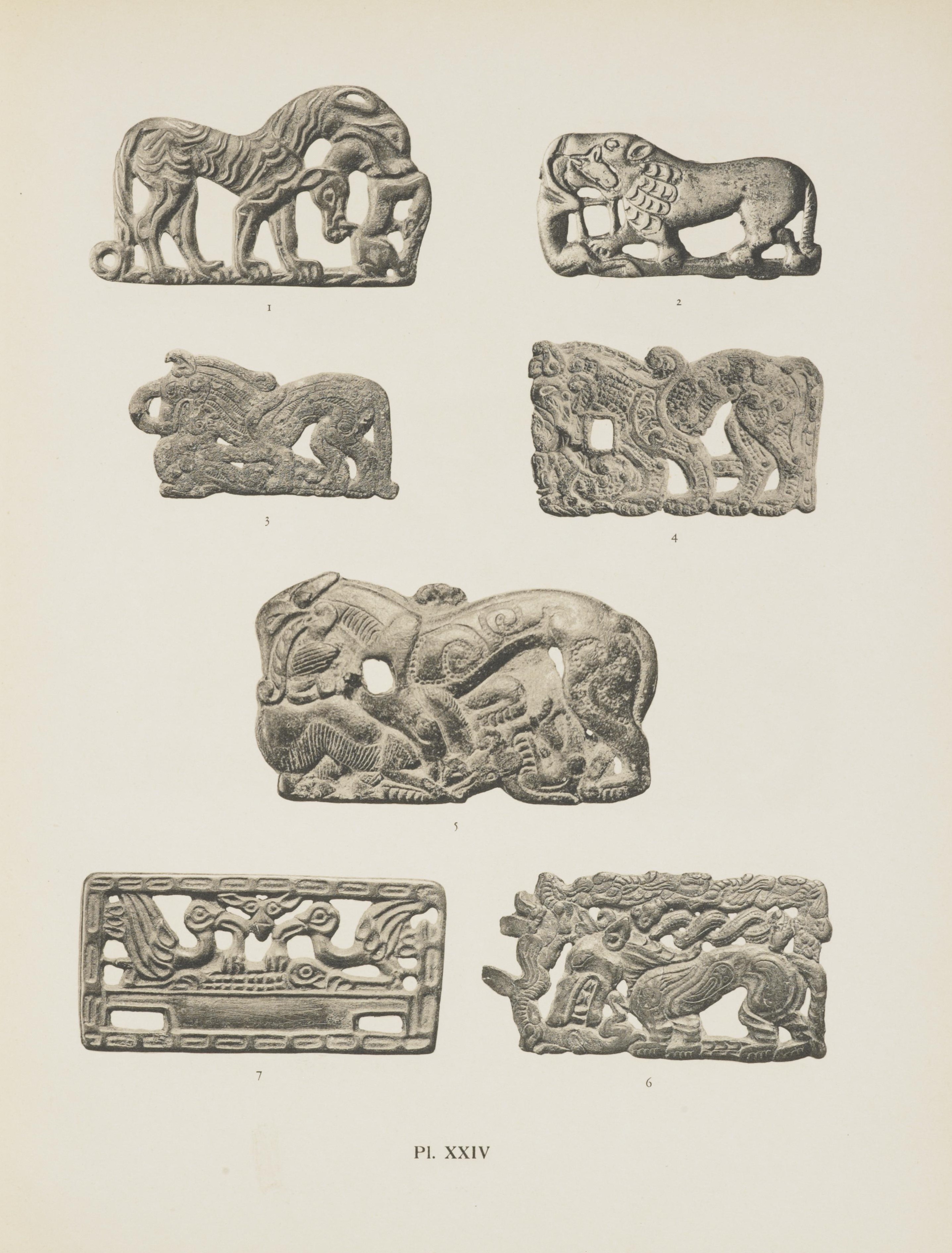
At this particular stage in the artistic intercrossing, there appears a strange intermediary scene between the animal-combat of the gold plaques and the animal-repast of Minussinsk. It has no parallel in the Steppe circle. The wild animal is made the principle figure, while frame and other details are discarded. Plate XXIV no. 3 shows us the earliest type. The wild animal seems to be derived from the tiger. The loop is inorganically placed between forehead and nose. The prey is unrecognisable. Incised ribbons that start from the joints and increase in width, decorate the body. The ornamental elements overshadow the organic and naturalistic elements, but there still remains some memory of anatomical construction. This first example of the motive should be placed about 500 A.D.
예술적 융합의 이 특정 단계에서 금판의 동물 싸움과 미누신스크의 동물 식사 사이에 이상한 중간 장면이 나타납니다. 대초원 테두리 안에는 이와 유사한 것이 없습니다. 야생 동물을 주요 인물로 삼고, 골격과 다른 세부 묘사는 생략했습니다. 도판24 3번은 가장 초기의 유형을 보여줍니다. 야생 동물은 호랑이에서 유래한 것으로 보인다. 고리는 이마와 코 사이에 무기적으로 위치하며, 먹이는 알아볼 수 없다. 관절에서 시작하여 폭이 넓어지는 새겨진 리본이 몸통을 장식한다. 장식적인 요소가 유기적이고 자연스러운 요소를 압도하지만, 해부학적 구조에 대한 기억은 여전히 남아 있습니다. 이 모티브의 첫 번째 예는 서기 500년경으로 추정됩니다.
A change of but little importance is found on Plate XXIV no. 4. The striped ribbons have been replaced by dotted and spiral lines. Once more we are able to follow the development of stylistic degeneracy even in the smallest details. On Plate XXIV no. 5 the composition has become still more confused. Above the shoulder where usually a spiral is found there is a bird-head. The principal animal reminds us of the art of the Altai where the tiger becomes fantastic through curling the upper lip, placing a scroll in the ear, and forming a pad of the whiskers. This pad is shaped like a half leaf, drawn with barbs like those of a feather, especially in those carved wood pieces from the Katanda river (11), that is to say, already of the Han period. Here the tiger is biting the hind leg of the soliped, and the tuft at the end of the tail can be seen above the lower jaw. The lines on mane and belly lead us to believe that the victim is a boar, although the head seems rather to be that of a ruminant. We see it in profile, crowned with the twisted horn of the ram, as well as with the lyre-shaped horns of the antilope which are turned full-face. Between these last two horns we find a paw, and there is another above. The dotted and spiral lines on the larger body are arbitrarily placed, but they do not cover the entire surface as in the two preceding pieces. According to our system of classification, this example is of the VI-VII centuries.
도판XXIV 4번에서는 그다지 중요하지 않은 변화가 발견됩니다. 줄무늬 리본은 점선과 나선형으로 대체되었습니다. 다시 한번 우리는 가장 작은 세부 사항에서도 양식적 퇴화의 발전을 따라갈 수 있습니다. 도판XXIV 5번에서는 구성이 훨씬 더 복잡해졌습니다. 보통 나선이 발견되는 어깨 부분 위에는 새 머리가 있습니다. 이 동물은 호랑이가 윗입술을 말아 올리고, 귀에 두루마리를 꽂고, 수염을 패드처럼 만들어 환상적인 분위기를 연출하는 알타이족의 예술을 연상시킵니다. 이 패드는 반쪽 잎 모양에 깃털처럼 뾰족한 가시가 그려져 있는데, 특히 카탄다 강에서 출토된 목각 조각품(11), 즉 한나라 시대의 조각품에서 두드러집니다. 여기서 호랑이는 갯지렁이의 뒷다리를 물고 있으며, 꼬리 끝의 뭉치가 아래턱 위로 보입니다. 갈기와 배에 있는 선으로 보아 피해자는 멧돼지일 가능성이 높지만, 머리는 반추동물의 것으로 보입니다. 우리는 그 옆모습을 볼 수 있는데, 숫양의 뒤틀린 뿔과 영양의 리라 모양 뿔이 얼굴을 향해 솟아 있는 모습이다. 이 마지막 두 뿔 사이에는 발이 하나 있고, 그 위에 또 다른 발이 있다. 더 큰 몸체의 점선과 나선은 임의로 배치되었지만, 앞의 두 작품처럼 표면 전체를 덮지는 않습니다. 우리의 분류 체계에 따르면, 이 작품은 6세기에서 7세기의 작품입니다.
Towards the end of the T'ang period, this type assumes fantastic forms (Plate XXIV no. 6). There the animal resembles a wolf with too short paws, its victim a contorted antilope. As emphasis on the joints of the larger animal, the artist has used three carefully drawn vulture-heads. This group is surrounded by a double weaving of animal-forms of which those in front of the large head cannot be recognised, due perhaps to the destruction of some portions by age. Immediately over the back of the animal we find two interlaced serpents each ending in a full-face bear's head. A ribbon starts above the tail of the wolf and forms the upper part of the frame. It is composed of an ibex-head and a vulture-head. The corner is formed by the ibex repeated three times along the upper horizontal edge. In front of each horn is a bird-head, of the type called on Minussinsk daggers " Griffon-heads ". This heterogeneous combination, and the baroque transformation of the motives, is beyond anything found in the Steppe circle.
당나라 말기에 이르러 이 유형은 기이한 형상을 띠게 된다(도판 XXIV 6). 이 그림에서 동물은 발이 너무 짧은 늑대를 닮았고, 그 희생자는 일그러진 영양(antilope)을 닮았습니다. 더 큰 동물의 관절을 강조하기 위해, 작가는 독수리 머리 세 개를 주의 깊게 그려 사용했습니다. 이 무리는 이중으로 엮인 동물 형상으로 둘러싸여 있는데, 큰 머리 앞쪽의 형상은 알아볼 수 없는데, 아마도 세월에 따라 일부가 훼손되었기 때문일 것입니다. 동물의 등 바로 위에는 서로 얽힌 두 마리의 뱀이 있는데, 각 뱀의 끝은 곰의 얼굴로 되어 있습니다. 리본은 늑대 꼬리 위에서 시작되어 프레임의 윗부분을 형성합니다. 아이벡스 머리와 독수리 머리로 구성되어 있습니다. 모서리는 아이벡스가 위쪽 수평 가장자리를 따라 세 번 반복되어 형성됩니다. 각 뿔 앞에는 미누신스크 단검에서 "그리폰 머리"라고 불리는 새 머리가 있습니다. 이러한 이질적인 조합과 모티브의 바로크적 변형은 대초원 테두리 안에서 발견되는 어떤 것보다 뛰어납니다.
Our region also adds a wealth of new themes to those of the Steppes in its use of the bird motive (Plate XXIV no. 7). This plaque is openwork, a technical process which when used in this way is reminiscent of Minussinsk. In a frame made up of small squares placed one after the other, there is a lower section like a rectangular band, perforated at either end, that would seem to have been intended for an inscription. Two birds of prey, characterised by beaks and claws, squat at either side of a fish that lies along the top of the band. A claw descends from the beak of each bird towards the back of the fish. The space between the two profiled bird-heads is filled by another, full-face. The drawing, especially that of plumage and scales, is all schematic, but enough of the Jenissei type for this piece to form part of the group that is of about 500 A.D.
우리 지역은 또한 새를 모티브로 사용함으로써 대초원 지역의 주제에 많은 새로운 주제를 추가합니다(사진 XXIV 7번). 이 명판은 투각 세공으로, 이런 방식으로 사용되면 미누신스크를 연상시키는 기술적인 기법을 사용합니다. 작은 정사각형들이 연이어 배치된 틀 안에는 양쪽 끝에 구멍이 뚫린 직사각형 띠 모양의 아랫부분이 있는데, 이는 비문을 새기기 위한 것으로 보입니다. 부리와 발톱이 특징인 두 마리의 맹금류가 띠 꼭대기에 있는 물고기 양쪽에 웅크리고 있습니다. 발톱은 각 새의 부리에서 물고기 뒤쪽으로 내려옵니다. 두 개의 옆모습을 한 새 머리 사이의 공간은 또 다른 통통한 얼굴로 채워져 있습니다. 특히 깃털과 비늘을 묘사한 그림은 모두 도식적이지만, 이 작품이 서기 500년경의 작품군에 속할 만큼 예니세이 유형의 그림입니다.
At Minussinsk the B-shaped plaque may be exchanged for one formed like a horse-shoe. In the separate development at the Chinese frontier we find the same phenomenon of about the year 1000 (Plate XXV no. 1). The frame is composed of the old leaf motive, but the animal ornamentation is difficult to recognise. At the larger end is a horned dragon curled so that its tail touches its head. The body has only hind legs. Under this fabulous animal is a serpent.
미누신스크에서는 B자 모양의 명판을 말굽 모양의 명판으로 교체할 수 있습니다. 중국 국경 지역의 별도 개발에서도 1000년경에 발생한 동일한 현상을 찾아볼 수 있습니다(도판 XXV 1번). 액자는 오래된 나뭇잎 모티브로 이루어져 있지만, 동물 장식은 알아보기 어렵습니다. 큰 쪽 끝에는 뿔 달린 용이 꼬리가 머리에 닿도록 몸을 말아 올리고 있습니다. 몸통에는 뒷다리만 있습니다. 이 기이한 동물 아래에는 뱀이 있습니다.

Below the latter, in the narrow section, we find one more animal, but this time undefinable. It is impossible to date this piece, nor a related fragment from the Loo collection (Pl. XXV no. 2), before the beginning of the Sung period. This second piece has a frame of two dragon-heads that surround a ring under which is the full-faced head of a lynx. This well defined animal could not be recognised under this schematic form, were it not found in a similar composition, but with more naturalistic details, at Minussinsk (10).
후자 아래, 좁은 부분에서 동물 한 마리를 더 발견할 수 있는데, 이번에는 정체를 알 수 없습니다. 이 작품이나 루(Loo) 소장품(Pl. XXV no. 2)에 있는 관련 단편의 연대를 송나라 시대 초기로 추정하는 것은 불가능합니다. 두 번째 작품에는 두 개의 용 머리가 있는 틀이 있고, 그 둘레에는 링이 있고, 링 아래에는 스라소니의 얼굴이 가득 들어 있습니다. 이 잘 정의된 동물은 미누신스크(10)에서 유사한 구성이지만 더 자연스러운 세부 사항을 갖춘 형태로 발견되지 않았다면 이 도식적 형태로는 인식될 수 없었을 것입니다.
d) Animals alone and in pairs.
d) 동물 혼자 및 짝으로 장식된 동물.
The reproduction on belt-plaques of several animals of the same species, or of one animal alone, is somewhat scarce in the Sarmatian region. On the other hand such designs are numerous in the Jenissei valley. There are few uses and ornaments where the affinity between Minussinsk and north China is as apparent as on belt-plaques decorated with animals alone or in pairs. If we continue to follow our system of chronological grouping by which we place strongly modeled pieces at a relatively early date, Plate XXV no. 3 is then of about 500. Its contour is the same as that of Plate XXV nos. I & 2, and, as in those examples, the different bodies are difficult to distinguish. It is, however, easy to recognise two dragon-heads at the centre, seen from above, that are biting the interlaced legs of some other animals.
사르마티아 지역에서는 허리띠에 같은 종의 여러 동물이나 한 동물만을 새긴 문양이 드물게 발견됩니다. 반면 예니세이 계곡에서는 그러한 문양이 많이 발견됩니다. 미누신스크와 중국 북부 사이의 연관성이 홀로 또는 쌍으로 동물이 장식된 허리띠 장식만큼 확실하게 드러나는 용도나 장식은 거의 없습니다. 상대적으로 이른 시기에 제작된 작품들을 연대순으로 분류하는 방식을 계속 따른다면, 도판25 3번은 그 다음 약 500년 전의 작품입니다. 그 윤곽은 도판25 1번과 2번의 윤곽과 동일하며, 앞서 언급한 예들처럼 각 작품을 구분하기는 어렵습니다. 그러나 위에서 보면 중앙에 두 개의 용 머리가 있는 것을 쉽게 알아볼 수 있는데, 이 용 머리가 다른 동물의 다리를 얽어 물고 있습니다.
At Minussinsk there are numerous plaques that have the hook on the rounded end, as have all the examples on Plate XXV with which we have dealt so far. The opposite end is again straight with two corners. In the Jenissei, as in our region, the central motive is that of a buffalo-head (Plate XXV no. 4) surrounded by short legs. Under the head, at both sides, are the characteristic folds of flesh ornamented by perforations. Once more we turn to about 500. This type is also found in South Russia in the region of the Selenga river (12). Plate XXV no. 5 is one of many extraordinary inventions from the north of China. Two centre disks are garlanded with animal-heads in groups of two. They are a combination of bird-heads with ram-horns. Such an unnatural design certainly brings us into the beginning of the II millennium.
미누신스크에는 둥근 끝에 갈고리가 달린 명판이 많이 있는데, 이는 우리가 지금까지 살펴본 판 XXV의 모든 예와 같습니다. 반대쪽 끝도 두 개의 모서리가 있는 직선 모양입니다. 우리 지역과 마찬가지로 예니세이에서도 중앙 모티브는 짧은 다리로 둘러싸인 물소 머리(판 XXV 4번)입니다. 머리 아래 양쪽에는 특징적인 살 주름이 있으며, 그 위에 천공으로 장식되어 있습니다. 다시 500년 즈음을 살펴보겠습니다. 이 유형은 러시아 남부 셀렝가 강 유역에서도 발견됩니다(12). 도판XXV 5번은 중국 북부에서 발견된 수많은 놀라운 발명품 중 하나입니다. 가운데 두 개의 원반에는 동물 머리가 두 개씩 모여 장식되어 있습니다. 새 머리와 숫양 뿔이 결합된 형태입니다. 이처럼 부자연스러운 디자인은 분명 우리를 제2천년기의 시작으로 인도합니다.
Because of its excellent modeling we place the plaque of Plate XXV no. 6 near the Han period (III-IV centuries A.D.). The edge, decorated with double lines frames two browsing horses. Only one peculiarity of Sarmatian art can be found here, the stylization of the hooves with the grooved comma-shape design. A repliqua of one half of this motive (Plate XXV no. 7) proves that naturalistically modeled forms may survive, although they may have lost their plastic clearness, their anatomical accuracy, and even their technical perfection. The very faulty casting of this piece brings us certainly past the year 1000.
훌륭한 조형미를 고려하여 도판XXV 6번는 한나라(서기 3-4세기)에 가까운 것으로 간주합니다. 이중선으로 장식된 가장자리에는 풀을 뜯는 두 마리의 말이 그려져 있습니다. 여기서 사르마티아 예술의 유일한 특징은 발굽에 홈이 파인 쉼표 모양의 디자인을 양식화한 것입니다. 이 모티브의 절반을 복제한 작품(도판 XXV 7번)은 자연주의적으로 조형된 형태가 본래의 조형적 선명도, 해부학적 정확성, 심지어 기술적 완벽함까지 잃었을지라도 여전히 남아 있을 수 있음을 보여줍니다. 이 작품의 매우 잘못된 주조는 분명 1000년을 넘어선 시점을 보여줍니다.
The combined forms of two outward-turned ibex (Plate XXVI no. 1) must be of the same date as the pair of horses of Plate XXV no. 6, but such a composition is not found at Minussinsk. The smooth and backward-arched horns are of considerably more than natural size. The plant growth, stylised like the hooves, may be seen in front of the necks and over the backs of the animals, and represents a forest. Grooved squares form the frame. Although this piece is but little perforated, the modeling stands out boldly. These two peculiarities are characteristic of a phase that owes much to an observation of nature.
두 마리의 바깥쪽으로 향한 아이벡스(도판 XXVI 1번)가 합쳐진 형태는 도판 XXV 6번의 말 한 쌍과 같은 시기에 만들어졌을 것으로 추정되지만, 그러한 구성은 미누신스크에서는 발견되지 않습니다. 매끄럽고 뒤로 휘어진 뿔은 실제 크기보다 훨씬 큽니다. 발굽처럼 양식화된 식물의 성장은 동물의 목 앞과 등 위에서 볼 수 있으며, 숲을 상징합니다. 홈이 파인 사각형이 프레임을 형성합니다. 이 작품은 천공이 거의 없지만, 조형미가 뚜렷하게 돋보입니다. 이 두 가지 특징은 자연 관찰에 크게 의존하는 이 작품의 특징입니다.

Plate XXVI no. 2 is in strong contrast to such a phase. Here the ibex-heads are turned full-face, so that the horns are developed on each side. In the centre of the upper border we find a pair of unconnected horns that serve merely to fill space. The animals are surrounded by leaves and stand upon a wavy ground.
도판XXVI 2번은 이러한 양상과 뚜렷한 대조를 이룹니다. 여기서 아이벡스의 머리는 정면을 향하고 있어 양쪽에 뿔이 발달해 있습니다. 위쪽 경계 중앙에는 연결되지 않은 한 쌍의 뿔이 있는데, 이는 단순히 공간을 채우는 역할을 합니다. 동물들은 잎사귀에 둘러싸여 있고, 물결 모양의 땅 위에 서 있습니다.
The back is cut away as much as possible, typical of the Jenissei valley. The modeling has been replaced by linear drawing in ridges, while the bulk of the bodies is almost flat. Were there not a horizontal line across the middle, these bodies would show the same treatment as those on plaques dealing with mythological scenes (Plate XXI nos. 1 & 2). Here, however, the stylization and geometric forms show progress and warrant a date about the beginning of the second half of the I millennium.
등은 최대한 잘라낸 형태인데, 이는 예니세이 계곡의 특징입니다. 조형은 능선을 따라 직선으로 표현된 것으로 대체되었으며, 대부분의 몸체는 거의 평평합니다. 중앙에 수평선이 없었다면, 이 조각상들은 신화적 장면을 다룬 명판(도판 XXI 1번과 2번)에 있는 조각상들과 같은 방식으로 처리되었을 것입니다. 그러나 이 조각상의 양식과 기하학적 형태는 진보를 보여주며, 제1천년기 후반기 초로 추정되는 시기를 뒷받침합니다.
Still another animal combination is found in the Jenissei as well as in the north of China, that of two yaks (13). Their heads are turned full-face, the folds of flesh are comma-shaped, repeated three times. The tuft at the end of each tail has the same motive. What differentiates this repliqua from its Siberian model is the emphasis here on linear decoration, which should therefore place it in the T'ang period. We give the same date to Plate XXVI no. 4, where we find a single horse that is a repetition of the pair of Plate XXII no.4. The garland over the contorted form of the animal has also been previously seen on Plate XXVI no. 6. It is composed of plaited ribbons with animal-heads. There is another similar ribbon that joins the hind leg to the frame. One type, only found at the northern frontier and at Minussinsk, and nearly identical in both regions, is that of Plate XXVII no. I. It was certainly one of the most popular and most admired designs of the period. One must not look for this type under our heading in previous literature on the subject, since it has always been termed an " animal-combat " (14). But one has only to glance at the hooves, the shape of the heads, and at the comma-design of the shoulder joints to know that these are two animals of the same species, two horses. They are playing, one biting at the neck of the other which in turn bites the foreleg of its companion. In an earlier publication I called this group " Horses at play " (15). This explanation has been accepted by Andersson, who goes still farther and calls it " A combat between rutting stallions " (16). This type is of the usual shape framed in grooved squares, wavy ground below, and perforated leaves above. In variations of the same scene, the stylization of the forest usually forms part of the frame, thereby causing less openwork. In another case, one horse is kneeling and has the forelegs of the other in his jaws. Since the modeling of this piece is more accentuated than in Plate XXVI no. I, I think this may be of the end of the Han period or but shortly after.
또 다른 동물 조합은 중국 북부뿐만 아니라 예니세이에서도 발견되는데, 바로 두 마리의 야크입니다(13). 야크의 머리는 얼굴을 정면으로 향하고 있으며, 살의 주름은 쉼표 모양으로 세 번 반복됩니다. 각 꼬리 끝의 털 뭉치에도 같은 무늬가 있습니다. 이 레플리콰를 시베리아 모형과 차별화하는 점은 선형 장식에 중점을 두었다는 점인데, 따라서 당나라 시대로 추정됩니다. 도판XXVI 4번도 같은 연대를 가지고 있는데, 도판XXII 4번에 있는 한 쌍의 말을 재현한 한 마리의 말이 발견됩니다. 동물의 뒤틀린 형상 위에 씌워진 화환은 도판XXVI 6번에서도 이미 확인되었습니다. 동물 머리가 그려진 리본을 엮어 만든 것입니다. 뒷다리를 프레임에 연결하는 또 다른 유사한 리본이 있습니다. 한 유형은 북쪽 국경과 미누신스크에서만 발견되며, 두 지역에서 거의 동일한 형태를 보이는데, 바로 도판XXVII 1번입니다. 이 작품은 분명 그 시대에 가장 인기 있고 가장 존경받는 디자인 중 하나였습니다. 이 주제에 대한 이전 문헌에서 이 유형을 찾아서는 안 됩니다. 왜냐하면 이 유형은 항상 "동물 전투"라고 불렸기 때문입니다. (14). 하지만 발굽, 머리 모양, 어깨 관절의 쉼표 모양만 봐도 이 두 마리가 같은 종, 즉 두 마리의 말이라는 것을 알 수 있습니다. 그들은 서로 놀고 있는데, 한 마리가 다른 마리의 목을 물고, 다른 마리는 다시 다른 마리의 앞다리를 물고 있습니다. 저는 이전 출판물에서 이 무리를 "놀고 있는 말들"(15)이라고 불렀습니다. 이 설명은 안데르손(Andersson)에 의해 받아들여졌으며, 그는 더 나아가 이를 "발정난 종마들 사이의 싸움"(16)이라고 부릅니다. 이 종은 홈이 있는 사각형, 아래쪽은 물결 모양의 바닥, 위쪽은 구멍이 뚫린 잎으로 구성된 일반적인 형태를 지닙니다. 같은 장면의 변형 작품에서는 숲의 양식화가 프레임의 일부를 차지하여 투각 효과를 덜 줍니다. 또 다른 경우에는 한 마리의 말이 무릎을 꿇고 다른 한 마리의 앞다리를 턱에 물고 있습니다. 이 작품의 조형이 도판XXVI 1번에 비해 더욱 강조되어 있어, 한나라 말기 또는 그 직후의 작품으로 추정됩니다.

We have already noticed on Plate XXIII nos. 1-4 that an unperforated background is usually a Chinese phenomenon. It also appears on plaques showing animals of the same species which are closely allied with the animal plaques just mentioned. On Plate XXVII no. 2 four animals are grouped in pairs. The curl of the upper lips is closely related to Altai forms of which we have already spoken. Their contorted bodies connect them with Sarmatian art, but the linear drawing is rather derived from the barbarians of the Chinese frontier. Typical of a non-organic composition is the fact that only one foreleg can be seen but both of the hindlegs. The border differs from the usual plaque frame, as here it is made up of spiral ribbons. This piece may also be of the T'ang period but very close to 1000.
우리는 이미 도판XXIII 1~4번에서 천공되지 않은 배경은 대개 중국에서 나타나는 현상임을 확인했습니다. 앞서 언급한 동물 판과 밀접한 관련이 있는 동종 동물을 묘사한 판에서도 이러한 현상이 나타납니다. 도판XXVII 2번에는 네 마리의 동물이 쌍으로 무리 지어 있습니다. 윗입술의 말림은 앞서 언급한 알타이 양식과 밀접한 관련이 있습니다. 그들의 일그러진 몸은 사르마트 예술과 연관이 있지만, 선형적인 그림은 중국 변경의 이방인에게서 유래한 것으로 보입니다. 비유기적 구성의 전형적인 특징은 앞다리는 한쪽만 보이고 뒷다리는 양쪽 모두 보인다는 것입니다. 테두리는 일반적인 명판 액자와 달리 나선형 리본으로 되어 있습니다. 이 작품 역시 당나라 시대의 것으로 추정되지만, 1000년경에 매우 가깝습니다.
We place a little later the two horses framed in a border composed of oblique stripes (Plate XXVII no. 3). The contorsion of the bodies and the linear decoration connect it with the preceding example. But the separate motives show once again a tendency to break up and combine with other motives to form new ornamentations. Thus, between the hindlegs, we find two roe-heads face to face, and on the other side an owl-head seen from the front but upside down. With Plate XXVII no. 4 we have once more gone beyond 1000. The two horses have become but a play of lines, but little connected with nature. Of the contorted hindlegs only scrolls above the backs remain. The section between the two animals is filled with two pairs of double spirals. This plaque typifies once more the weakening of form under the Mongols.
조금 후에 우리는 사선 줄무늬로 구성된 테두리 안에 두 마리의 말을 배치합니다(도판27 3번 그림). 몸의 굴곡과 선형적인 장식은 앞선 예와 연결됩니다. 그러나 각각의 모티브는 다시 한번 분리되고 다른 모티브와 결합되어 새로운 장식을 형성하는 경향을 보입니다. 따라서 뒷다리 사이에는 서로 마주 보는 두 개의 노루 머리가 있고, 반대편에는 앞에서 보았지만 뒤집힌 올빼미 머리가 있습니다. 도판27 4번을 통해 다시 한번 1000년을 넘어섰습니다. 두 마리 말은 선의 유희에 불과할 뿐, 자연과의 연결은 거의 없다. 뒤틀린 뒷다리는 등 위쪽의 소용돌이 모양만 남아 있다. 두 마리 사이의 부분은 두 쌍의 이중 나선으로 가득 차 있다. 이 명판은 몽골군에 의해 약화된 형상을 다시 한번 보여줍니다.
An exact duplicate of a pair of Minussinsk animals (17) is upon a very openwork plaque composed of two opposed browsing camels (Plate XXVIII no. 1). As with all plaques common to the two extremes of the Steppes it should be placed in the III-IV century A.D. The frame is made up of unusually short leaf decorations. Between the two animals are two intertwined trees. The hair on the humps is drawn with vertical stripes. In reality two-humped camels are not indigenous to the Jenissei valley. Their appearence in the art of this region must be an importation from the south as Czaplicka has already mentioned (18). The frame is simplified on the plaque decorated with camels with raised heads (Plate XXVIII no. 2). The leaves are connected neither with the border nor with the tree at the centre, they are below the muzzles and at the backs of the animals. So simplified a form would at Minussinsk already belong to the middle of the I millennium and in China should date, at the earliest, at the beginning of the T'ang period.
미누신스크 동물 한 쌍(17)의 정확한 복제품이 마주 보고 있는 두 마리의 낙타가 그려진 매우 투각된 명판(도판 XXVIII 1번) 위에 있습니다. 대초원의 양 극단에 공통적으로 나타나는 모든 명판과 마찬가지로, 이 명판 역시 서기 3~4세기에 제작된 것으로 추정됩니다. 액자는 특이하게 짧은 잎 장식으로 이루어져 있습니다. 두 동물 사이에는 두 그루의 나무가 서로 얽혀 있습니다. 혹의 털은 세로 줄무늬로 그려져 있습니다. 사실 두 개의 혹을 가진 낙타는 예니세이 계곡의 토종이 아닙니다. 차플리츠카(Czaplicka)가 이미 언급했듯이(18) 이 지역 예술에서 이들의 출현은 남쪽에서 유입된 것임이 분명하다. 낙타의 머리가 치켜든 모습으로 장식된 명판에서는 프레임이 단순화되어 있다(도판 XXVIII 2번). 잎은 테두리나 중앙의 나무와 연결되지 않고, 동물의 주둥이 아래와 등에 붙어 있다. 이처럼 단순화된 형태는 미누신스크에서는 이미 1천년기 중반에 속하며, 중국에서는 이르면 당나라 초기로 거슬러 올라갈 것이다.

We find a pair of camels completely lacking in modeling (Plate XXVIII no. 3) created at a period around 1000. The motive of intertwined trees has become a double rope which continues the braid of the frame, rests on the backs of the camels and passes through their mouths like bridles. This example very clearly shows that after a certain lapse of time ancient forms can become quite new and no longer hold their original meaning.
우리는 모형 제작이 아주 부족한 한 쌍의 낙타(도판28 3번)를 발견하는데, 이 작품은 기원후 1000년경에 제작되었습니다. 얽힌 나무라는 모티브는 프레임(틀)의 끈을 이어주는 이중 밧줄로 바뀌었고, 낙타의 등에 얹혀져 고삐처럼 낙타의 입을 통과합니다. 이 사례는 일정 시간이 지나면 고대 형태가 매우 새롭게 변해 원래 의미를 더 이상 유지하지 못할 수 있음을 분명하게 보여줍니다.
Plate XXVIII no. 4 gives an idea of the diversity of possible variations. This pair of ibex is far more broken up than any Minussinsk piece, although the element that causes this dissolution is formed of an ancient motive from this region, the circular perforation of which we spoke at length in Chapter VI. It takes possession of the tree at the centre and changes it into three wheels. It appears above the horns and below the bodies, in fact if takes hold of all posible spaces. Only the ibex themselves, well modeled moreover, are not so treated.
도판XXVIII 4번은 가능한 변형의 다양성을 보여줍니다. 이 아이벡스 한 쌍은 미누신스크 조각품보다 훨씬 더 많이 조각되어 있는데, 이러한 조각상의 해체를 야기하는 요소는 이 지역의 고대 모티브에서 비롯된 것으로, 둥근 천공에 대해서는 6장에서 자세히 다루었습니다. 그것은 중앙에 있는 나무를 차지하여 세 개의 바퀴로 변형시킵니다. 뿔 위와 몸통 아래에 나타나, 사실상 가능한 모든 공간을 차지합니다. 게다가 잘 모델링(곧 입체감을 살린)된 아이벡스 자신들만이 그렇게 취급되지 않습니다.
Three stylistic tendencies meet here, the heraldic grouping and the circular perforations of Minussinsk, the modeling of an early period, and finally the tendency towards a schematic transformation which is an artistic characteristic peculiar to the barbarians of the northern Chinese frontier. A date near 1000 best corresponds to the coincidence of these three elements. When even the modeling disappears as in Plate XXVIII no. 5, we must be at an even later period and have entered the II millennium. Here the perforations have even broken up the forms of the standing animals, probably stags, the heads of which are backward-turned. Animals so geometrically simplified, three instead of a pair, and all turned in the same direction, are certainly an invention of our region. Among the latest yet most primitive plaques, is that of Plate XXVIII no. 6, composed in the same way as Plate XXVIII no. 4. The stags are nearly unrecognisable. The centre tree, a very ancient motive, has become a dotted line, and the circle above is less a symbol than a method by which the artist avoided small perforations and replaced them with a linear design. Such a weakening of original forms can only be possible at a late Mongol period. This object, so to speak, is of " no date ".
여기에는 세 가지 스타일적 경향이 만납니다. 미누신스크의 문장학적 그룹화와 원형 천공, 초기 시기의 조형, 마지막으로 중국 북부 국경의 이방인들에게서 나타나는 예술적 특징인 도식적 변형 경향이 있습니다. 1000년에 가까운 날짜가 이 세 요소의 일치에 가장 잘 부합합니다. 도판28 5번에서처럼 모델링(곧 입체감을 살린)(입체감이 살아있는)마저 사라지면, 우리는 훨씬 더 늦은 시기, 즉 제2천년기에 접어들었음을 의미합니다. 여기서 천공은 서 있는 동물, 아마도 수사슴의 형태까지 망가뜨렸습니다. 수사슴은 머리가 뒤로 젖혀져 있습니다. 기하학적으로 단순화된 동물들은 한 쌍이 아닌 세 마리로, 모두 같은 방향으로 향하고 있는데, 이는 분명 우리 지역의 발명품입니다. 가장 최신이면서도 가장 원시적인 명판 중 하나는 XXVIII번 판 6호로, XXVIII번 판 4호와 같은 방식으로 구성되었습니다. 사슴은 거의 알아볼 수 없을 정도입니다. 아주 오래된 모티브였던 중앙의 나무는 점선으로 바뀌었고, 그 위의 원은 상징이라기보다는 작가가 작은 구멍을 피하고 선형 디자인으로 대체한 방식에 가깝습니다. 원래 형태가 이렇게 약화됨은 몽골 후기에야 가능할 수 있습니다. 이 유물은 말하자면 "연대 미상"입니다.
There are animals in plaque form of so small a volume as to be mere skeletons. A wild animal (Plate XXIX no. I) may, in spite of this fact, be recognised as a wolf. The disappearance of the body surface, however, cannot be possible before the middle of the I millennium. There is still less volume in the ibex of Plate XXIX no. 2, where even a true drawing of the legs has been lost. The back, the legs joined together, and the jaws, have become grooved bars. We always find at the end of this art, that is to say at the beginning of the II millennium, the same tendency to forget nature by placing the emphasis on the ornament.
동물들은 뼈만 남은 작은 판 형태의 화석을 가지고 있습니다. 이러한 사실에도 불구하고 야생 동물(도판 XXIX 1번)은 늑대로 인식될 수 있습니다. 그러나 체표면(몸 외관)이 사라지는 것은 1천년기 중반 이전에는 불가능할 것입니다. 도판 XXIX 2번의 아이벡스 화석은 더욱 부피가 줄어들었는데, 다리의 정확한 그림조차 없어졌습니다. 등, 연결된 다리, 그리고 턱은 홈이 파인 막대처럼 보입니다. 우리는 항상 이 예술의 끝, 즉 2천년대 초반에 장식에 중점을 두어 자연을 잊는 동일한 경향을 발견합니다.

The figure astride a camel (Plate XXIX no. 3) is of a type already observed in the hooks of Plate XX nos. 3 & 4, and is of the same period, the beginning of the II millennium.
낙타를 탄 모습(도판 XXIX 3번)은 이미 도판 XX 3번과 4번의 고리에서 관찰된 유형이며, 2천년기 초인 같은 시기에 만들어졌습니다.
The small figure (Plate XXIX no. 4) is not sufficiently distinct for us to draw any conclusions ; it must probably be of the end of the T'ang period. A heraldic head of a lion (Plate XXIX no. 5) is a reminder of the fact that bands of hunters often reached Persia. As this piece is inspired by a Persian model and exceptionally reproduced at the northern frontier, the adoption of this foreign motive places it in the II millennium. By the same method of deduction Tallgren has classified a poorer casting of the same model and calls it " modern " (19).
작은 인물(도판 XXIX 4번)은 뚜렷하게 구별되지 않아 어떤 결론을 내리기 어렵습니다. 아마도 당나라 말기의 인물일 것입니다. 사자 머리 문장(도판 XXIX 5번)은 사냥꾼 무리가 페르시아에 자주 도착했다는 사실을 상기시켜 줍니다. 이 작품은 페르시아 모델에서 영감을 받아 북부 국경에서 특별히 제작되었으며, 이러한 외국 모티브를 채택함으로써 2천년기에 속한다고 볼 수 있습니다. 동일한 추론 방법을 통해 Tallgren은 동일한 모델의 더 낮은 캐스팅을 분류하고 이를 "현대적"이라고 부릅니다(19).
e) Geometrically designed ornaments.
e) 기하학적으로 디자인된 장식.
In an enumeration of decorations to be found on belt-plaques, the geometric design cannot be omitted. It is already discovered at Minussinsk and probably comes from a simplification of openwork plaques ornamented with serpents (20). There also appears in this region a double ladder type, originally with a bird-head (21), but in the Jenissei as well as in China, this animal form is sometimes omitted. Here (Plate XXIX no. 6) the only organic form is the leaf designed frame. The sections that joined the central bar to the frame are broken. Andersson considers that possibly leaves of this type may be animal rudiments, such as hooves or ears (22). This theory is refuted, however, by the consecutive order of Minussinsk pieces. This example from the north of China may be dated at the beginning of the second half of the I millennium. That this type developed with the Mongols into a complicated geometric decoration is proved by Plate XXIX no. 7. Except for the indistinct design of the frame, the leaf motive has lost its original meaning and has formed a rosette, no longer in any way connected with natural forms. In our search for a probable date we found unexpected aid from the extreme west of the Steppe circle. Fettich has published belt-plaques with the same design of the period of the " occupation of land " by the Hungarians, that is to say the IX century (23). This piece from the Chinese frontier may therefore be dated with great certainty in the IX-X century.
허리띠 명판에서 발견되는 장식들을 살펴보면 기하학적 디자인을 빼놓을 수 없습니다. 이 디자인은 미누신스크에서 이미 발견되었으며, 아마도 뱀으로 장식된 투각 명판의 단순화된 형태에서 유래했을 것입니다(20). 이 지역에는 원래 새의 머리를 가진 이중 사다리 형태도 나타나지만(21), 예니세이족과 중국에서는 이 동물 형태가 때때로 생략됩니다. 여기(도판 XXIX 6번)에서 유일한 유기적 형태는 잎으로 디자인된 틀입니다. 중앙 막대를 틀에 연결하는 부분은 끊어져 있습니다. 안데르손은 이러한 유형의 잎이 발굽이나 귀와 같은 동물의 흔적일 가능성이 있다고 생각합니다(22). 그러나 미누신스크 조각품의 순서가 연속적이라는 점에서 이 이론은 반박된다. 중국 북부에서 발견된 이 유물은 기원전 1천년기 후반 초에 제작된 것으로 추정된다. 이 유형이 몽골과 함께 복잡한 기하학적 장식으로 발전했다는 것은 도판29 7번을 통해 입증된다. 프레임의 모호한 디자인을 제외하면, 잎 모양은 원래 의미를 잃었고 장미 모양으로 변해 더 이상 자연 형태와 관련이 없습니다. 추정 연대를 찾던 중, 우리는 대초원 권역 최서단에서 예상치 못한 도움을 받았습니다. 페티히는 헝가리인들이 "토지를 점령"했던 시기, 즉 9세기와 동일한 디자인의 허리띠 명판을 출간했습니다(23). 따라서 중국 국경에서 발견된 이 유물은 9~10세기로 매우 확실하게 추정될 수 있습니다.
2) Buckles to end a chain.
2) 사슬을 마무리하는 버클.
The openwork objects collected under this heading are with reservations added to this chapter because of their general shape always furnished with either hook or loop. Their use is supported by examples published by Andersson (24). The objects have been proved at the Chinese frontier, but not yet among the Sarmatians. In our region this object is actually found connected with a chain, but at the same time its use as a belt-fastener still remains possible. The chain is always attached so that the forward bending hook hangs from the bottom. It is possible that there were two buckles made to fit each end of the chain. In fact there are isolated pieces that could have been used in such a way. Even when only the buckles have been preserved, as is the case for all the examples on Plate XXX, the decoration on these pieces proves that they were meant to hang vertically.
이 항목에 포함된 투각 세공품은 일반적인 형태 때문에 항상 갈고리 또는 고리가 달려 있으므로 이 장에 추가된 예약 사항이 있습니다. 안데르손(Andersson)이 발표한 사례들이 이러한 용도를 뒷받침합니다(24). 이 유물들은 중국 국경 지역에서는 입증되었지만, 사르마트인들 사이에서는 아직 발견되지 않았습니다. 우리 지역에서는 이 유물이 실제로 사슬에 연결된 채 발견되었지만, 동시에 벨트 고정 장치로 사용되었을 가능성도 여전히 남아 있습니다. 사슬은 항상 앞쪽으로 구부러진 갈고리가 아래쪽에 걸리도록 연결되어 있습니다. 사슬 양쪽 끝에 맞춰 두 개의 버클이 있었을 가능성이 있습니다. 실제로 그러한 용도로 사용되었을 가능성이 있는 개별 조각들이 존재합니다. 도판 XXX의 모든 예에서처럼 버클만 보존된 경우라 하더라도, 이 작품들의 장식은 그것들이 수직으로 걸려 있도록 의도되었다는 것을 증명합니다.
The oldest piece in this group (Plate XXX no. 1) is closely connected with Minussinsk art. There too we find a decoration grouped around a convex central disk (Pl. III, line IV, 3, no. 98). The circular perforations at the eyes and nostrils and the slits at the ears on the two ass-heads, are typical of the art of the Jenissei. The bar between the two muzzles holds the hook. The date, as in all cases where the Minussinsk influence is very evident, is about 500 A.D.
이 그룹에서 가장 오래된 작품(도판 XXX 1번)은 미누신스크 예술과 밀접한 관련이 있습니다. 여기에서도 볼록한 중앙 원반을 중심으로 장식이 모여 있는 것을 볼 수 있습니다(도판 III, 선 IV, 3, 98번). 두 당나귀 머리의 눈과 콧구멍에 있는 원형 천공과 귀에 난 틈은 예니세이 예술의 전형입니다. 두 주둥이 사이의 막대에는 갈고리가 걸려 있습니다. 미누신스크의 영향이 매우 뚜렷하게 드러나는 모든 경우에서 그렇듯이, 제작 연대는 서기 500년경입니다.

For Plate XXX no. 2 we have reached a period at the end of the millennium as is clearly shown by a comparison with the hook of Plate XX no. 9, the ornamentation of which is identical. Even the loop on the tiger's back, made to hold the chain, is not missing. Above the ram, and connected with a loop, is a ring which, strangely enough, has a hook at the side. Joined to this ring by another loop, is the part with which we are chiefly concerned here, the buckle. As with the first example it is composed of the heads of two asses, one of which has an inexplicable form added to it. This time the hook is not under, but over the two heads. If we had not already the date of the lower section, discussed in Chapter VI no. 3, a comparison of the two pairs of ass-heads would suffice to reach a comparitively late date.
도판XXX 2번은 1천년기 마지막에 도달한 것으로, 도판 XX 9번의 고리와 비교해 보면 분명히 알 수 있습니다. 도판 XX 9번의 고리는 장식이 동일합니다. 호랑이 등에 사슬을 걸기 위해 만들어진 고리도 그대로 남아 있습니다. 숫양 위에는 고리로 연결된 고리가 있는데, 이상하게도 옆면에 갈고리가 있습니다. 이 고리에 또 다른 고리가 연결되어 있는데, 바로 여기서 우리가 주로 다루는 부분인 버클입니다. 첫 번째 예시처럼 버클은 두 마리의 당나귀 머리로 이루어져 있는데, 그중 한 마리에는 불가사의한 형상이 더해져 있습니다. 이번에는 갈고리가 두 머리 아래가 아니라 위에 있습니다. 6장 3번에서 논의한 아랫부분의 연대를 미리 알지 못했다면, 두 쌍의 당나귀 머리를 비교하는 것만으로도 비교적 늦은 연대를 알아낼 수 있을 것입니다.
The general shape of such pieces is sometimes a circle, sometimes a square. In order to fill this form the artist invented about the year 1000, groups of animals which are not found so combined in other parts of the Steppes. Plate XXX no. 3 is principally composed of a bar and of a hook formed like a head, perhaps that of a roe. The two arcs of the buckle end just before the hook in two backward turned tiger-heads. A contemporary piece (Plate XXX no. 4) has added an upper loop to the circle and hook. The general form is that of a tiger treated like a coiled animal, a familiar Sarmatian motive and very similar to it, even in this elongated form. This breaking down of the motive is characteristic of a period between T'ang and the end of Sung, and agrees very well with the general tendency of the art peculiar to the Chinese frontier. In Plate XXX no. 5, the tiger has been doubled and between the two jaws, seen full-face, is the head of a hare, the ears of which serve to form a loop. Plate XXX no. 6 is once more square. The outline is composed of two transversal bars joined by two S-shaped tigers (cf. Plate XVI no. 7). An unusual feature is that the bird-head hook bends inward instead of outward. The combination of two tigers and a hare is transformed into an interlaced motive (Plate XXX no. 7) similar to Plate XVI no. 13. The victim is stretched full length between its enemies. A protuberance is broken. Plate XXX no. 8 is of the same type but further developed, for above the hare-head we can perceive another turned in the opposite direction. The hook has again been changed into the head of a fabulous animal. With this example we end the series of objects all very evidently of the same type and of the same period. The date of these pieces is already assured by the parallels to be found among the appliques.
이러한 조각품의 일반적인 형태는 때로는 원형이고, 때로는 사각형입니다. 이 형태를 채우기 위해 예술가는 1000년경에 대초원의 다른 지역에서는 흔히 볼 수 없는 동물 무리를 조합하여 조각했습니다. 도판XXX 3번은 주로 막대와 머리 모양, 아마도 노루의 머리 모양으로 생긴 고리로 구성되어 있습니다. 버클의 두 둥근 활모양 후크 바로 앞에서 뒤로 휘어진 두 개의 호랑이 머리 모양으로 끝납니다. 동시대 작품(도판 XXX 4번)은 원과 후크에 위쪽 고리를 추가했습니다. 전체적인 형태는 똬리를 튼 동물처럼 묘사된 호랑이의 모습으로, 익숙한 사르마트족의 모티브이며, 길쭉한 형태에서도 매우 유사합니다. 이러한 동기의 분해는 당나라와 송나라 말기 사이의 시기의 특징이며, 중국 변경 지방의 예술에 대한 전반적인 경향과 매우 잘 일치합니다. 도판 XXX 5에서는 호랑이가 두 배로 표현되었고, 두 턱 사이에는 토끼의 머리가 정면에서 정면을 바라보고 있는데, 토끼의 귀는 고리 모양을 이루고 있습니다. 도판 XXX 6은 다시 정사각형입니다. 윤곽은 특이한 점은 새머리 모양의 갈고리가 바깥쪽이 아닌 안쪽으로 구부러져 있다는 것입니다. 호랑이 두 마리와 토끼 한 마리가 결합된 모습은 도판XVI 13번과 유사한 얽히고설킨 모티브(도판 XXX 7번)로 변형됩니다. 희생자는 적들 사이에 완전히 뻗어 있습니다.두 개의 가로 막대가 S자 모양의 호랑이 두 마리로 연결되어 있습니다(도판 XVI 7 참조). 돌출부가 부러졌습니다. 도판XXX 8번 판은 같은 유형이지만 더욱 발전된 형태입니다. 토끼 머리 위로 반대 방향으로 돌린 또 다른 토끼 머리가 보입니다. 갈고리는 다시 신화 속 동물의 머리로 바뀌었습니다. 이 예를 통해 우리는 모두 동일한 유형과 동일한 시기의 작품 시리즈를 마무리합니다. 아플리케(applique : 표면에 붙인 장식물)에서 발견되는 유사성을 통해 이 작품들의 연대는 이미 확실합니다.
The hook form of Plate XXX no. 9 connects it with the last examples. It differs from them, however, by its nearly completely circular form, which nevertheless lacks both drawing and accents. The principal motive is that of a serpent coiled into an irregular S-shape. Besides the usual loop it has also the belt-plaque hook. Between the body and the end of the tail is a stylised hedgehog. This vigourous yet barbarous piece forms part of the end of our art and is of the beginning of the II millennium.
도판 XXX 9번의 갈고리 모양은 앞선 예들과 연결됩니다. 그러나 거의 완전한 원형이라는 점에서 앞선 예들과는 차이가 있는데, 그럼에도 불구하고 그림과 강조가 부족합니다. 주된 모티브는 불규칙한 S자 모양으로 똬리를 튼 뱀입니다. 일반적인 고리 외에도 허리띠 모양의 장식 고리가 있습니다. 몸통과 꼬리 끝 사이에는 양식화된 고슴도치가 있습니다. 이 활기차면서도 야만적인 작품은 우리 예술의 종말을 상징하며, 2천 년기의 시작을 알리는 작품입니다.
Concerning Plate XXX no. I0 the use and the way in which the object was placed are uncertain. Our reason for placing this piece under the above heading is that the loop can only be understood in a vertical position. It is formed of the forequarters of a fabulous being. Two animal-heads (perhaps of lynx) are in a horizontal position. They have rings on either side of them followed by squares decorated with crosses. On the whole this example suggests a period at the beginning of the II millennium.
도판 XXX I0번에 대해서는 그 용도와 그 물체가 놓인 방식이 불확실합니다. 이 작품을 위 제목 아래에 배치한 이유는 고리가 수직 위치에서만 이해될 수 있기 때문입니다. 그것은 전설적인 존재의 앞부분으로 이루어져 있습니다. 동물 머리 두 개(아마도 스라소니)가 수평으로 놓여 있습니다. 양쪽에는 고리가 있고, 그 뒤로 십자가로 장식된 사각형들이 있습니다. 전반적으로 이 예는 2천년기 초의 시기를 시사합니다.
As we have seen, the buckle used to end a chain has only in one case an ornamental connection with Siberia (Plate XXX no. 1); all the other examples serve to enrich the repertory of forms with local inventions.
앞서 살펴본 바와 같이 사슬을 끝내는 데 사용된 버클은 시베리아와 장식적인 관련이 있는 경우가 단 한 가지뿐입니다(도면 XXX 1). 다른 모든 예는 지역적 발명품으로 형태 레퍼토리를 풍부하게 하는 데 도움이 됩니다.
'알타이, 시베리아' 카테고리의 다른 글
| 시노 시베리안 예술 SINO-SIBERIAN ART 2 (1) | 2025.09.18 |
|---|---|
| 알타이의 세계 5 (1) | 2025.09.15 |
| 미래에서 온 알타이 4 (0) | 2025.09.08 |
| 알타이의 미소 3 (0) | 2025.09.08 |
| 고구려 수렵도와 알타이 2 (2) | 2025.09.01 |


